Artwork
Newhaven Harbour, Sussex
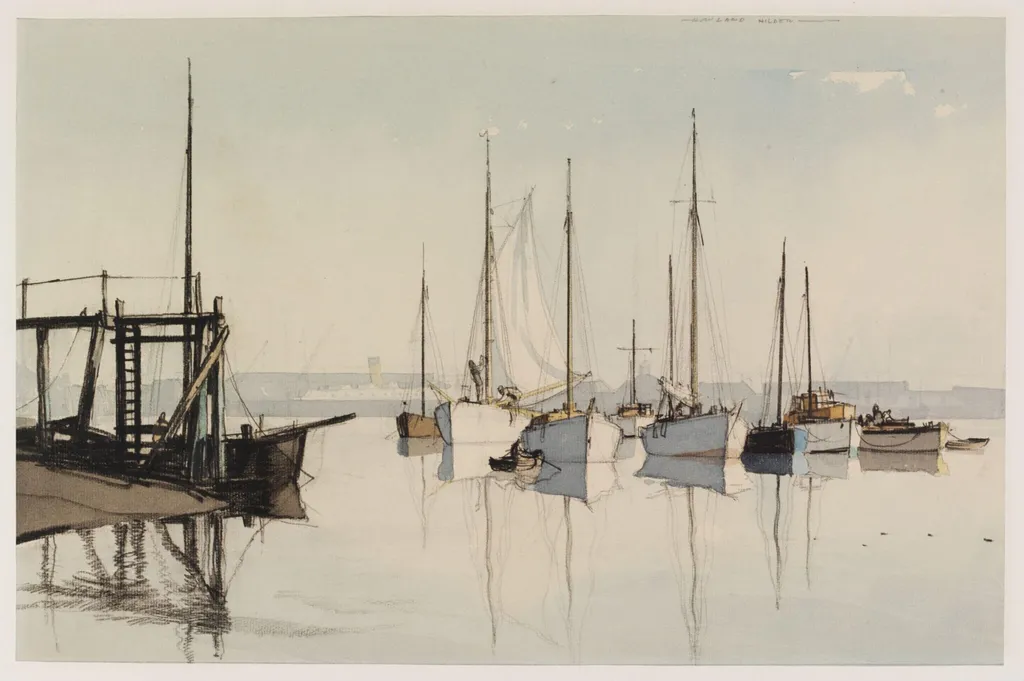
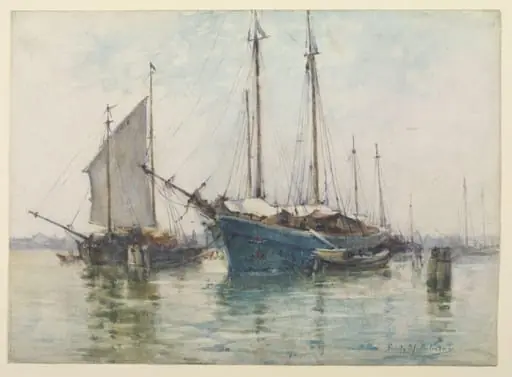
Newhaven Harbour, Sussex is a watercolor work on paper by Rowland Hillder. It dates from 1940 and is held in the collection of the Victoria and Albert Museum.
About this work
Overview
Its subdued palette and gentle composition reflect the project’s aim to preserve ordinary scenes at risk from conflict or change.
Newhaven Harbour, Sussex is a watercolour landscape created in 1940 by Rowland Hilder. Painted in a horizontal format, it captures the quiet stillness of a coastal harbour with moored vessels. The work was produced under the *Recording Britain* initiative, a government-backed effort to visually document the nation’s landscapes during the Second World War. Its subdued palette and gentle composition reflect the project’s aim to preserve ordinary scenes at risk from conflict or change.
Subject & Meaning
The painting depicts a group of fishing and working boats anchored in calm water, their masts and hulls arranged in loose clusters. No figures are present, emphasizing solitude and quietude. The scene suggests a moment suspended in time, evoking the everyday rhythms of coastal life. By focusing on unassuming vessels rather than grand architecture, Hilder highlights the resilience of ordinary places, aligning with the project’s goal of safeguarding vulnerable vernacular landscapes.
Technique & Style
Hilder employed loose, fluid watercolour strokes to suggest form without rigid definition. The reflections of boats in the water are softly blurred, merging with the surface to create a hazy, atmospheric effect. Pale washes of blue and green dominate, with minimal contrast to reinforce the sense of stillness. The technique prioritizes mood over detail, using transparency and wet-on-wet methods to evoke light and quiet movement, characteristic of the *Recording Britain* aesthetic.
History & Provenance
Commissioned in 1940 as part of the *Recording Britain* project, the work was produced under the auspices of the Committee for the Employment of Artists in Wartime. Led by Sir Kenneth Clark, the initiative sought to create a visual archive of British scenery threatened by war or urban development. Over 1,500 works were completed by 97 artists; Hilder’s contribution was later acquired by the Victoria and Albert Museum, where it remains part of the collection.
Context
During the Second World War, cultural preservation became a national priority as bombing and industrial expansion endangered historic sites. The *Recording Britain* project responded to this anxiety by mobilizing artists to record rural and coastal scenes before they vanished. Hilder’s work, like others in the series, reflects a quiet patriotism—not through heroism, but through attentive observation of the familiar and the fleeting.
Legacy
Newhaven Harbour, Sussex endures as one of many works in the *Recording Britain* archive, now a vital historical record of mid-20th-century British landscapes. Its unembellished realism and emotional restraint distinguish it from wartime propaganda, offering instead a contemplative view of everyday life. The painting continues to be studied for its technical subtlety and its role in documenting a nation’s sense of place during a time of upheaval.
Artist & collection
Artist
Rowland Hilder kept a studio boat on the River Hamble, painting the same stretch of water every morning—until the tide turned, then he’d pack up and head home for tea.