Artwork
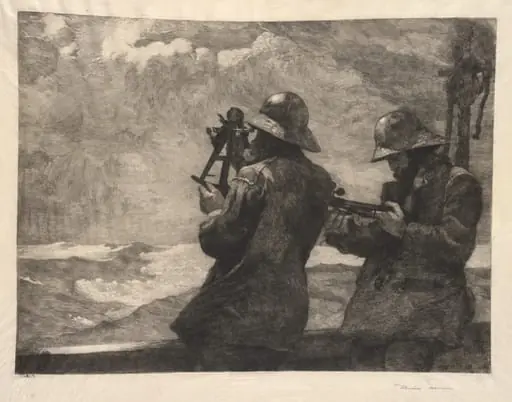
Eight Bells
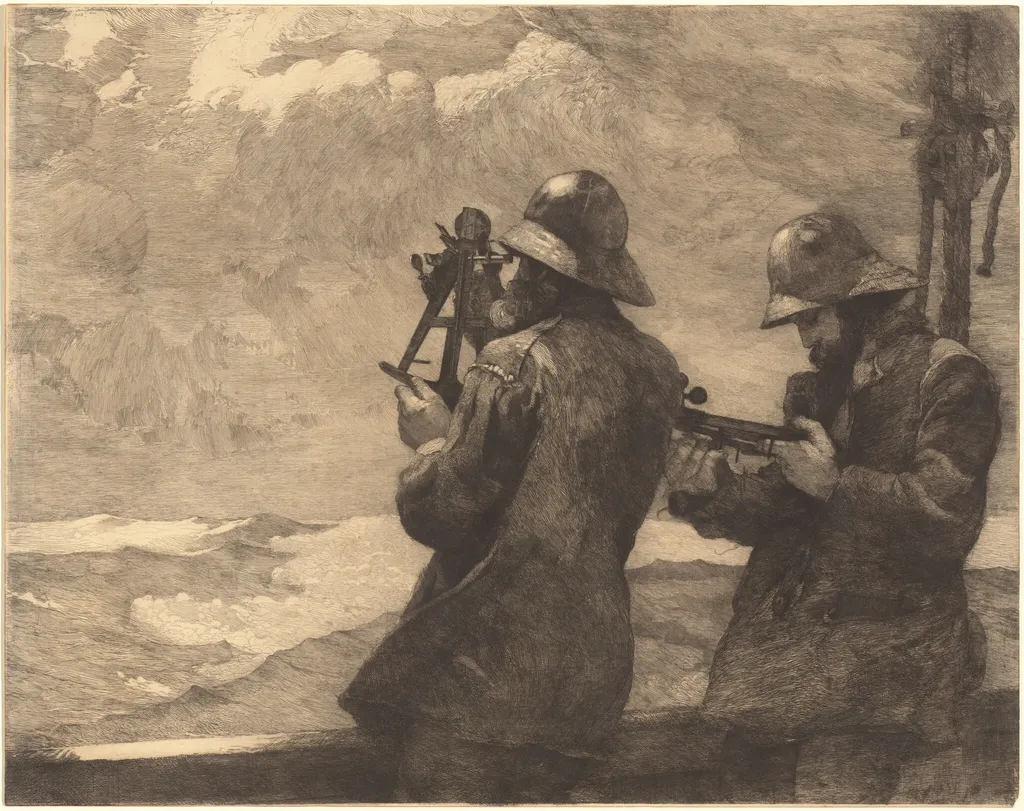
Eight Bells is an ink print by the Impressionist artist Winslow Homer. It dates from 1887 and is held in the collection of the National Gallery of Art.
About this work
Overview
Unlike his oil paintings, Homer used the precision of printmaking to distill the intensity of maritime life into a single, focused image.
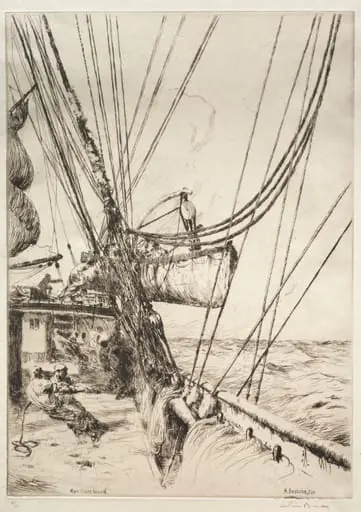
Created in 1887, Eight Bells is an etching by Winslow Homer that captures two sailors on the deck of a vessel during a storm. The scene is rendered in fine, incised lines typical of the etching process, conveying both the physical strain of the environment and the quiet resolve of the figures. Unlike his oil paintings, Homer used the precision of printmaking to distill the intensity of maritime life into a single, focused image.
Subject & Meaning
The two sailors, one scanning the horizon through a telescope and the other resting a rifle across his arms, embody vigilance and endurance. Their postures suggest a moment of pause amid danger, not panic. The absence of dramatic action shifts focus to their quiet determination, reflecting the daily realities of seafaring life. The storm around them is not a spectacle but a constant, unyielding presence.
Technique & Style
Homer employed etching to achieve a tactile quality, using varied line weights and cross-hatching to suggest wind-tossed fabric, crashing waves, and heavy clouds. The acid-bitten plate allowed for both fine detail and rough texture, mirroring the unpredictability of the sea. The composition’s tight framing and lack of horizon emphasize immersion in the moment, enhancing the sense of immediacy.
History & Provenance
The print was made shortly after Homer returned from extended stays along the Maine coast, where he observed sailors and maritime conditions firsthand. It was published in 1887 as part of a limited edition, likely distributed to collectors and art societies. Early impressions are rare, and the work was not widely reproduced during Homer’s lifetime, preserving its intimate, artisanal character.
Context
In the late 19th century, etching experienced a revival among American artists seeking alternatives to academic painting. Homer, already known for his watercolors and oils, turned to printmaking to explore narrative economy and atmospheric effect. Eight Bells aligns with broader interests in realism and the dignity of labor, reflecting a cultural shift toward honoring everyday resilience.
Legacy
Eight Bells remains a significant example of American printmaking’s potential for emotional depth. It influenced later artists who valued the medium’s capacity for subtlety over spectacle. Though less celebrated than Homer’s paintings, the etching endures as a quiet testament to the discipline and solitude inherent in maritime work, studied for its technical restraint and psychological nuance.
Artist & collection
Artist
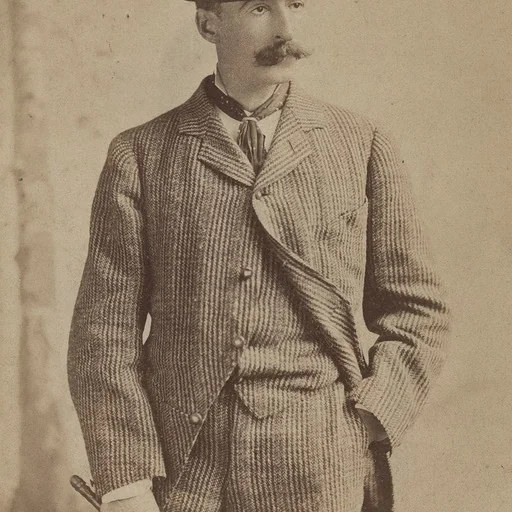
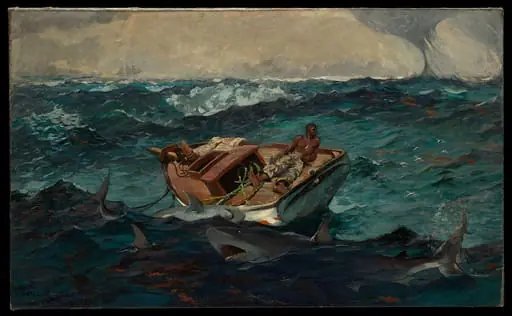
Winslow Homer (February 24, 1836 – September 29, 1910) was an American landscape painter and illustrator, best known for his marine subjects.

![Sur la falaise [Self-Portrait], by Henri-Charles Guérard](https://artifactworldgallery.com/img/henri-charles-guerard--sur-la-falaise-self-portrait--02b0dc51287f939f-w320.webp)
![Landscape [Paesaggio], by Carlo Paolo Agazzi](https://artifactworldgallery.com/img/carlo-paolo-agazzi--landscape-paesaggio--e606f4ada87d2052-w320.webp)