Artwork
Introduction of Ulysses to Nausica
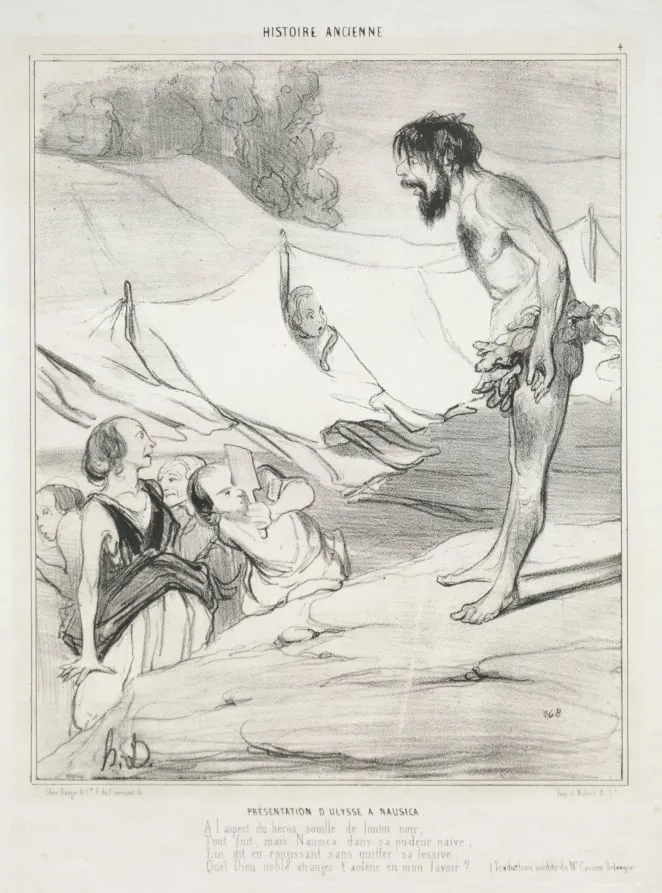
Introduction of Ulysses to Nausica is a print by the Romanticist artist Honoré Daumier. It dates from 1842 and is held in the collection of the Cleveland Museum of Art.
About this work
Daumier shows a man in rags kneeling before a group of women in old-fashioned robes.
Daumier shows a man in rags kneeling before a group of women in old-fashioned robes. The women stand stiff and formal. The man’s tattered clothes contrast with their smooth dresses.
This comes from a comic series Daumier made for a Paris newspaper. He turned an ancient Greek story into a funny, modern scene. The women look shocked, like they just found a stray dog in their parlor.
Look up Honoré Daumier (French, 1808–1879).
Overview
This lithograph, published in Le Charivari on March 30, 1842, is the fourth plate in Honoré Daumier’s series Ancient History. It reimagines a moment from Homer’s Odyssey as a satirical contemporary scene, blending classical narrative with 19th-century social commentary. The image was part of a weekly comic strip aimed at Parisian readers, using irony to critique class and propriety.
Subject & Meaning
Daumier depicts Ulysses, shipwrecked and disheveled, kneeling before Nausica and her attendants, who are rendered in stiff, aristocratic poses. The contrast between the beggar’s ragged form and the women’s pristine, outdated garments underscores a clash between vulnerability and social decorum. The scene mocks the pretensions of the bourgeoisie by placing a mythic hero in the role of an unwelcome intruder in a refined domestic space.
Technique & Style
Executed in lithography, the print uses bold, fluid lines and stark tonal contrasts to emphasize the figures’ emotional and social distance. Daumier’s loose, expressive draftsmanship renders Ulysses with dynamic energy, while the women are defined by rigid contours and minimal detail, heightening their mechanical composure. The composition isolates the group against a blank background, focusing attention on their interaction.
History & Provenance
Created for the satirical weekly Le Charivari, this print was one of many in Daumier’s Ancient History series, which ran in early 1842. The series was part of his broader output for the press, where he frequently adapted classical themes to lampoon modern society. The print was widely distributed among Parisian readers and later collected by institutions as a key example of political and social caricature.
Context
In 1842, France was under the July Monarchy, a period marked by rising middle-class influence and strict social codes. Daumier’s series used classical allusions to bypass censorship while critiquing contemporary manners. By casting Ulysses as a destitute outsider, he highlighted the hypocrisy of elite propriety and the marginalization of the poor, resonating with urban audiences familiar with such disparities.
Legacy
Daumier’s reinterpretation of myth as social satire influenced later generations of illustrators and cartoonists. This print exemplifies his ability to fuse historical narrative with sharp contemporary critique, establishing a model for visual commentary in the press. Today, it remains a significant artifact in the study of 19th-century French graphic art and the evolution of political satire.
Artist & collection

Artist
Honoré-Victorin Daumier was a French painter, sculptor, and printmaker, whose many works offer commentary on the social and political life in France, from the Revolution of 1830 to the fall of the Second French Empire in 1870.