Artwork
The Clayton Tomb, Bletchingly Church, Surrey
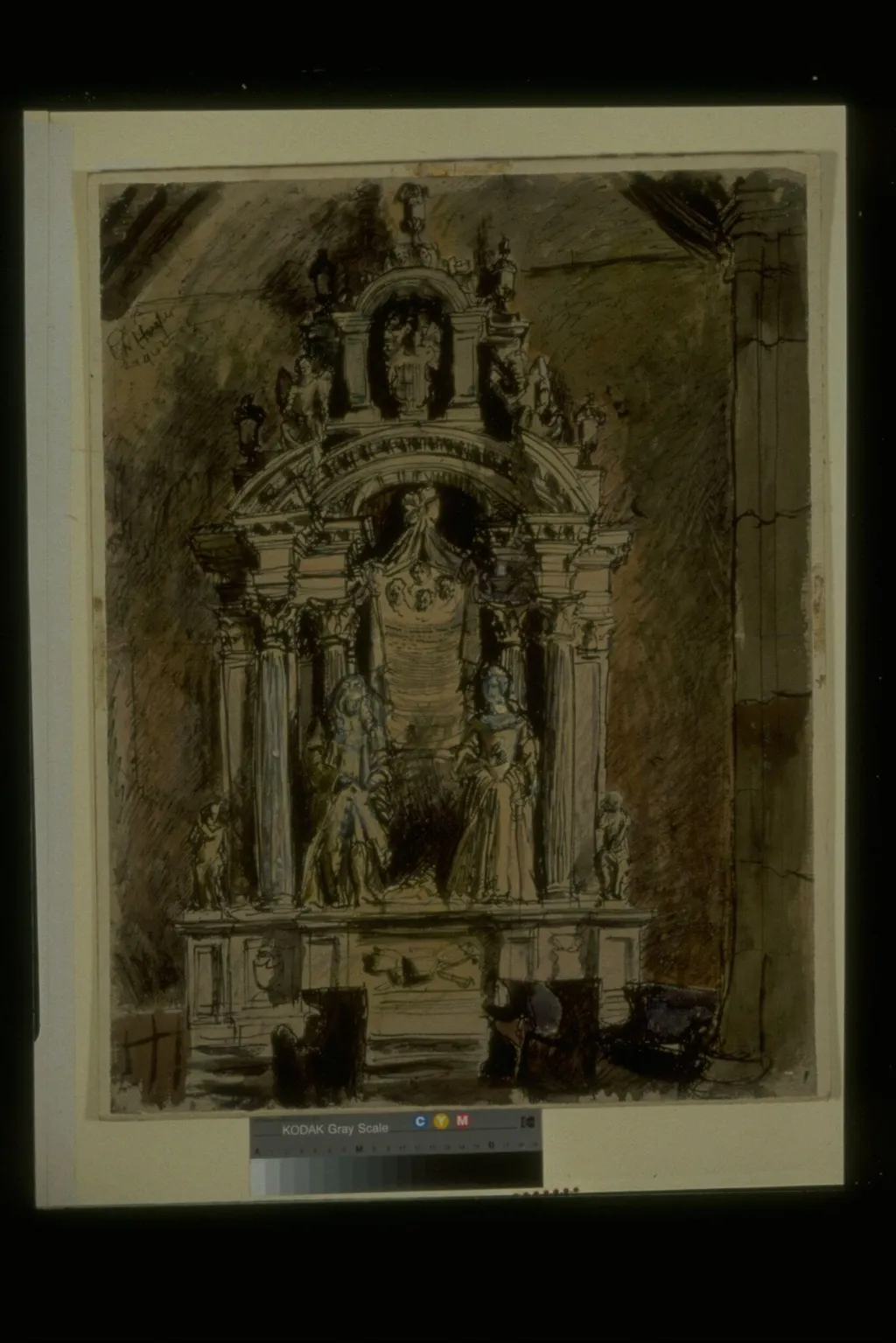
The Clayton Tomb, Bletchingly Church, Surrey is a watercolor work on paper by George W. Hooper. It dates from 1942 and is held in the collection of the Victoria and Albert Museum.
About this work
Overview
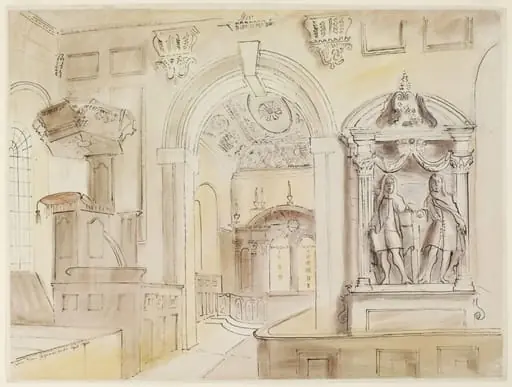
The watercolour, executed in 1942, portrays the interior of Bletchingly Church in Surrey, where a monumental Baroque tomb dominates the scene. The tomb occupies the central space, eclipsing the surrounding pews, and is illuminated from the right, which highlights its intricate sculptural details.
Subject & Meaning
The composition records a funerary monument that includes a towering carved arch and figures, with two kneeling figures at its base and a woman and child positioned nearby. By capturing this specific ecclesiastical setting, the work reflects an effort to preserve a visual record of England’s historic architecture during a period of national uncertainty.
Technique & Style
Rendered with swift brushwork and a muted palette, the watercolour emphasizes the tomb’s heavy ornamentation, giving the stone a near‑three‑dimensional presence. The artist’s loose handling conveys a study-like immediacy rather than a finished, polished finish, focusing attention on texture and form.
History & Provenance
Created as part of the Recording Britain project, the piece was commissioned to document threatened heritage sites across rural and southern England. The initiative, overseen by Sir Kenneth Clark and financed by the Pilgrim Trust, mobilised artists to capture landscapes, buildings, and monuments vulnerable to wartime damage and post‑war development.
Context
During World War II, concerns about bombings, urban expansion, and the erosion of rural traditions prompted a concerted effort to archive the nation’s visual culture. This watercolour contributes to that archival mission, offering a snapshot of a specific church interior that might otherwise have been lost to history.
Artist & collection
Artist
George W. Hooper painted quiet scenes of everyday places in watercolor. In 1942 he showed Tunbridge Wells’ curved Calverley Crescent and an old tomb at Bletchingly Church, Surrey, both in soft strokes of color. He…

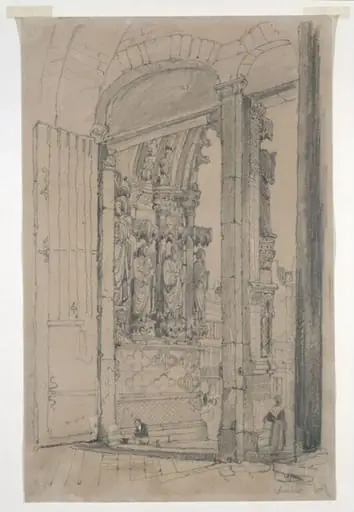 Amiens Cathedral
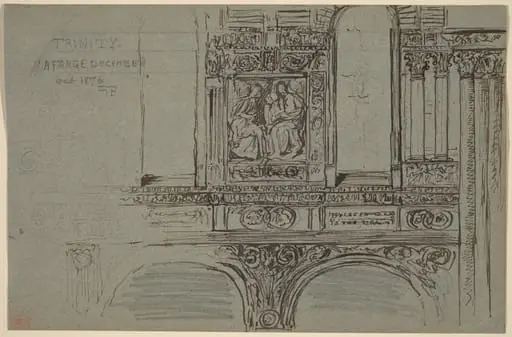 Trinity Church, Boston (nave) - Mural Study
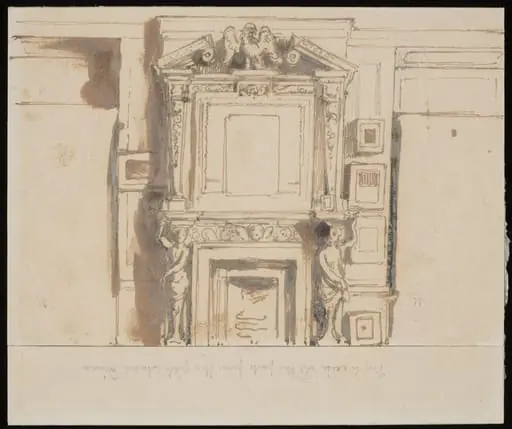 Ornamental Fireplace
 Interior of St. Peter's Church, Gayhurst
 Magnificent Catafalque in Honor of John III, King of Poland
 Untitled
 Untitled
 A Gothic Arch
 Shrine of the Annunciation, Nazareth
 The Prisons: Round Arches Springing from a Square Column
 Architectural Details for a Wall Decoration with Empress Maria Theresia Embracing the Young Wolfgang Amadeus Mozart
 The Founder's Tomb, Church of Saint Bartholomew the Great