Artwork
Desene după Grigorescu
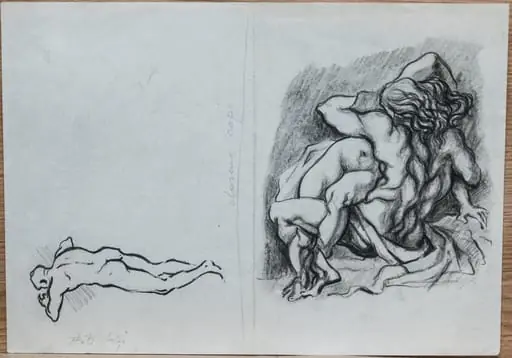
Desene după Grigorescu is a drawing by Teodor Hrib. It dates from 1950 and is held in the collection of the Gavrila Simion Eco-Museum Research Institute Tulcea.
About this work
If you want to see more drawings like this, you might want to check out the work of artist Hrib, Teodor.
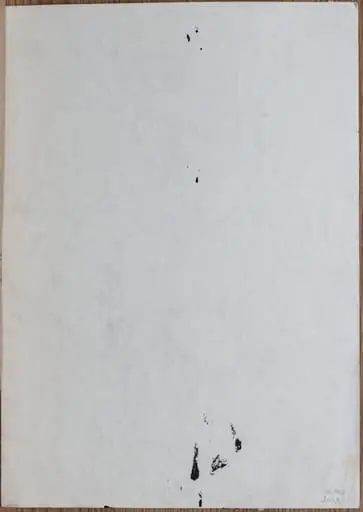
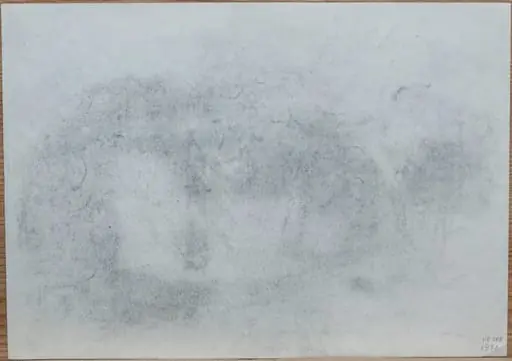
This drawing is a simple, white sheet with some light gray marks. It's not clear what the marks are supposed to be, but they might be the start of a drawing.
The paper has some wrinkles and a few small stains. There's a small, handwritten note in the bottom-right corner that says "NR 666 1928".
If you want to see more drawings like this, you might want to check out the work of artist Hrib, Teodor.
Overview
Created around 1950 by Teodor Hrib, this drawing is part of a private collection of studies inspired by the Romanian artist Grigorescu. Executed on a modest sheet of paper, it features faint gray graphite marks that suggest tentative sketching. The surface shows signs of age—minor wrinkles and faint stains—indicating handling and storage over time. The work is held in the Museum of Ethnography, where it is preserved as a fragment of artistic process rather than a finished composition.
Subject & Meaning
The drawing does not depict a clear subject, offering only ambiguous, light strokes that may represent early attempts to capture form or movement. Its connection to Grigorescu suggests an exercise in emulation or memory, possibly a student’s response to the earlier artist’s style. The lack of detail implies it was never intended as a public work, but rather a private moment of observation or practice, reflecting the quiet, iterative nature of artistic development.
Technique & Style
Hrib employed minimal graphite, using soft, uneven pressure to lay down faint gray lines across the paper. The strokes are hesitant, lacking definition, and show no attempt at shading or contouring. The style is unrefined and immediate, characteristic of preparatory sketches. The absence of erasures or revisions suggests either spontaneity or a deliberate restraint, aligning with a practice focused on gesture over precision.
History & Provenance
A small handwritten notation in the lower right corner reads 'NR 666 1928,' possibly indicating a catalog number and year associated with an earlier collection or exhibition. The drawing entered the Museum of Ethnography’s holdings after Hrib’s lifetime, likely as part of a broader donation of his personal papers and studies. Its preservation underscores institutional interest in documenting the lesser-known phases of Romanian artists’ creative processes.
Context
In postwar Romania, many artists revisited the work of 19th-century figures like Grigorescu as a way to reconnect with national artistic traditions amid political pressures. Hrib’s sketch, though unassuming, fits within this broader trend of quiet homage. Such drawings were often made in solitude, away from public view, serving as personal bridges between generations of Romanian draftsmen.
Legacy
This drawing contributes to understanding the private, often overlooked labor behind artistic influence. It reveals how later artists engaged with predecessors not through grand statements, but through tentative, repeated attempts. As a fragment preserved in a museum, it invites reflection on the value of unfinished work and the quiet continuity of artistic lineage in 20th-century Romania.
Artist & collection
Artist
Teodor Hrib shaped small plaster figures and ink drawings in the 1800s academic tradition.
Museum
Gavrila Simion Eco-Museum Research Institute Tulcea
Continue through works from the same source collection.