Artwork
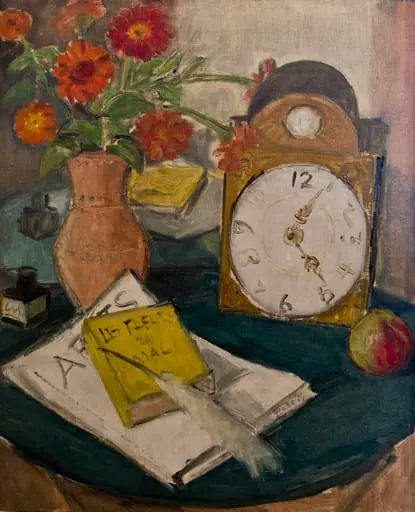
Natură statică cu bujori, ceas
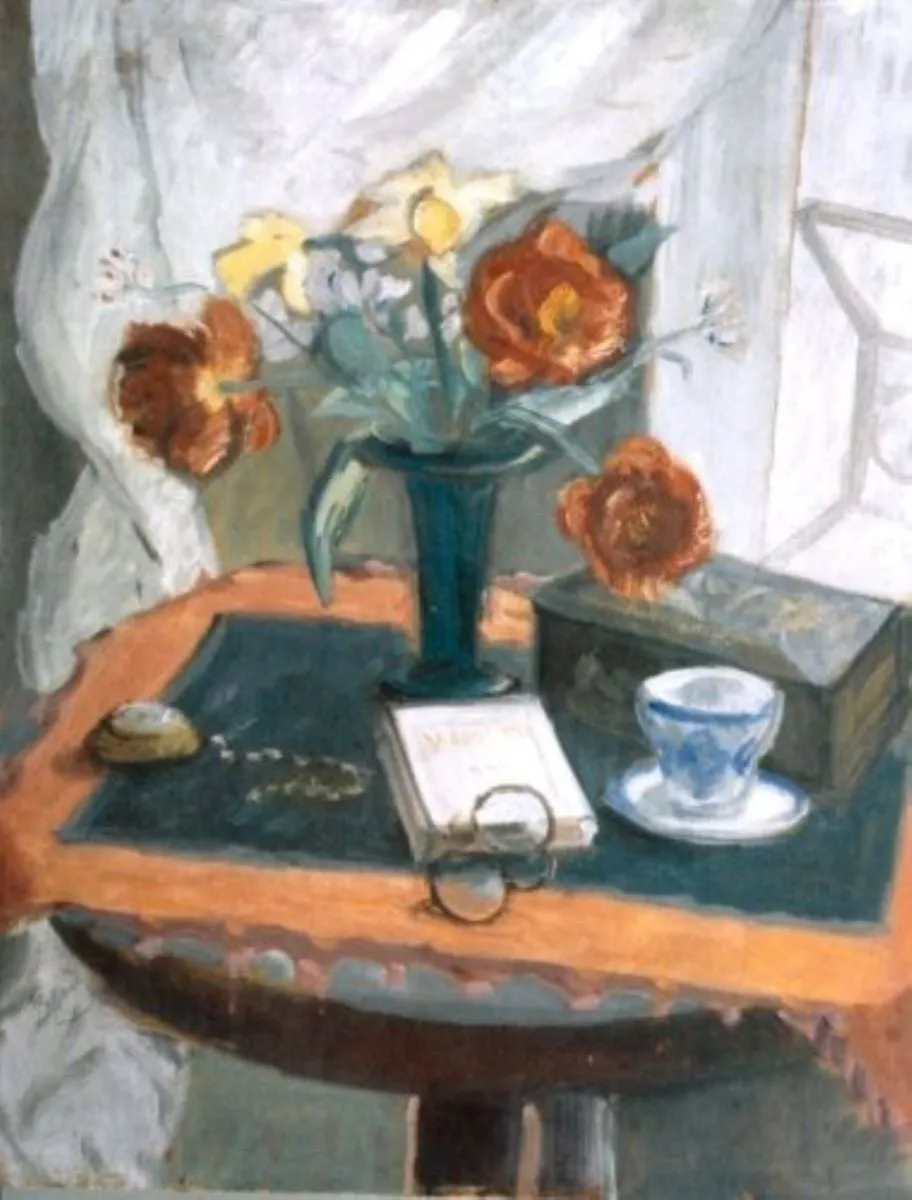
Natură statică cu bujori, ceas is an unspecified painting by Theodor Pallady. It is held in the collection of the National Museum of Art of Romania.
About this work
Overview
Soft, diffused lighting casts gentle shadows, emphasizing stillness and the passage of time through the drooping blooms and scattered petals.
A quiet still life depicts a wooden table arranged with modest, everyday objects: a tall blue vase with three wilting flowers, a white cup and saucer, an open book topped with spectacles, and a small dark box. The setting is subdued, with a blurred pale curtain and faint suggestion of a window behind. Soft, diffused lighting casts gentle shadows, emphasizing stillness and the passage of time through the drooping blooms and scattered petals.
Subject & Meaning
The arrangement suggests a moment of pause, perhaps after a period of reading or contemplation. The wilting flowers and abandoned glasses imply absence, evoking transience and quiet solitude. The open book hints at recent human presence, now departed, while the dark box remains enigmatic, adding a tone of quiet mystery to the scene's otherwise domestic simplicity.
Technique & Style
The painting employs subtle chiaroscuro to model forms with soft gradations of light and shadow, avoiding harsh contrasts. Brushwork is restrained, with blurred edges in the background enhancing the sense of depth and focus on the foreground objects. The muted palette and delicate handling of textures—petals, fabric, glass—convey a restrained realism grounded in observation rather than dramatic effect.
History & Provenance
The work’s origins are undocumented in public records, and no known artist or exhibition history is associated with it. It appears to be a private study or minor work, possibly from the late 19th or early 20th century, reflecting a tradition of intimate still lifes common in regional European art circles where quiet domesticity was valued over grand narrative.
Context
This piece aligns with a broader trend in European still life painting that favored quiet, unadorned compositions over opulent displays. Similar works by lesser-known artists often captured fleeting moments of domestic life, using decay and absence as subtle metaphors. The emphasis on ordinary objects and soft lighting reflects a shift away from theatricality toward introspective realism in the period.
Legacy
Though not widely exhibited or studied, the painting contributes to a quieter lineage of still life that values emotional resonance over spectacle. Its understated treatment of time, memory, and absence continues to resonate with viewers drawn to the poetry of the mundane, influencing contemporary artists who explore similar themes of impermanence in everyday settings.
Artist & collection
Artist
Theodor Pallady made still lifes and interiors in early 20th-century Bucharest. His Place Dauphine shows a quiet Parisian square, while Natură moartă (Ulcică cu flori și chibrituri) piles everyday objects on a table.…