Artwork
Natură statică cu mere
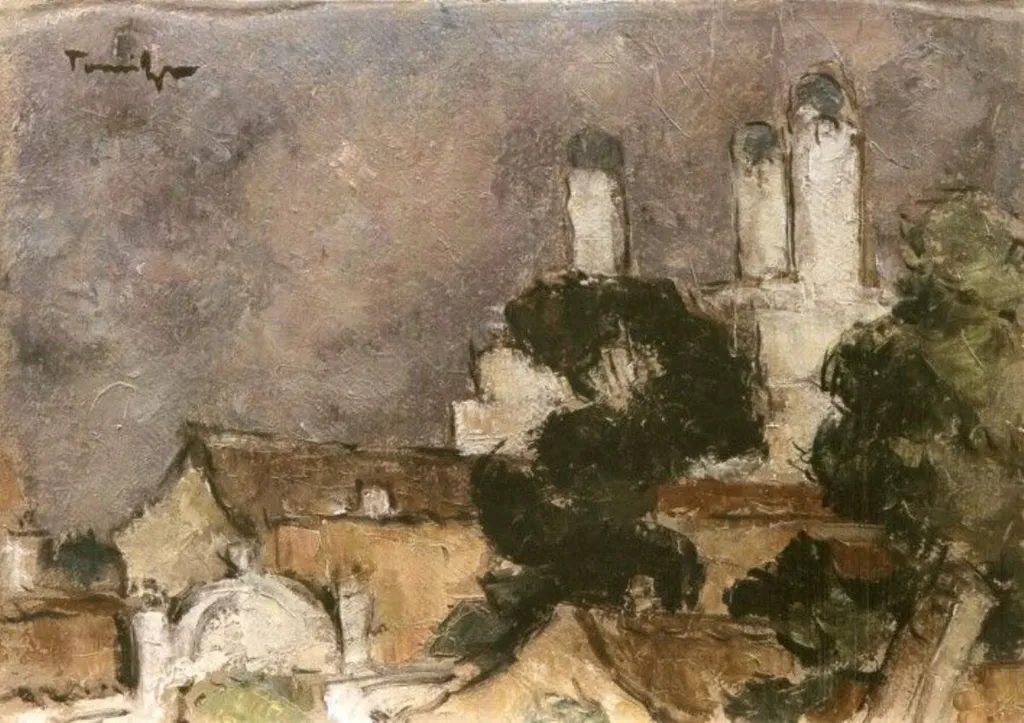
Natură statică cu mere is an unspecified painting by Nicolae Tonitza. It is held in the collection of the National Museum of Art of Romania. This still life presents a sparse arrangement of domestic objects rendered with heavy, tactile brushwork.
About this work
Overview
The composition centers on a dark, cluttered table surface, with three distant vertical forms receding into a muted background.
This still life presents a sparse arrangement of domestic objects rendered with heavy, tactile brushwork. The composition centers on a dark, cluttered table surface, with three distant vertical forms receding into a muted background. The palette is restrained—dominated by earth tones and cool grays—while the surface is built up through dense applications of paint, creating a physical texture that draws attention to the materiality of the medium itself.
Subject & Meaning
The objects—likely fruit, vessels, and a teapot—are rendered without clear definition, suggesting a focus on form and presence rather than narrative. The ambiguity of the items invites contemplation of everyday stillness. There is no overt symbolism; instead, the work emphasizes the quiet dignity of ordinary things, rendered through abstraction and material emphasis rather than literal representation.
Technique & Style
The painting employs impasto extensively, with thick layers of paint applied in uneven, deliberate strokes that create a sculpted surface. This technique gives the objects a tactile, almost three-dimensional presence. The brushwork is rough and unrefined, rejecting smooth blending in favor of visible, gestural marks. The result is a surface that feels built rather than painted, emphasizing the artist’s physical engagement with the medium.
History & Provenance
The work’s origins are undocumented in public records, and no known exhibition or ownership history has been established. Its attribution remains tentative, with stylistic similarities pointing to early 20th-century European modernism, particularly artists who favored material experimentation over traditional representation. The absence of clear provenance leaves its creation context open to scholarly interpretation.
Context
Created during a period when many artists were moving away from realism, this piece reflects broader trends toward abstraction and material inquiry. The rejection of polished finish aligns with contemporaneous movements that valued process and texture over idealized form. Its subdued palette and fragmented composition echo the quiet, introspective turn in modernist still life, distancing itself from decorative traditions.
Legacy
Though not widely exhibited or reproduced, the work contributes to a lesser-known strand of modernist still life that prioritized texture and material presence over clarity or symbolism. Its influence is subtle, resonating in later artists who explored the physicality of paint as a carrier of meaning. It stands as a quiet example of how ordinary subjects could be transformed through radical technique.
Artist & collection
Artist
Nicolae Tonitza painted quiet still lifes and village scenes, often showing colorful vegetables on a table or blooming flowers in simple pots.