Artwork
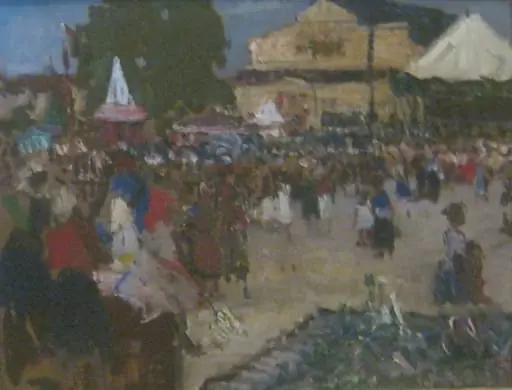
Târg în preajma Buzăului
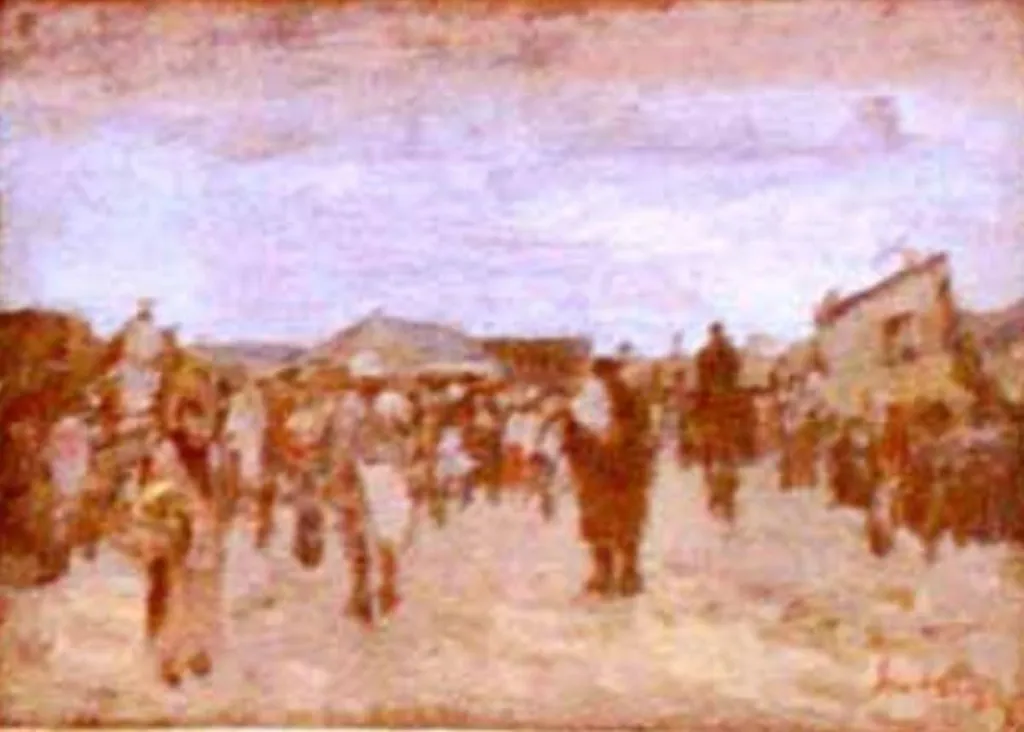
Târg în preajma Buzăului is an unspecified painting by Ion Andreescu. It dates from 1882 and is held in the collection of the National Museum of Art of Romania.
About this work
Overview
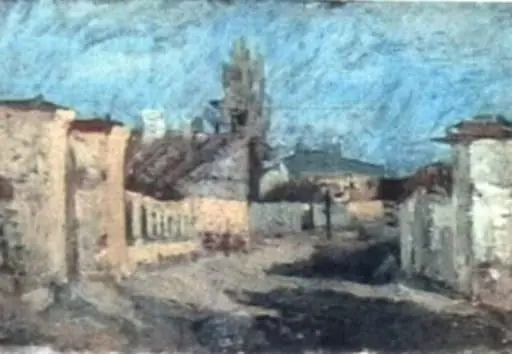
Painted in 1882 by Ion Andreescu, Târg în preajma Buzăului captures a rural marketplace near the Buzău River in Romania.
Painted in 1882 by Ion Andreescu, Târg în preajma Buzăului captures a rural marketplace near the Buzău River in Romania. The scene unfolds under a dry, sunlit sky, with figures and livestock intermingled in a dense, unstructured arrangement. The palette leans toward muted earth tones, reinforcing a sense of arid warmth and temporal distance. The work conveys the rhythm of everyday commerce without idealization.
Subject & Meaning
The painting depicts a local market where farmers, traders, and animals converge in a moment of routine exchange. Horses, cattle, and sheep are woven into the human crowd, suggesting the economic and social centrality of livestock in rural life. There is no focal hero or narrative climax—only the quiet persistence of daily labor, rendered without sentimentality or grandeur.
Technique & Style
Andreescu employed loose, energetic brushwork to suggest motion and density rather than detail. Thick applications of paint, particularly in the foreground, create texture that mimics the roughness of soil and wool. The lack of polished finish and the slightly faded appearance reflect an interest in immediacy over finish, aligning with emerging realist tendencies in late 19th-century Romanian art.
History & Provenance
Created during Andreescu’s mature period, the work was likely painted on-site, as was his practice. It remained in Romanian collections after his death in 1882, and its condition suggests minimal restoration. The painting’s survival through decades of political change underscores its status as a document of pre-industrial rural life in the region.
Context
In the 1880s, Romania was undergoing rapid modernization, yet many communities still relied on traditional agrarian economies. Andreescu’s focus on such scenes countered academic preferences for historical or mythological subjects. His work aligned with broader European trends toward naturalism, offering a quiet counterpoint to urbanizing narratives of progress.
Legacy
Târg în preajma Buzăului is recognized as one of Andreescu’s most representative works, reflecting his commitment to observing ordinary life with honesty. It influenced later Romanian realists who sought to depict national identity through vernacular scenes rather than imported aesthetics. The painting endures as a record of a vanishing way of life, valued for its unembellished vision.
Artist & collection
Artist
Ion Andreescu painted quiet scenes of everyday life and landscapes in the late 1800s.