Artwork
Baz Bahadur and Rani Rupmati
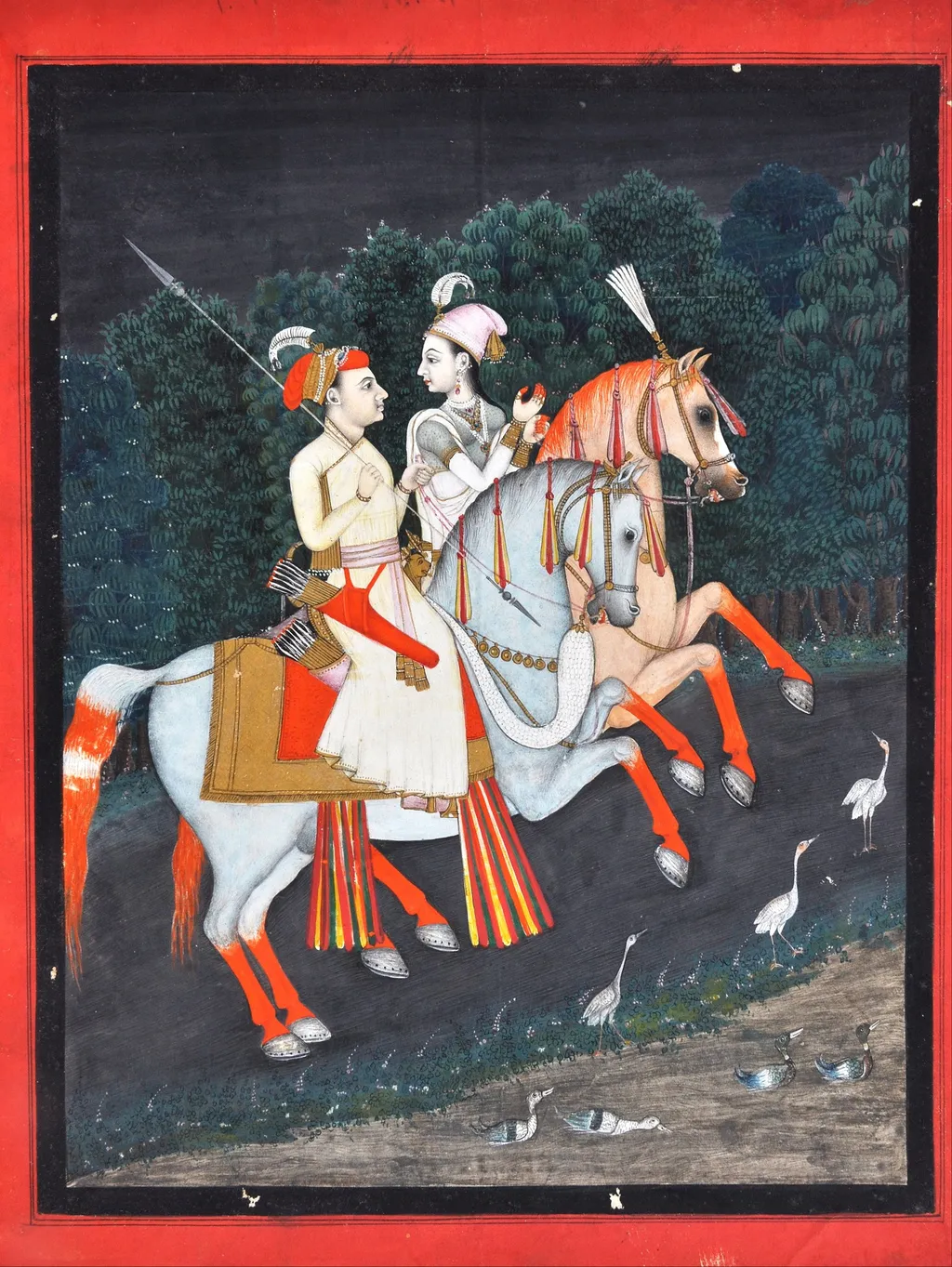
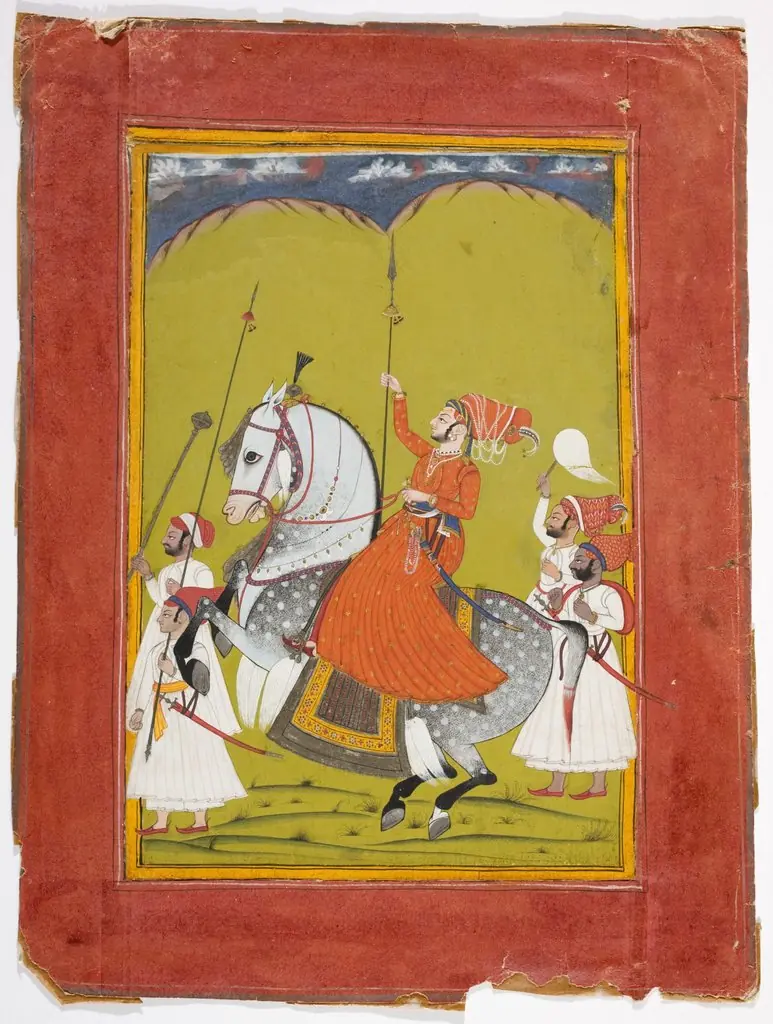
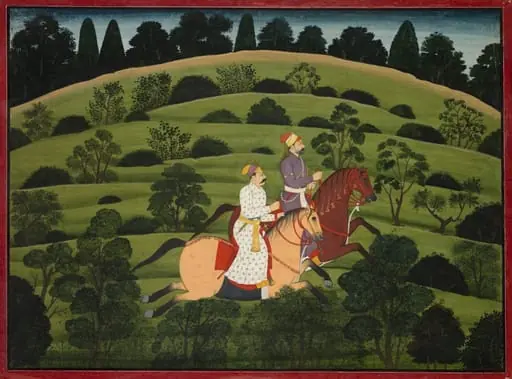
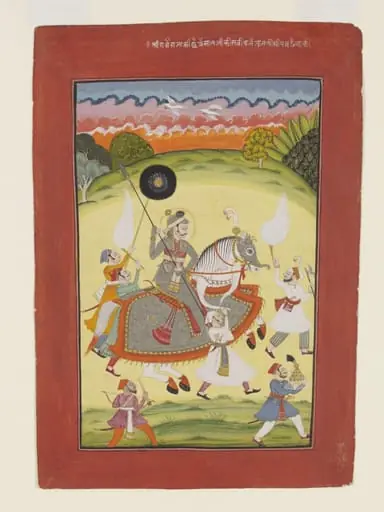
Baz Bahadur and Rani Rupmati is an unspecified painting by Unknown. It is held in the collection of the National Museum. This painting depicts Baz Bahadur, the last independent ruler of Malwa, and his consort Rani Rupmati mounted on a single white horse.
About this work
Overview
The figures are shown in motion, the horse’s hooves raised as if mid-stride, suggesting a moment of leisurely procession rather than battle.
This painting depicts Baz Bahadur, the last independent ruler of Malwa, and his consort Rani Rupmati mounted on a single white horse. The scene is rendered in a delicate, stylized manner typical of late 16th-century Deccan court art. The figures are shown in motion, the horse’s hooves raised as if mid-stride, suggesting a moment of leisurely procession rather than battle. The composition emphasizes elegance and intimacy, set against a quiet natural backdrop.
Subject & Meaning
Baz Bahadur and Rani Rupmati were historical figures whose romance became legendary in central Indian lore. The painting captures their bond through shared horsemanship and synchronized attire, symbolizing harmony between ruler and consort. The absence of conflict or grandeur suggests a focus on personal devotion rather than political power. Their presence together in this intimate setting reflects the cultural idealization of their relationship in courtly poetry and memory.
Technique & Style
Executed in opaque watercolor on paper, the work employs fine brushwork and flat, luminous color fields. The horse’s mane and tassels are detailed with delicate lines, while the riders’ garments are rendered in contrasting hues—white, pink, and red—to distinguish identity without realism. Background elements like trees and birds are simplified, serving as atmospheric rather than descriptive features. The style aligns with the Deccan school’s preference for lyrical composition over spatial depth.
History & Provenance
The painting likely originated in the court of Malwa during the late 1500s, shortly after Baz Bahadur’s defeat by Mughal forces in 1561. It may have been commissioned by a loyalist or later copied in a Mughal-influenced atelier preserving regional memory. Acquired by the National Museum in New Delhi, its journey from Malwa to institutional collection remains undocumented, though its preservation reflects enduring cultural interest in the couple’s story.
Context
This work emerged during a period of political transition in central India, as Deccan sultanates faced Mughal expansion. While courtly painting in the north grew more formalized under Akbar, regional centers like Malwa retained a more poetic, personal aesthetic. The depiction of a ruler and his beloved on horseback echoes broader Indo-Islamic traditions of romantic portraiture, distinct from military or ceremonial imagery dominant elsewhere.
Legacy
Though not widely reproduced, the image of Baz Bahadur and Rani Rupmati endures in regional folklore and later artistic interpretations. This painting serves as one of the few surviving visual records of Malwa’s courtly culture before its absorption into the Mughal Empire. Its quiet dignity and emotional tone distinguish it from more propagandistic royal portraits, offering a glimpse into the personal dimensions of power in a fading kingdom.
Artist & collection

 Domestic Scene
 Giacomo and Cardinal Marco, investing Andrea, Abbot of San Zeno, with his Benefice
 The Nymph of Fontainebleau
 Portrait of a Woman
 Madonna and Child with Saints in the Enclosed Garden
 Venus and Minerva
 Family Group of Four on Sofa
 Wall painting from Room H of the Villa of P. Fannius Synistor at Boscoreale