Artwork
Sir Bevil Grenville (1596-1643)
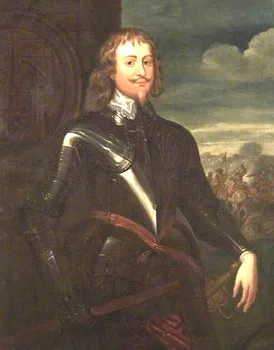
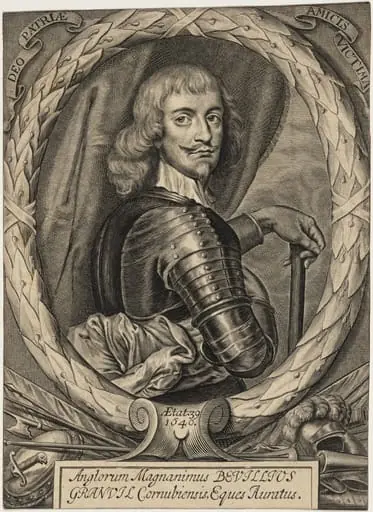
Sir Bevil Grenville (1596-1643) is an oil painting by Unknown. It dates from 1650 and is held in the collection of the Victoria and Albert Museum. This oil painting depicts Sir Bevil Grenville, a Royalist commander during the English Civil War.
About this work
Overview
Dressed in dark attire with a white collar and red sash, he stands upright against a muted, cloud-streaked sky.
This oil painting depicts Sir Bevil Grenville, a Royalist commander during the English Civil War. Dressed in dark attire with a white collar and red sash, he stands upright against a muted, cloud-streaked sky. His right hand grips a sword, while his left rests on his hip, conveying quiet authority. The composition is restrained, focusing on his presence rather than elaborate surroundings. The work is part of the Victoria and Albert Museum’s collection.
Subject & Meaning
Sir Bevil Grenville was a prominent supporter of King Charles I, known for his military leadership and personal integrity. The portrait captures him not as a battlefield figure but as a nobleman prepared for duty. The sword signifies his martial role, while the sash may denote rank or allegiance. His composed stance and direct gaze suggest resolve rather than aggression, reflecting the ideals of gentlemanly honor valued by Royalists.
Technique & Style
The artist employs a naturalistic approach, with soft modeling of the figure against a loosely rendered background. The dark clothing contrasts with the pale collar and the diffuse sky, drawing attention to the face and hands. Brushwork is controlled yet fluid, particularly in the rendering of fabric and hair. The background’s atmospheric haze avoids distraction, keeping focus on the subject’s dignified bearing.
History & Provenance
The painting was likely commissioned during Grenville’s lifetime, possibly shortly before his death in 1643 at the Battle of Lansdowne. It remained within family hands for generations before entering the Victoria and Albert Museum’s collection. Its survival through the Interregnum and subsequent political shifts speaks to its enduring personal and historical significance to the Grenville lineage.
Context
Created during the early years of the English Civil War, the portrait reflects the cultural values of the Royalist gentry. Portraits like this served both as personal memorials and political statements, asserting identity amid rising conflict. The absence of heraldic symbols or grand architecture aligns with the modesty of provincial nobility, contrasting with more ornate courtly portraits of the period.
Legacy
The portrait endures as a quiet testament to a Royalist leader whose death marked a turning point in the South West campaign. It offers insight into how provincial elites represented themselves during turbulent times—not through spectacle, but through understated dignity. Its preservation in a national collection underscores its role as a historical document as much as a work of art.
Artist & collection

 Domestic Scene
 Giacomo and Cardinal Marco, investing Andrea, Abbot of San Zeno, with his Benefice
 The Nymph of Fontainebleau
 Portrait of a Woman
 Madonna and Child with Saints in the Enclosed Garden
 Venus and Minerva
 Family Group of Four on Sofa
 Wall painting from Room H of the Villa of P. Fannius Synistor at Boscoreale
 Portrait of a Young Man
 Leopold Wilhelm, geboren 1614, Bischof v. Passau u. Straßburg 1625, v. Halberstadt 1628, v. Olmütz 1637, v. Breslau 1655, Hoch- und Deutschmeister 1642, Statthalter d. Niederlande 1646-56, gestorben 1
 Charles I
 John Lambert, Parliamentary General
 Un general englez ; pandant: Soția unui general englez
 Portrait of a Man (said to be Robert, Mester Erskine, probably Colonel Alexander Erskine of Cambuskenneth, d.1640)
 Portrait of a Man, called Robert, Mester Erskine, probably Colonel Alexander Erskine of Cambuskenneth (died 1640)
 Portrait of an officer
 Oliver Cromwell (1599–1658)
 Portrait of King Charles I (1600-1649), with the Order of the Garter
 Man In armour, with yellow flowing hair
 Sir Bevil Grenville