Artwork
View of Krzeszów
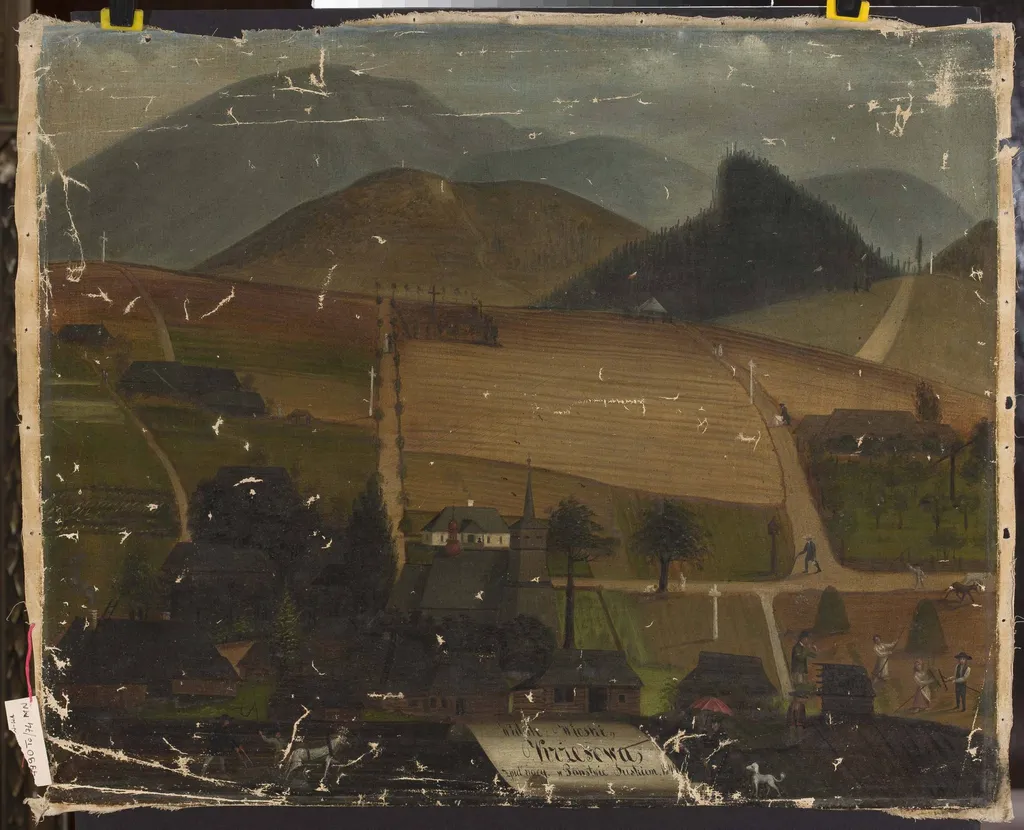
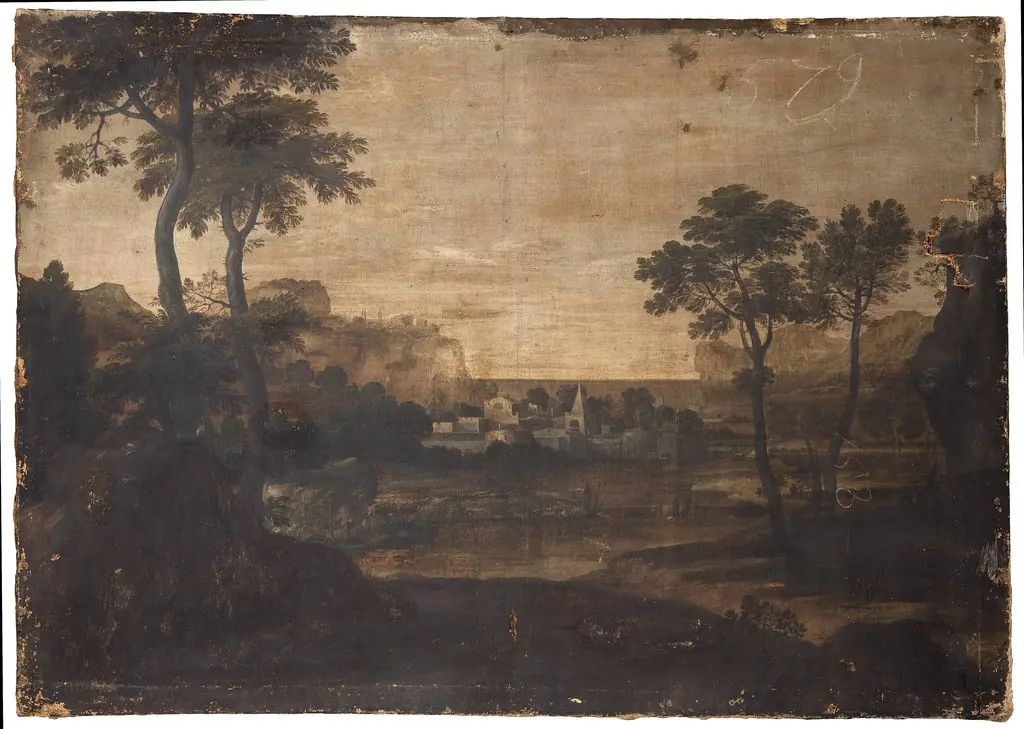
View of Krzeszów is an oil painting by the German Romanticist artist Unknown. It dates from 1844 and is held in the collection of the National Museum in Warsaw. This oil painting depicts a quiet rural landscape centered on the village of Krzeszów.
About this work
Overview
This oil painting depicts a quiet rural landscape centered on the village of Krzeszów. Rolling hills frame the scene, with distant mountains forming a soft horizon. A church and scattered buildings anchor the composition, while small figures and animals suggest daily life. The palette favors earthy browns and muted greens, creating a subdued, atmospheric tone that emphasizes stillness over drama.
Subject & Meaning
There is no overt symbolism; the meaning lies in the quiet observation of place and time, reflecting a regional identity rooted in agricultural rhythms.
The painting presents an unidealized view of rural existence, focusing on ordinary activities rather than grand narratives. The presence of a church hints at spiritual or communal life, while the scattered figures and livestock imply routine labor. There is no overt symbolism; the meaning lies in the quiet observation of place and time, reflecting a regional identity rooted in agricultural rhythms.
Technique & Style
Executed in oil paint, the work employs fine brushwork to render textures of stone, foliage, and clothing with precision. The composition uses atmospheric perspective to recede the mountains into a hazy distance, while foreground details remain sharply defined. Light is diffused and even, avoiding strong contrasts, which contributes to the painting’s calm, observational quality.
History & Provenance
The painting is associated with the Krzeszów region in Lower Silesia, likely created by a local artist or artisan familiar with the area’s topography and architecture. Its origins trace to the 18th or early 19th century, a period when regional landscapes were increasingly documented by painters with ties to monastic or noble patrons in the area.
Context
During the late 1700s and early 1800s, depictions of rural life in Central Europe shifted from idealized pastoral scenes toward more documentary approaches. This painting aligns with that trend, reflecting a growing interest in recording specific locales rather than generic countryside. It may have served as a record for local institutions or private collectors with regional ties.
Legacy
The painting remains a modest but valuable record of Krzeszów’s historical landscape before industrialization altered its character. Though not widely exhibited, it contributes to regional art histories by preserving visual details of architecture, dress, and land use from a time when such documentation was rare. Its value lies in its unembellished fidelity to place.
Artist & collection

 Domestic Scene
 Giacomo and Cardinal Marco, investing Andrea, Abbot of San Zeno, with his Benefice
 The Nymph of Fontainebleau
 Portrait of a Woman
 Madonna and Child with Saints in the Enclosed Garden
 Venus and Minerva
 Family Group of Four on Sofa
 Wall painting from Room H of the Villa of P. Fannius Synistor at Boscoreale
 Mont Blanc
 Alunișul
 Landscape with a meadow and a range of hills, sketch
 Study from Podolia
 Lowland landscape, sketch
 New England Village
 Glăjăria veche de la Avrig
 Landscape of fields
 Bjerglandskab ved Civitella
 Karl Jauslin (1842-1904) - Malerei, Dorfansicht
 Mountain landscape with church and monastery
 Landskap