Artwork
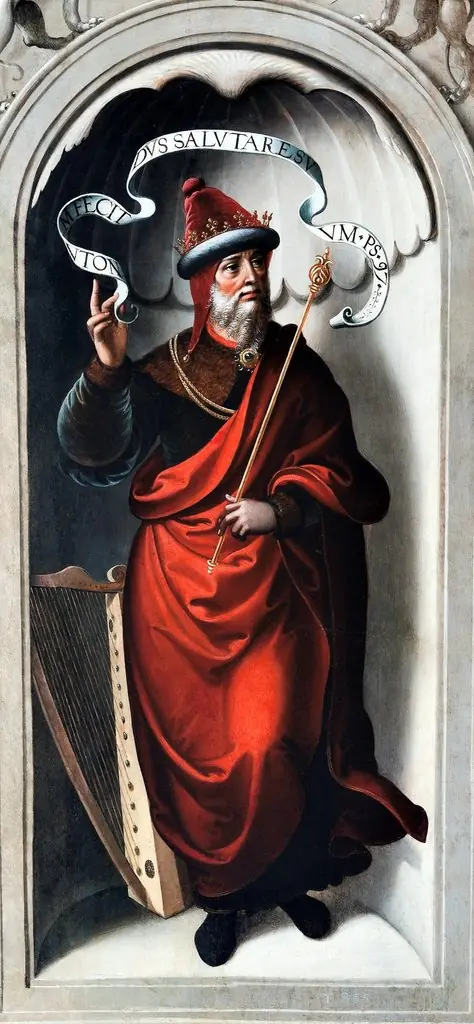
King David
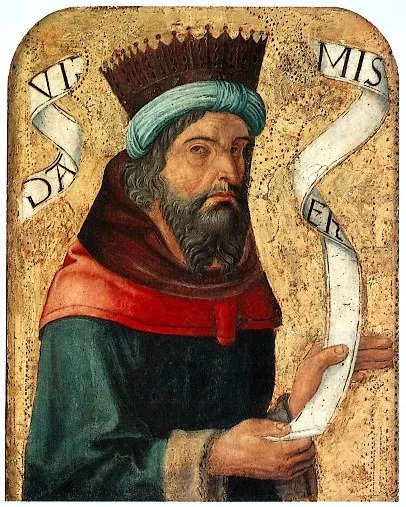
King David is a tempera painting by the High Renaissance artist Unknown. It dates from 1500 and is held in the collection of the National Museum of Ancient Art.
About this work
Overview
Dressed in a richly colored robe of red and blue, he wears a crown and holds a long white scroll, suggesting his role as both monarch and sacred writer.
This tempera painting portrays King David as a solemn, regal figure, rendered with deliberate formality. Dressed in a richly colored robe of red and blue, he wears a crown and holds a long white scroll, suggesting his role as both monarch and sacred writer. The warm golden background contrasts with the cooler hues of his garments, focusing attention on his presence. The medium of tempera lends a fine, luminous texture to the surface, enhancing the painting’s quiet intensity.
Subject & Meaning
King David is depicted not as a warrior or poet in motion, but as a contemplative authority. His direct gaze and still posture convey moral gravity, aligning him with divine wisdom. The scroll he holds likely represents the Psalms, traditionally attributed to him, reinforcing his identity as a divinely inspired figure. The composition avoids narrative action, instead emphasizing his enduring spiritual and royal stature.
Technique & Style
Tempera paint, made from pigment mixed with egg yolk, was applied in thin, precise layers to build subtle tonal variations. The artist used fine brushwork to define the folds of the robe and the texture of the crown, while the golden background was likely applied with broad, even strokes to create a radiant, non-representational space. The style reflects Byzantine and early Gothic conventions, prioritizing symbolic presence over naturalistic depth.
History & Provenance
The painting’s origins are not documented, but its materials and iconography suggest it was created in a monastic or ecclesiastical context during the late medieval period, likely between the 13th and 15th centuries. Such images were often used for private devotion or liturgical instruction. Its survival indicates it was valued within a religious community, though its specific commission and early ownership remain unknown.
Context
In medieval Christian art, King David was frequently depicted as a prototype of Christ, linking Old Testament kingship with New Testament prophecy. His portrayal in regalia, holding sacred text, reinforced the idea of divine authority passed through lineage. This image would have been familiar in illuminated manuscripts and altar panels, serving as a visual anchor for theological teachings on justice, psalmody, and sacred rule.
Legacy
Though not widely known today, this painting exemplifies the enduring medieval tradition of portraying biblical figures with symbolic clarity rather than psychological realism. Its use of tempera and hierarchical composition reflects a pre-Renaissance aesthetic that prioritized spiritual meaning over individual expression. Such works influenced later devotional imagery and remain important for understanding medieval visual theology.
Artist & collection

 Domestic Scene
 Giacomo and Cardinal Marco, investing Andrea, Abbot of San Zeno, with his Benefice
 The Nymph of Fontainebleau
 Portrait of a Woman
 Madonna and Child with Saints in the Enclosed Garden
 Venus and Minerva
 Family Group of Four on Sofa
 Wall painting from Room H of the Villa of P. Fannius Synistor at Boscoreale