Artwork
Text, Folio 5 (recto), from a Manuscript of the Perfection of Wisdom in Eight Thousand Lines (Ashtasahasrika Prajnaparamita-sutra)

Text, Folio 5 (recto), from a Manuscript of the Perfection of Wisdom in Eight Thousand Lines (Ashtasahasrika Prajnaparamita-sutra) is an unspecified painting. It dates from 1119 and is held in the collection of the Cleveland Museum of Art.
About this work
Overview
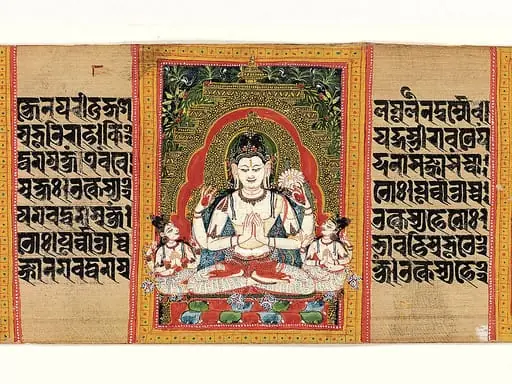
The work is a painted scroll fragment from a manuscript of the *Perfection of Wisdom in Eight Thousand Lines* (Ashtasahasrika Prajnaparamita‑sutra). It presents three circular depictions of a seated figure, each rendered in a calm pose with hands resting on the lap. The images are set against a muted brown ground and interspersed with hand‑written text in orderly columns.
Subject & Meaning
The central figure, clothed in a red robe with a white drape over one shoulder, represents a meditative presence, likely a bodhisattva associated with the Prajnaparamita teachings. The serene expression and posture convey the sutra’s emphasis on transcendent wisdom and the inner stillness cultivated through contemplation.
Technique & Style
The scroll employs mineral pigments applied to paper, with a limited palette of red, white, blue‑green and earth tones. The circular portraits are outlined in fine brushwork, while the surrounding script combines decorative flourishes with legible hand‑written characters, arranged in neat vertical columns that echo traditional East Asian manuscript conventions.
History & Provenance
This fragment originates from a larger illustrated manuscript of the *Ashtasahasrika Prajnaparamita* produced for devotional use. The piece is now part of the collection at the Cleveland Museum of Art, where it is displayed alongside other examples of Buddhist manuscript illumination, illustrating the historical practice of integrating visual and textual elements in religious texts.
Artist & collection

 Perfection of Wisdom in Eight Thousand Lines: Ashtasahasrika Prajnaparamita: Decorated Leaf
 Perfection of Wisdom in Eight Thousand Lines: Ashtasahasrika Prajnaparamita
 Perfection of Wisdom in Eight Thousand Lines: Ashtasahasrika Prajnaparamita: Decorated Leaf
 Perfection of Wisdom in Eight Thousand Lines: Ashtasahasrika Prajnaparamita: Decorated Leaf (recto)
 Perfection of Wisdom in Eight Thousand Lines: Ashtasahasrika Prajnaparamita: Decorated Leaf
 Prajnaparamita flanked by a white female figure and a white bodhisattva, folio 90 (recto), from a Manuscript of the Perfection of Wisdom in Eight Thousand Lines (Ashtasahasrika Prajnaparamita-sutra)
 Untitled
 Leaf from a Jain Manuscript: Kalpa-sutra: text (verso)