Artwork
Perfection of Wisdom in Eight Thousand Lines: Ashtasahasrika Prajnaparamita: Decorated Leaf

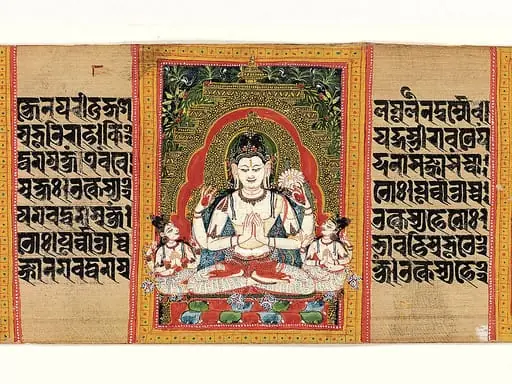
Perfection of Wisdom in Eight Thousand Lines: Ashtasahasrika Prajnaparamita: Decorated Leaf is an unspecified painting. It dates from 1119 and is held in the collection of the Cleveland Museum of Art.
About this work
Overview
Its composition features three seated figures arranged in a linear sequence, each rendered with a serene expression, cross‑legged posture, and modest robes.
The work titled *Perfection of Wisdom in Eight Thousand Lines: Ashtasahasrika Prajnaparamita: Decorated Leaf* is a slender, elongated painting executed on aged paper. Its composition features three seated figures arranged in a linear sequence, each rendered with a serene expression, cross‑legged posture, and modest robes. The backdrop is dominated by vivid red, deep blue, and gold tones, while interspersed black ink inscriptions run between the figures.
Subject & Meaning
The three figures likely represent embodiments of the Prajñāpāramitā doctrine, a central theme in Mahāyāna Buddhism that emphasizes the perfection of wisdom. Their tranquil demeanor and simple attire suggest an emphasis on inner contemplation rather than worldly display. The accompanying Sanskrit text, rendered in an ancient script, reinforces the doctrinal focus, presenting excerpts from the eight‑thousand‑line version of the Prajñāpāramitā sutra.
Technique & Style
Executed with ink on paper, the painting combines linear brushwork for the figures with bold, flat color fields of red, blue, and gold that form the background. Small white circular marks—resembling beads—appear between the figures, adding a decorative rhythm to the composition. The script is inscribed in black ink, employing a historic calligraphic style that contrasts with the vivid chromatic backdrop.
Context
Such decorated leaf formats were commonly used for devotional scrolls in medieval Indian and Tibetan Buddhist contexts, serving both as visual meditation aids and as carriers of sacred text. The narrow, portable shape suggests the piece may have been intended for personal contemplation or as part of a larger assemblage of sutra illustrations.
Artist & collection

 Text, folio 3 (recto), from a Manuscript of the Perfection of Wisdom in Eight Thousand Lines (Ashtasahasrika Prajnaparamita-sutra)
 Text, Folio 5 (recto), from a Manuscript of the Perfection of Wisdom in Eight Thousand Lines (Ashtasahasrika Prajnaparamita-sutra)
 Prajnaparamita flanked by a white female figure and a white bodhisattva, folio 90 (recto), from a Manuscript of the Perfection of Wisdom in Eight Thousand Lines (Ashtasahasrika Prajnaparamita-sutra)
 Text, folio 4 (recto), from a Manuscript of the Perfection of Wisdom in Eight Thousand Lines (Ashtasahasrika Prajnaparamita-sutra)
 Untitled
 Perfection of Wisdom in Eight Thousand Lines: Ashtasahasrika Prajnaparamita: Decorated Leaf
 Perfection of Wisdom in Eight Thousand Lines: Ashtasahasrika Prajnaparamita
 Perfection of Wisdom in Eight Thousand Lines: Ashtasahasrika Prajnaparamita: Decorated Leaf (recto)
 Perfection of Wisdom in Eight Thousand Lines: Ashtasahasrika Prajnaparamita: Decorated Leaf