Artwork
Perfection of Wisdom in Eight Thousand Lines: Ashtasahasrika Prajnaparamita: Decorated Leaf

Perfection of Wisdom in Eight Thousand Lines: Ashtasahasrika Prajnaparamita: Decorated Leaf is an unspecified painting. It dates from 1119 and is held in the collection of the Cleveland Museum of Art. This painted leaf, titled Perfection of Wisdom in Eight Thousand Lines: Ashtasahasrika Prajnaparamita, dates to 1119.
About this work
If you're interested in learning more about this style of art, you might want to check out the work of the artist, whose name is unfortunately not provided.
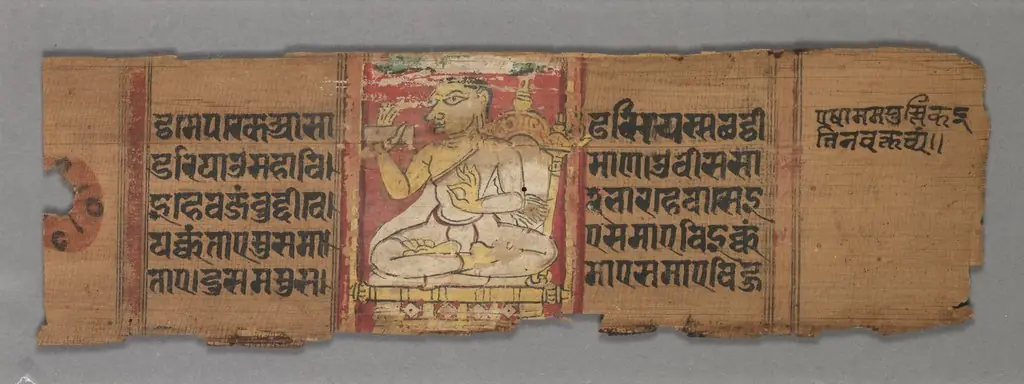
This painting shows a long, narrow strip of paper with text and images. The text is written in a foreign language and is arranged in blocks, with some images of people in between.
The images are colorful and depict people sitting in various poses. The text and images are arranged in a way that suggests a story or message is being conveyed.
The painting is quite old, dating back to 1119, and is held at The Cleveland Museum of Art. If you're interested in learning more about this style of art, you might want to check out the work of the artist, whose name is unfortunately not provided.
Overview
This painted leaf, titled Perfection of Wisdom in Eight Thousand Lines: Ashtasahasrika Prajnaparamita, dates to 1119. It is a single page from a larger manuscript, characterized by its elongated format. The artwork combines blocks of text in an unidentified script with vibrant figural illustrations. Currently, this ancient artifact is preserved within the collection of The Cleveland Museum of Art, offering insight into early manuscript illumination.
Subject & Meaning
The artwork's title directly references the Ashtasahasrika Prajnaparamita, a foundational Buddhist scripture on the "Perfection of Wisdom." This leaf likely served to illustrate or elaborate upon the philosophical concepts within the text. The interspersed colorful depictions of individuals in various seated postures would have visually reinforced the narrative or doctrinal points being conveyed by the accompanying foreign script, making the sacred text more accessible.
Technique & Style
Executed on a long, narrow strip of paper, this painting exemplifies a traditional manuscript illumination style. The composition features meticulously arranged blocks of text, separated by vibrant, polychrome illustrations. These images primarily depict human figures seated in diverse positions, rendered with a distinct palette. The integration of script and imagery on a single surface suggests a deliberate artistic approach to enhance the textual content through visual storytelling.
History & Provenance
Created in 1119, this decorated leaf represents a historical example of manuscript art from the early 12th century. Its precise origin within that period is not specified, and the artist responsible for its creation remains anonymous. The leaf's journey through time has led it to its current home at The Cleveland Museum of Art, where it contributes to the institution's collection of ancient and religious artworks.
Artist & collection

 Perfection of Wisdom in Eight Thousand Lines: Ashtasahasrika Prajnaparamita: Decorated Leaf
 Perfection of Wisdom in Eight Thousand Lines: Ashtasahasrika Prajnaparamita
 Perfection of Wisdom in Eight Thousand Lines: Ashtasahasrika Prajnaparamita: Decorated Leaf (recto)
 Perfection of Wisdom in Eight Thousand Lines: Ashtasahasrika Prajnaparamita: Decorated Leaf
 Leaf from a Jain Manuscript: Kalpa-sutra: text (verso)
 Prajnaparamita flanked by a white female figure and a white bodhisattva, folio 90 (recto), from a Manuscript of the Perfection of Wisdom in Eight Thousand Lines (Ashtasahasrika Prajnaparamita-sutra)
 Text, folio 4 (recto), from a Manuscript of the Perfection of Wisdom in Eight Thousand Lines (Ashtasahasrika Prajnaparamita-sutra)
 Text, Folio 5 (recto), from a Manuscript of the Perfection of Wisdom in Eight Thousand Lines (Ashtasahasrika Prajnaparamita-sutra)
 Text, folio 3 (recto), from a Manuscript of the Perfection of Wisdom in Eight Thousand Lines (Ashtasahasrika Prajnaparamita-sutra)