Artwork
Naval battle between a Christian galley and a Saracen galley, profane paintings from Sigena
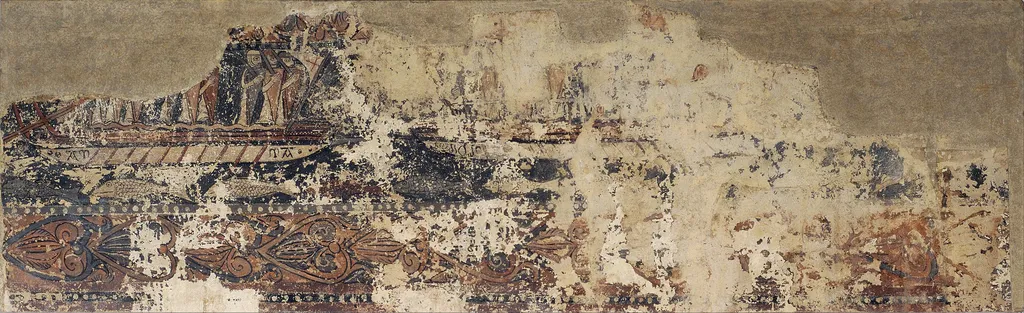
Naval battle between a Christian galley and a Saracen galley, profane paintings from Sigena is an unspecified painting by the Byzantine icon painting artist Unknown. It dates from 1200 and is held in the collection of the Museu Nacional d'Art de Catalunya. This painting depicts a naval engagement between two galleys, one identified as Christian and the other as Saracen.
About this work
Overview
This painting depicts a naval engagement between two galleys, one identified as Christian and the other as Saracen. Executed in muted earth tones, the composition emphasizes motion and disorder rather than clarity. The background is indistinct, with a weathered, uneven surface that blurs the horizon, focusing attention on the collision of vessels and the turmoil of combat.
Subject & Meaning
The scene illustrates a historical conflict between Christian and Muslim naval forces, likely referencing Mediterranean raids or crusading campaigns. The lack of identifiable figures or symbols suggests the artist prioritized the raw intensity of battle over narrative detail. The work may have served as a secular decoration, reflecting contemporary anxieties or glorifications of maritime warfare.
Technique & Style
Brushwork is deliberately coarse and energetic, conveying the violence of the encounter through textured strokes rather than refined detail. Color is restrained, dominated by browns and beiges, with minimal contrast. While light and shadow are present, they are not used systematically to model form; instead, they contribute to the overall sense of atmospheric chaos.
History & Provenance
The painting originates from the Royal Monastery of Santa María de Sigena in Aragon, Spain, where it was part of a series of secular murals. These works, created in the late 13th or early 14th century, were later removed and dispersed. This piece survived in fragments, its original context lost, and is now recognized as an unusual example of medieval non-religious imagery.
Context
During the period of its creation, the Crown of Aragon was actively engaged in Mediterranean conflicts, including naval skirmishes with Muslim powers. While religious themes dominated art, this painting reflects a rare secular interest in military action. Its placement in a monastery suggests a complex relationship between spiritual and worldly power in medieval Iberia.
Legacy
As one of the few surviving secular medieval murals from the region, it offers insight into visual culture beyond ecclesiastical subjects. Though not widely influential in its time, modern scholarship values it for its departure from religious norms and its raw, expressive style, which challenges assumptions about medieval artistic priorities.
Artist & collection

 Domestic Scene
 Giacomo and Cardinal Marco, investing Andrea, Abbot of San Zeno, with his Benefice
 The Nymph of Fontainebleau
 Portrait of a Woman
 Madonna and Child with Saints in the Enclosed Garden
 Venus and Minerva
 Family Group of Four on Sofa
 Wall painting from Room H of the Villa of P. Fannius Synistor at Boscoreale
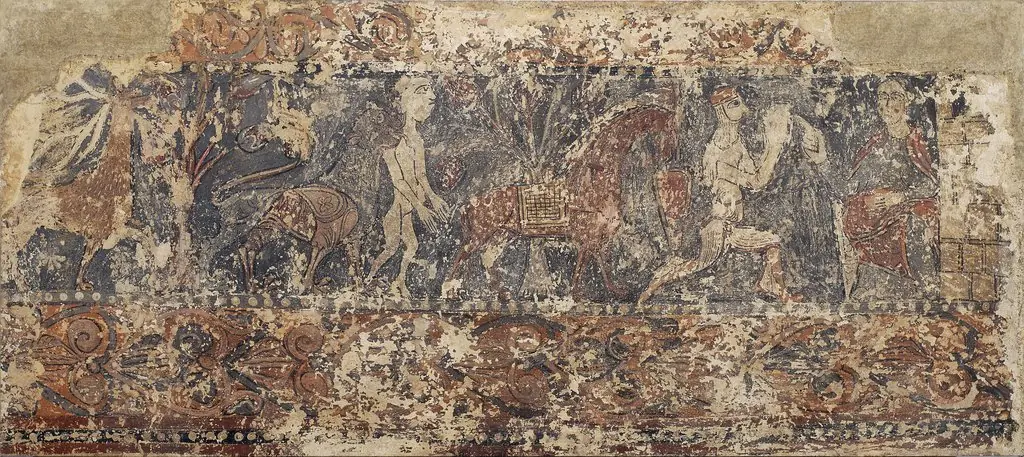 Profane paintings from Sigena: Deer eating fruit from a tree, lion holding a naked man and dismounted knight kneeling before a lady on a throne
 Altar of Santa Maria de Taüll
 Hut with Sky, Trees and Rooftops: View from the Artist's Studio
 Amintiri din deltă
 Saint Franciscus
 House with Storerooms, Tomb of Ineni
 Coffered ceiling panel with palm leaf and birds
 Saint Catherine