Artwork
Bishamonten, the Guardian of the North, with his Retinue
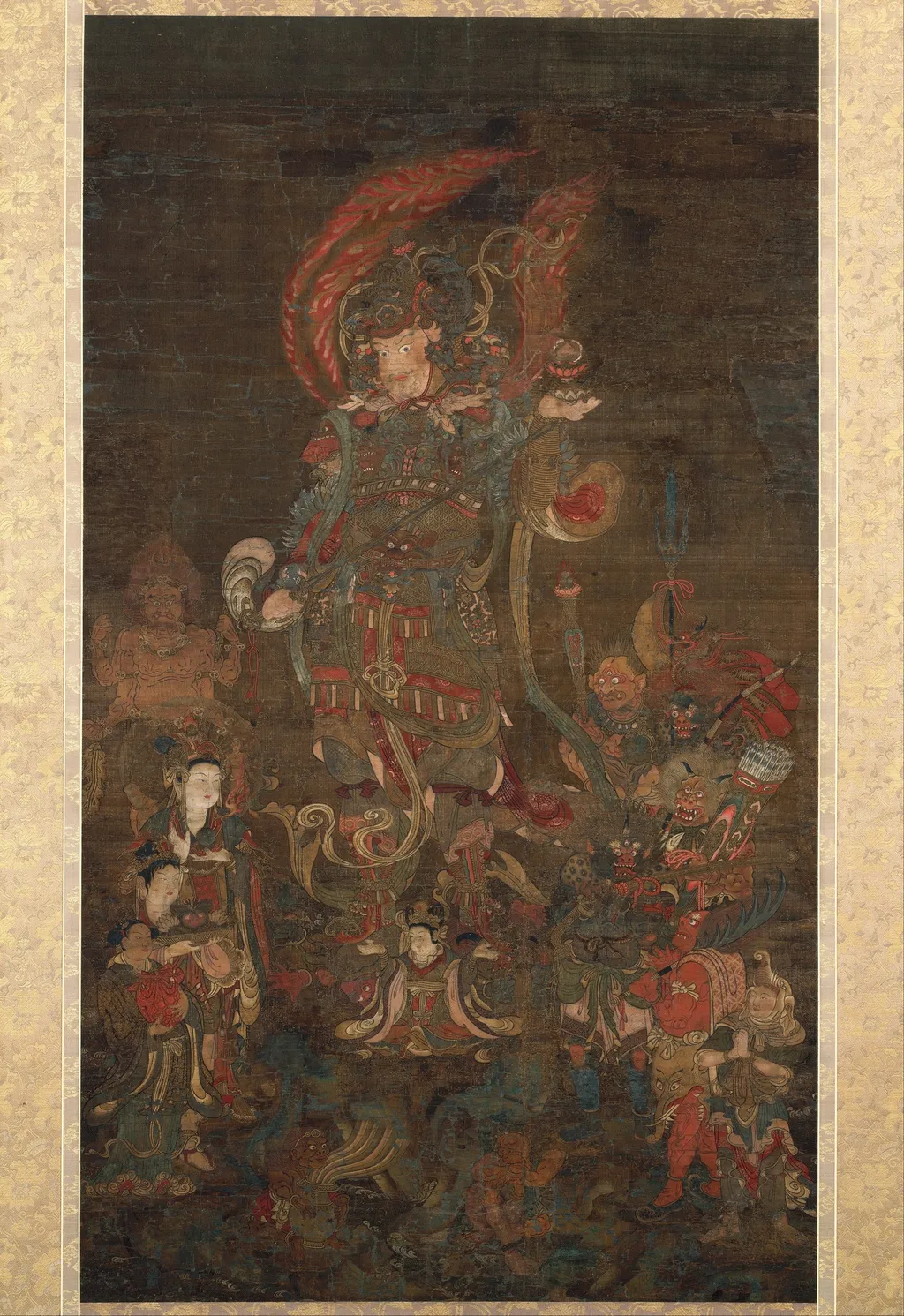
Bishamonten, the Guardian of the North, with his Retinue is an unspecified painting by Unknown. It is held in the collection of the Museum of Fine Arts Boston.
About this work
Overview
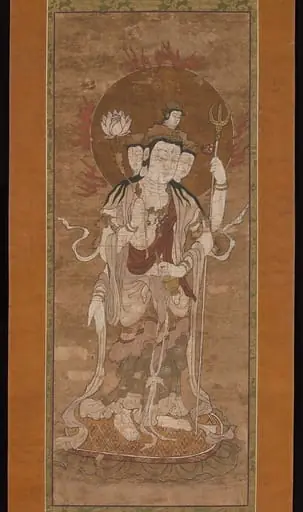
This vertical scroll painting depicts Bishamonten, one of the Four Heavenly Kings in Buddhist cosmology, as the protector of the northern direction.
This vertical scroll painting depicts Bishamonten, one of the Four Heavenly Kings in Buddhist cosmology, as the protector of the northern direction. He is shown centrally, towering above a retinue of attendants and celestial beings. The composition emphasizes hierarchy through scale and positioning, with the main figure rendered in elaborate armor and a crimson cloak, surrounded by smaller figures in varied attire, suggesting a divine court in motion.
Subject & Meaning
Bishamonten embodies protection, righteousness, and the defense of the Dharma. His staff signifies authority, while the bowl may represent the offering of spiritual wealth or the containment of evil forces. The surrounding figures—some reverent, others distracted—reflect the diversity of beings under his guardianship, reinforcing his role as a cosmic guardian who maintains order amid chaos.
Technique & Style
The painting employs fine brushwork to render intricate textile patterns, metallic armor details, and facial expressions with subtle nuance. Colors are restrained, dominated by earth tones, with strategic accents of red and blue drawing attention to key elements. The layered composition and meticulous patterning reflect the conventions of Heian- to Kamakura-period Buddhist art, prioritizing symbolic clarity over naturalistic depth.
History & Provenance
Created during the Kamakura period (1185–1333), the work likely originated in a temple or monastic context, possibly used in ritual processions or as an object of veneration. Its scroll format suggests it was stored rolled and unrolled for ceremonial viewing. Though its early ownership is undocumented, its preservation indicates continued reverence within a religious community over centuries.
Context
Bishamonten’s imagery flourished in Japan during a time of political instability, when Buddhist deities were invoked for protection. The painting aligns with broader trends in esoteric Buddhism, where celestial guardians were visualized as part of elaborate mandalas or devotional arrays. Its stylistic features echo Chinese Tang dynasty prototypes, adapted through Japanese aesthetic sensibilities toward restraint and symbolic density.
Legacy
The painting exemplifies the enduring role of Buddhist iconography in Japanese visual culture. While later periods favored more expressive or minimalist styles, this work preserves the formal rigor of medieval devotional art. It remains a reference for understanding how religious authority was visually constructed, influencing subsequent generations of temple art and ritual object design.
Artist & collection

 Domestic Scene
 Giacomo and Cardinal Marco, investing Andrea, Abbot of San Zeno, with his Benefice
 The Nymph of Fontainebleau
 Portrait of a Woman
 Madonna and Child with Saints in the Enclosed Garden
 Venus and Minerva
 Family Group of Four on Sofa
 Wall painting from Room H of the Villa of P. Fannius Synistor at Boscoreale
 Monju Riding Lion with Attendants
 Mount Kurama Mandala: Bishamonten Triad (Kuramayama mandara: Bishamonten sanzonzō)
 Monju Riding Lion with Attendants
 荼枳尼天像|Dakini
 The Eight Hosts of Deva, Naga, and Yakshi
 Shakyamuni with two attendants
 Dragon King
 Cundi Bodhisattva
 Medicine Master Buddha and the Twelve Divine Generals
 馬鳴菩薩図像|Iconographic Drawing of the Bodhisattva Memyō (Ashvaghosha)
 Aizen Myōō
 十二天像(梵天)|One of the Twelve Devas: Bonten