Artwork
Portrait of I.A. Balashov
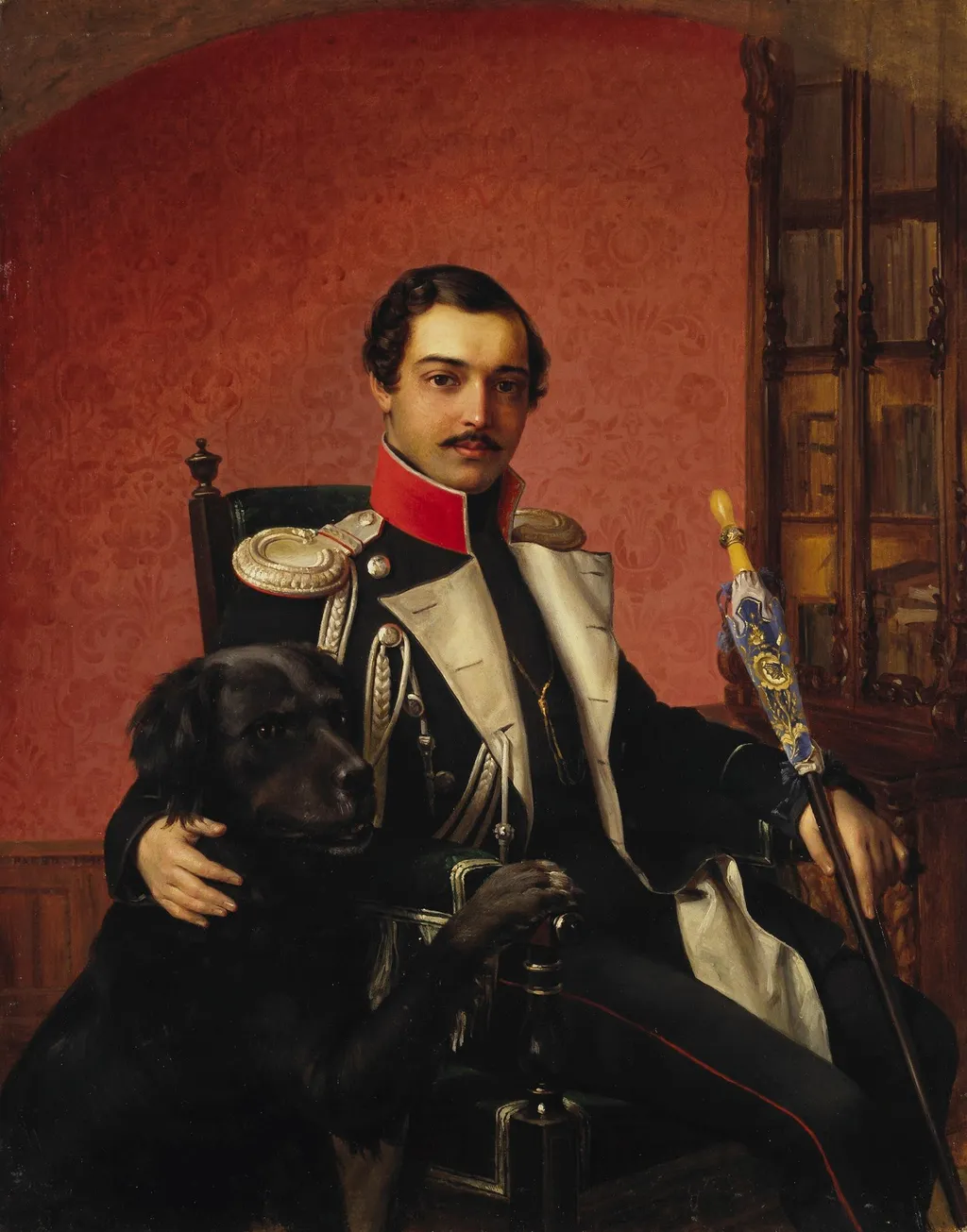
Portrait of I.A. Balashov is an oil painting by Unknown. It dates from 1841 and is held in the collection of the Hermitage Museum. This oil painting depicts I.
About this work
Overview
The background is a richly patterned red wall, contributing to the portrait’s solemn atmosphere.
This oil painting depicts I.A. Balashov, a Russian military officer, seated in a formal pose beside a large black dog. The composition emphasizes stillness and authority, with the subject dressed in a uniform featuring a red collar and holding a sword in a scabbard adorned with blue and gold detailing. The background is a richly patterned red wall, contributing to the portrait’s solemn atmosphere. Lighting techniques enhance the three-dimensionality of the figure and the dog.
Subject & Meaning
Balashov’s direct gaze and rigid posture convey a sense of duty and composure, typical of military portraiture in early 19th-century Russia. The presence of the dog, gazing outward, may symbolize loyalty or vigilance, reinforcing the subject’s role as a disciplined officer. The sword, held but not drawn, suggests readiness without aggression, reflecting the officer’s status and restrained power within the imperial hierarchy.
Technique & Style
The artist employs chiaroscuro to model the figure and the dog with strong contrasts between light and shadow, lending volume and realism. The texture of the dog’s fur is rendered with fine brushwork, catching highlights to suggest sheen. The patterned wall behind provides a decorative counterpoint to the solid forms of the subject, while the muted tones of the uniform contrast with the vivid red background, focusing attention on the central figures.
History & Provenance
The portrait was likely commissioned during Balashov’s service in the Russian imperial army, possibly in the early 1800s. It remained within family or state collections until entering a public museum, where it is now preserved. No definitive record of the artist’s identity has been established, though stylistic elements align with Russian academic portraiture of the period.
Context
Created during the Napoleonic Wars era, such portraits served to affirm the nobility and discipline of military officers loyal to the Tsar. The inclusion of a dog—a common motif in aristocratic portraiture—signaled personal character as much as social standing. The red background and ornate details reflect the imperial aesthetic favored in official imagery, reinforcing the subject’s alignment with state power.
Legacy
The portrait remains a representative example of Russian military portraiture from the early 19th century, illustrating the fusion of personal identity and institutional duty. While not widely exhibited, it contributes to scholarly understanding of how status, loyalty, and visual symbolism were communicated in official imagery during a time of political and military upheaval in Europe.
Artist & collection

 Domestic Scene
 Giacomo and Cardinal Marco, investing Andrea, Abbot of San Zeno, with his Benefice
 The Nymph of Fontainebleau
 Portrait of a Woman
 Madonna and Child with Saints in the Enclosed Garden
 Venus and Minerva
 Family Group of Four on Sofa
 Wall painting from Room H of the Villa of P. Fannius Synistor at Boscoreale
 Albert of Saxe-Coburg-Gotha, Prince Consort (1819–1861)
 Aleksanteri II:n muotokuva
 Portrait of William II, King of the Netherlands
 Alfonso XII
 Portrait of Grand Prince Alexander Nikolayevich
 Portrait of Grand Duke Mikhail Nikolaevich
 Portrait of Field-Marshal Count Fiodor (Friedrich Wilhelm) Berg
 José Martínez de Roda luego marqués de Vistabella
 Portrait of William II, King of the Netherlands
 Portrait of Prince Andrei Obolensky