Artwork
Diamond Mountain (Kumgangsan)
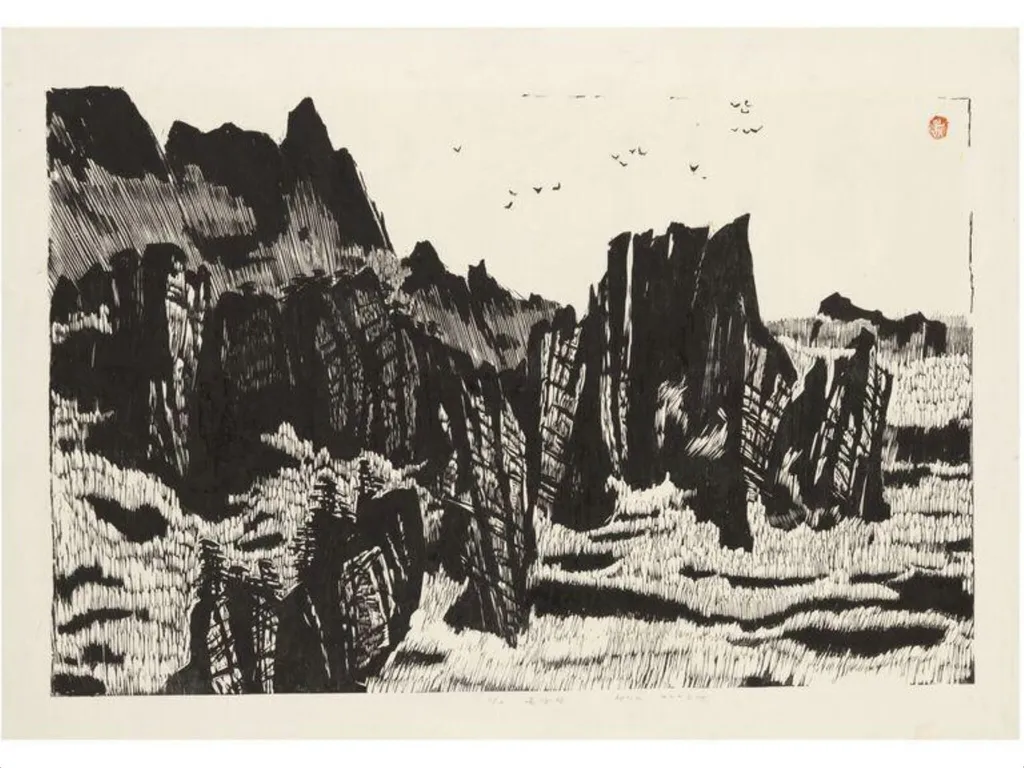
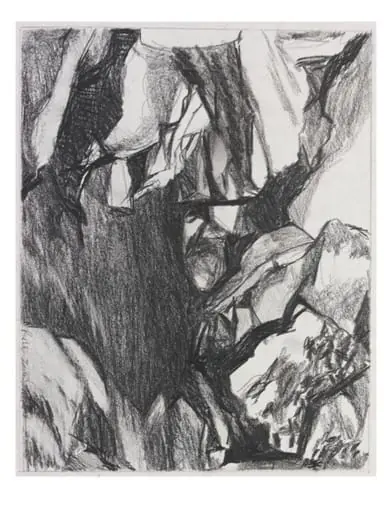
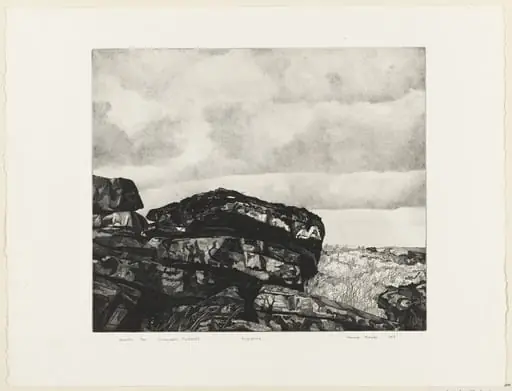
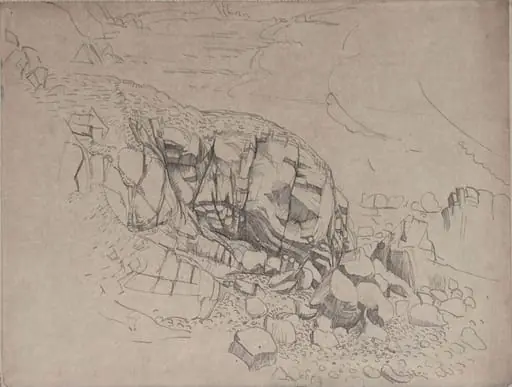
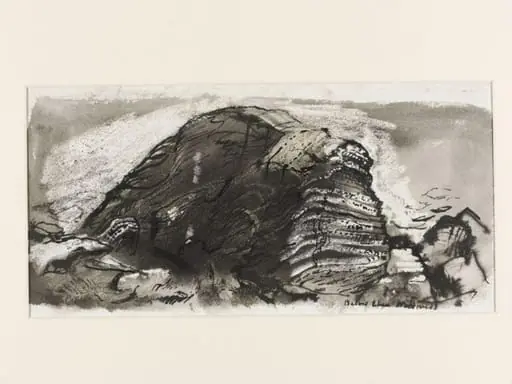
Diamond Mountain (Kumgangsan) is a print by In Jae Hwang. It dates from 2004 and is held in the collection of the Victoria and Albert Museum.
About this work
The artist used sharp, repeated cuts to shape both rocky peaks and crashing waves.
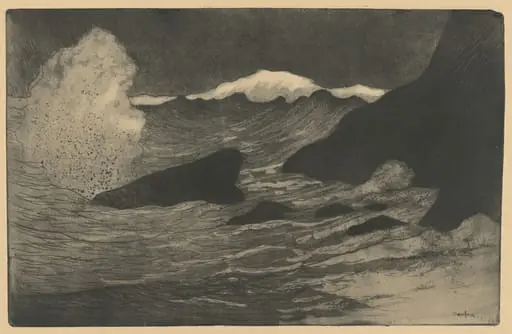
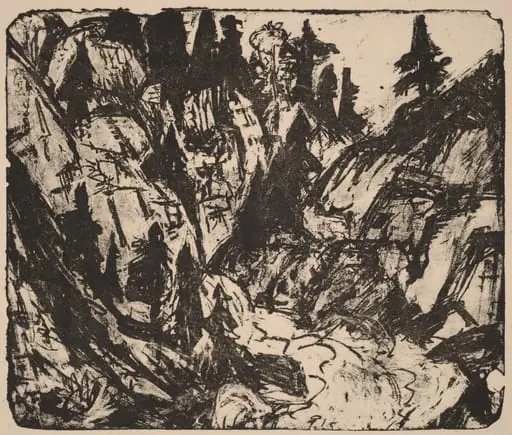
Hwang In Jae made *Diamond Mountain (Kumgangsan)* in 2004 as a print. It’s a bold, graphic take on the Diamond Mountains where land meets sea. The artist used sharp, repeated cuts to shape both rocky peaks and crashing waves.
Check out how the lines push downward, making the scene feel wild and steep. Pine trees stand dark against the mountain. A few seabirds circle high above.
If you like this, look up Hwang, In Jae.
Overview
Hwang In Jae created Diamond Mountain (Kumgangsan) in 2004 as a woodcut print, capturing the rugged junction of mountain and sea along Korea’s eastern coast. The composition emphasizes verticality and motion, with strong downward thrusts that amplify the terrain’s raw energy. The image is rendered entirely through repeated linear incisions, rejecting soft gradients in favor of stark, rhythmic contrasts.
Subject & Meaning
The scene depicts the Diamond Mountains as a wild, untamed landscape where steep cliffs plunge into turbulent waves. Pine trees, rendered as dark silhouettes, cling to the rock faces, suggesting resilience in harsh conditions. Above, a handful of seabirds drift in the empty sky, introducing a quiet counterpoint to the earth’s forceful geometry. The image conveys nature’s indifference to human presence.
Technique & Style
The print employs traditional woodcut methods with a modern graphic sensibility. Repeated, sharp linear cuts define both the jagged rock formations and the churning sea, unifying the elements through rhythmic repetition. The absence of tonal shading heightens the contrast between solid forms and open space. The composition’s directional force, pulling the eye downward, reinforces the sense of natural momentum.
History & Provenance
Created in 2004, the print is part of Hwang In Jae’s contemporary engagement with Korea’s natural landmarks. Unlike historical depictions of Kumgangsan that often idealized the scenery, Hwang’s version strips away romanticism, focusing on structural intensity. The work emerged from a period of renewed interest in Korean landscape identity, though it resists overt political or cultural commentary.
Context
The Diamond Mountains have long held cultural significance in Korea, appearing in classical poetry and painting as symbols of spiritual retreat. Hwang’s print diverges from these traditions by emphasizing physical force over poetic serenity. His approach aligns with late 20th-century Korean printmaking that prioritized materiality and formal rigor, reflecting a broader shift toward abstraction and elemental expression.
Legacy
Hwang’s Diamond Mountain contributes to a modern reimagining of Korean natural imagery through minimalist printmaking. Its emphasis on line and structure has influenced younger artists exploring landscape without nostalgia. The work stands as a quiet but forceful statement on the enduring presence of nature, independent of human narrative or embellishment.
Artist & collection
Artist
This Korean artist once spent a year alone in a Seoul studio painting nothing but mountains from memory.