Artwork
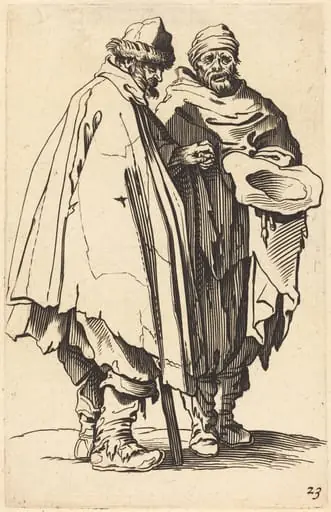
The Beggars: The Blind Man and His Companion
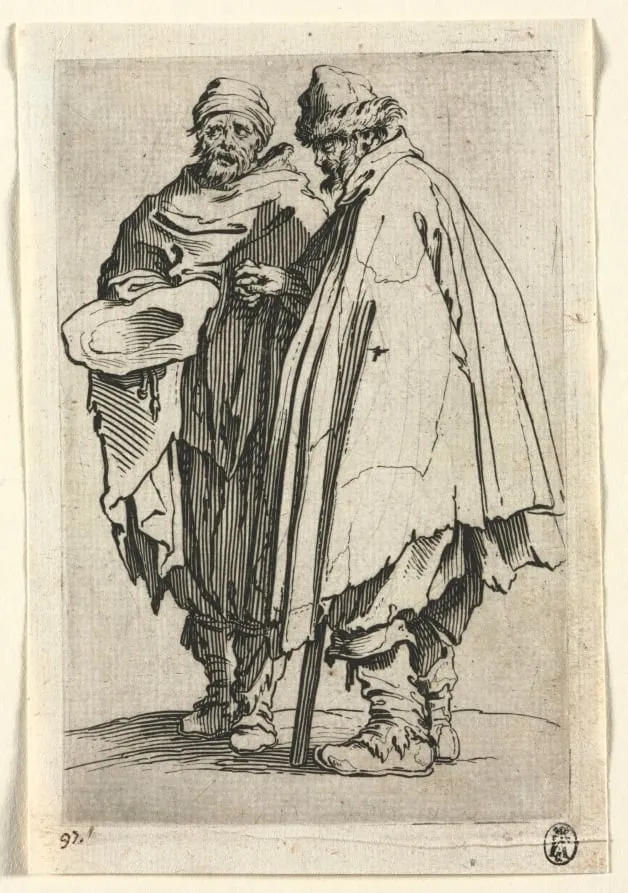
The Beggars: The Blind Man and His Companion is a print by the Baroque artist Jacques Callot. It dates from 1623 and is held in the collection of the Cleveland Museum of Art.
About this work
Overview
The work is part of a series on marginalized figures and is currently held in the collection of The Cleveland Museum of Art.
Created around 1623 by Jacques Callot, this etching depicts two impoverished men navigating the world together. One is blind, relying on his companion for guidance, while the other leans on a staff. Rendered in fine, expressive lines, the image captures a moment of quiet dependence. The work is part of a series on marginalized figures and is currently held in the collection of The Cleveland Museum of Art.
Subject & Meaning
The two figures represent the vulnerability of the destitute in early 17th-century society. Their physical closeness suggests mutual survival rather than charity. The blind man’s grip on his companion’s shoulder and the companion’s weary stance convey a bond forged by necessity. The absence of context or setting emphasizes their isolation, inviting reflection on social neglect and human resilience.
Technique & Style
Callot employed fine-line etching to achieve subtle tonal variation, using deep shadows and minimal detail to suggest texture and age. The figures’ wrinkled skin and frayed clothing are rendered with economical strokes, avoiding ornamentation. The contrast between light and dark, known as chiaroscuro, heightens emotional weight without cluttering the composition, focusing attention on their posture and connection.
History & Provenance
This print belongs to a larger series by Callot documenting beggars, soldiers, and laborers, produced during his time in Florence and Paris. It was likely made for private collectors interested in social realism rather than religious or mythological themes. The Cleveland Museum of Art acquired the work in the 20th century, where it remains part of its print collection.
Context
In early 1600s Europe, widespread poverty and displacement followed religious wars and economic instability. Artists like Callot turned to everyday suffering as subject matter, moving away from idealized scenes. His depictions of beggars were not merely documentary but carried moral weight, reflecting contemporary debates about charity, class, and human dignity.
Legacy
Callot’s series influenced later artists who sought to portray the marginalized with dignity rather than caricature. His precise technique and empathetic observation helped shift printmaking toward social commentary. Though not widely known outside specialist circles, this work stands as an early example of visual empathy in European print culture.
Artist & collection
Artist
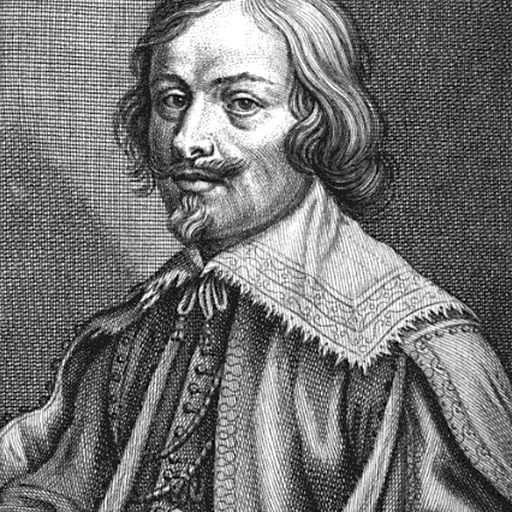
Jacques Callot was a baroque printmaker and draftsman from the Duchy of Lorraine.

 Holy Family at supper
 Restoration of the Aqueduct at Pisa
 Restoration of the Aqueduct at Pisa
 Square in Paris with Many Figures
 Square in Paris with Many Figures
 Horsemen Attacked by Robbers
 HOW WILL A COVERED PART BE CORRECTED?HOW WIKA A COVERED HEART DEED CORRECTED?
![Christ Walking on the Water [second plate], by Jacques Callot](https://artifactworldgallery.com/img/jacques-callot--christ-walking-on-the-water-second-plate--2069f3bfe4cb2126-w320.webp) Christ Walking on the Water [second plate]
Christ Walking on the Water [second plate]
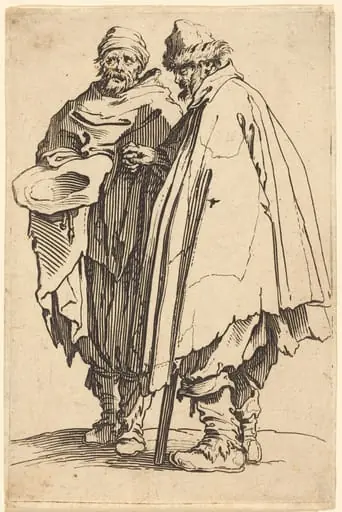 Blind Beggar and Companion
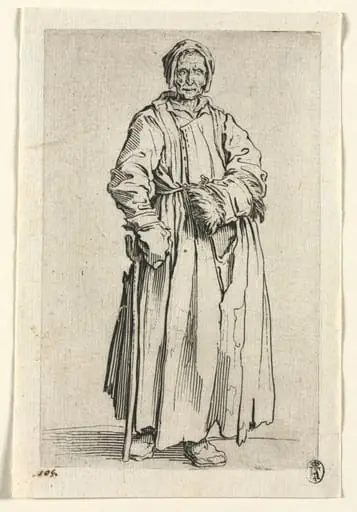 The Beggars: One-Eyed Woman
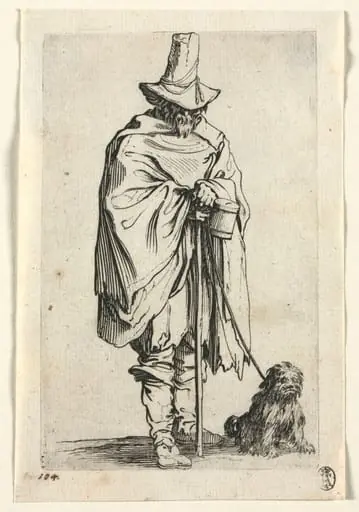 The Beggars: Blind Man with His Dog
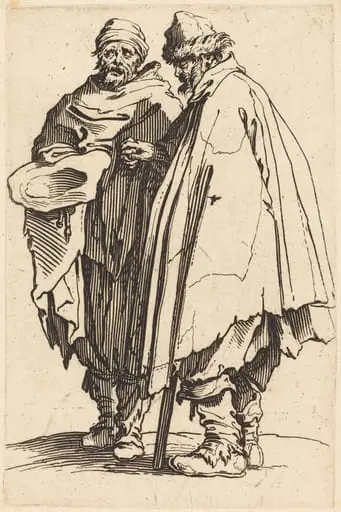 Blind Beggar and Companion
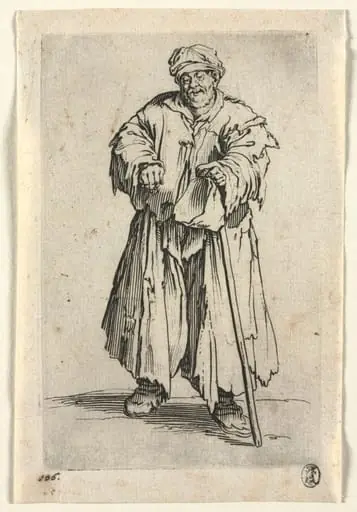 The Beggars: Obese Beggar with Lowered Eyes
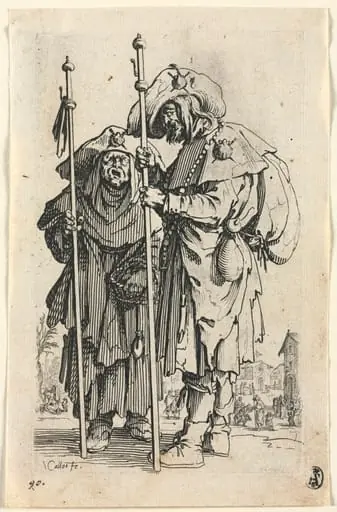 The Beggars: The Two Pilgrims
 Blind Beggar and Companion
 The Beggars: Beggar without Hat or Shoes
 The Beggars: Malingerer
 Beggar Man and Beggar Woman Conversing