Artwork
The Life of the Virgin: Frontispiece
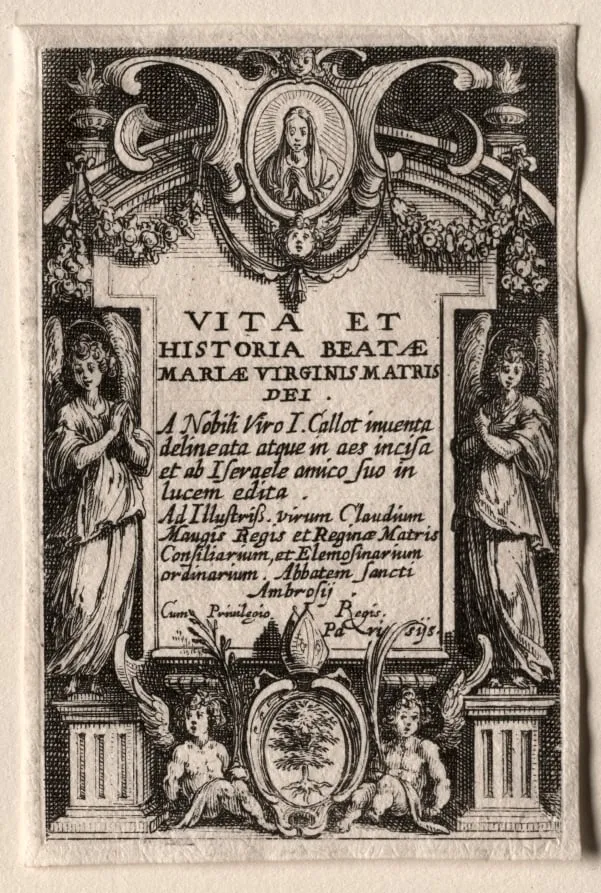
The Life of the Virgin: Frontispiece is a print by the Baroque artist Jacques Callot. It dates from 1634 and is held in the collection of the Cleveland Museum of Art.
About this work
Overview
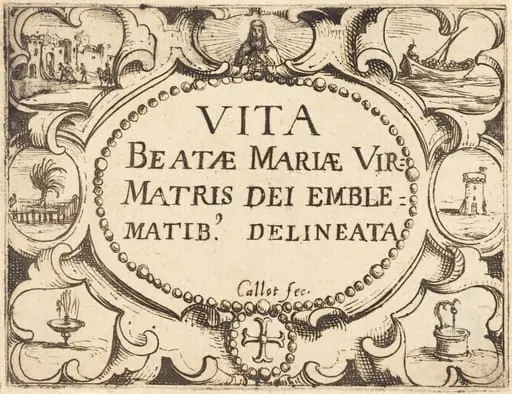
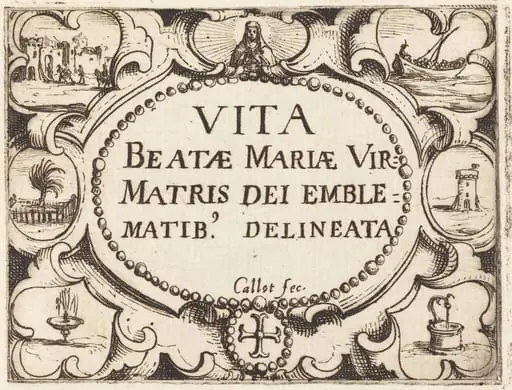
This print, created around 1634 by Jacques Callot, serves as the frontispiece to a devotional volume on the Virgin Mary.
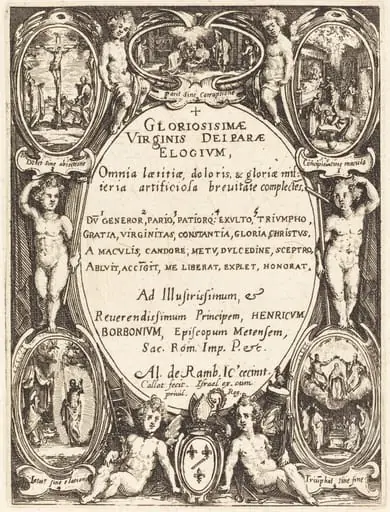
This print, created around 1634 by Jacques Callot, serves as the frontispiece to a devotional volume on the Virgin Mary. Executed in etching, it presents a richly ornamented title page designed to introduce a sacred narrative. The composition is structured hierarchically, with celestial imagery above and earthly figures below, framed by elaborate scrollwork and Latin inscriptions that announce the book’s subject.
Subject & Meaning
The central scene depicts two cherubs beneath a tree, flanking a shield bearing a similar tree motif. Above them, a radiant figure within a halo rests atop a crown-like form, suggesting divine authority. Two female figures, likely saints or allegorical representations, hold scrolls, reinforcing the theme of sacred testimony. The tree imagery may allude to the Tree of Life or the lineage of Christ, while the overall design emphasizes reverence and theological continuity.
Technique & Style
Callot employed fine-line etching to achieve intricate detail, characteristic of Baroque printmaking. Delicate hatching and precise contours define the figures and ornamental borders, while the layered composition creates depth despite the flat plane. The use of Latin text and symbolic elements reflects the period’s fusion of textual scholarship and visual allegory, with decorative flourishes enhancing the print’s ceremonial function.
History & Provenance
The print was produced as part of a larger illustrated devotional series, likely commissioned for a religious audience. It entered the collection of The Cleveland Museum of Art in the 20th century, where it is preserved as an example of early 17th-century French print culture. Its survival in good condition reflects its value as both an artistic and liturgical object.
Context
Created during the height of the Counter-Reformation, the image aligns with Catholic efforts to reinforce Marian devotion through accessible visual media. Baroque aesthetics—dramatic composition, symbolic richness, and ornate detail—were employed to inspire piety. Callot’s work fits within a broader tradition of religious prints that combined scholarly Latin texts with emotionally resonant imagery for private or institutional use.
Legacy
Callot’s frontispiece exemplifies how print technology extended the reach of religious iconography beyond manuscript culture. Its precise craftsmanship influenced later devotional publications, and its symbolic language remained a reference for ecclesiastical design. Though not widely known today, it remains a significant artifact of early modern Catholic visual culture and the role of print in shaping spiritual experience.
Artist & collection

Artist
Jacques Callot was a baroque printmaker and draftsman from the Duchy of Lorraine.

 Holy Family at supper
 Restoration of the Aqueduct at Pisa
 Restoration of the Aqueduct at Pisa
 Square in Paris with Many Figures
 Square in Paris with Many Figures
 Horsemen Attacked by Robbers
 HOW WILL A COVERED PART BE CORRECTED?HOW WIKA A COVERED HEART DEED CORRECTED?
![Christ Walking on the Water [second plate], by Jacques Callot](https://artifactworldgallery.com/img/jacques-callot--christ-walking-on-the-water-second-plate--2069f3bfe4cb2126-w320.webp) Christ Walking on the Water [second plate]
Christ Walking on the Water [second plate]