Artwork
The Mysteries of the Passion: The Flagellation
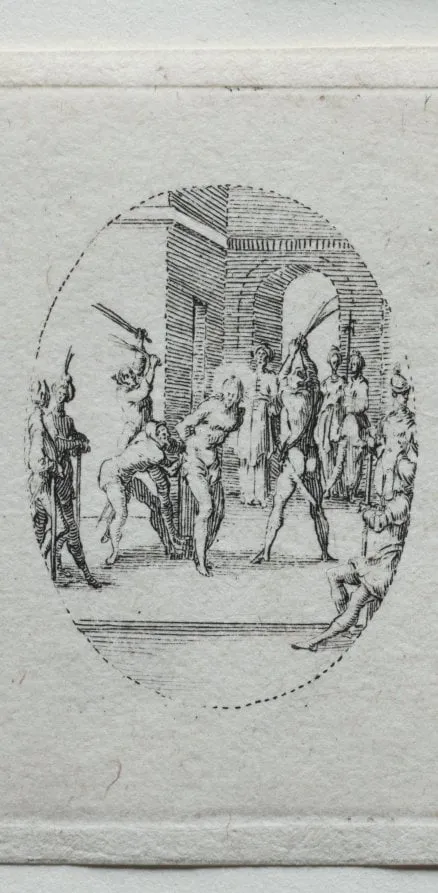
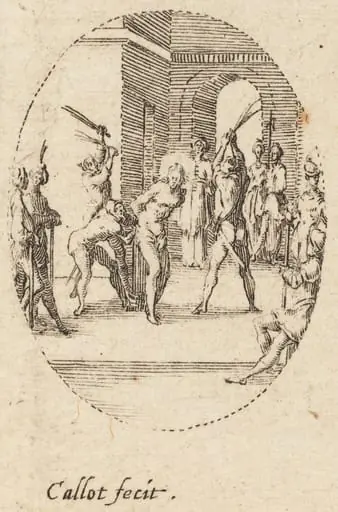
The Mysteries of the Passion: The Flagellation is a print by the Baroque artist Jacques Callot. It dates from 1631 and is held in the collection of the Cleveland Museum of Art.
About this work
Overview
Rendered in black ink on paper, the work captures the moment of Christ’s flagellation with intense emotional clarity.
Created in 1631 by Jacques Callot, this etching is part of a series illustrating scenes from the Passion of Christ. Rendered in black ink on paper, the work captures the moment of Christ’s flagellation with intense emotional clarity. Its circular composition draws the viewer’s eye inward, emphasizing the violence and tension at the center. The piece is held in the collection of The Cleveland Museum of Art.
Subject & Meaning
The scene depicts Christ bound and subjected to whipping by a group of soldiers and onlookers. Figures are arranged in a dense, swirling mass, conveying chaos and cruelty. Some tormentors raise their whips with mechanical precision, while others watch with detached or fearful expressions. The composition underscores the suffering of the innocent amid human brutality, a common theme in devotional imagery of the period.
Technique & Style
Callot employed fine, precise etching lines to render sharp contrasts between light and shadow, a technique known as chiaroscuro. The absence of color heightens the drama, directing focus to the interplay of form and expression. Figures are rendered with angular, tense postures, and the background architecture is simplified yet suggestive, framing the action without distraction.
History & Provenance
The print was produced during Callot’s mature period in Nancy, France, following his earlier work in Italy. It was likely made for private devotion or scholarly circulation among collectors. The Cleveland Museum of Art acquired the print in the 20th century as part of its growing holdings of Northern European prints, where Callot’s technical innovations were highly regarded.
Context
This work emerged during a time of religious turmoil in Europe, when Catholic devotional imagery remained influential despite Protestant critiques. Callot’s series on the Passion responded to Counter-Reformation demands for emotionally resonant religious art. His detailed, theatrical style bridged Northern engraving traditions with Italian dramatic composition.
Legacy
Callot’s etchings influenced generations of printmakers through their technical precision and narrative intensity. His use of tightly framed, emotionally charged scenes became a model for depicting sacred violence. While not widely exhibited today, this print remains a key example of early 17th-century printmaking’s capacity for psychological depth and formal control.
Artist & collection

Artist
Jacques Callot was a baroque printmaker and draftsman from the Duchy of Lorraine.

 Holy Family at supper
 Restoration of the Aqueduct at Pisa
 Restoration of the Aqueduct at Pisa
 Square in Paris with Many Figures
 Square in Paris with Many Figures
 Horsemen Attacked by Robbers
 HOW WILL A COVERED PART BE CORRECTED?HOW WIKA A COVERED HEART DEED CORRECTED?
![Christ Walking on the Water [second plate], by Jacques Callot](https://artifactworldgallery.com/img/jacques-callot--christ-walking-on-the-water-second-plate--2069f3bfe4cb2126-w320.webp) Christ Walking on the Water [second plate]
Christ Walking on the Water [second plate]