Artwork
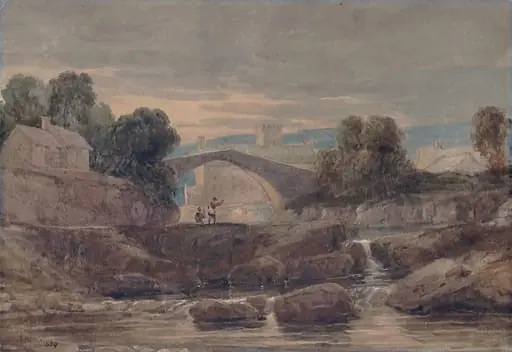
Church and bridge at Hubberholme, Yorkshire
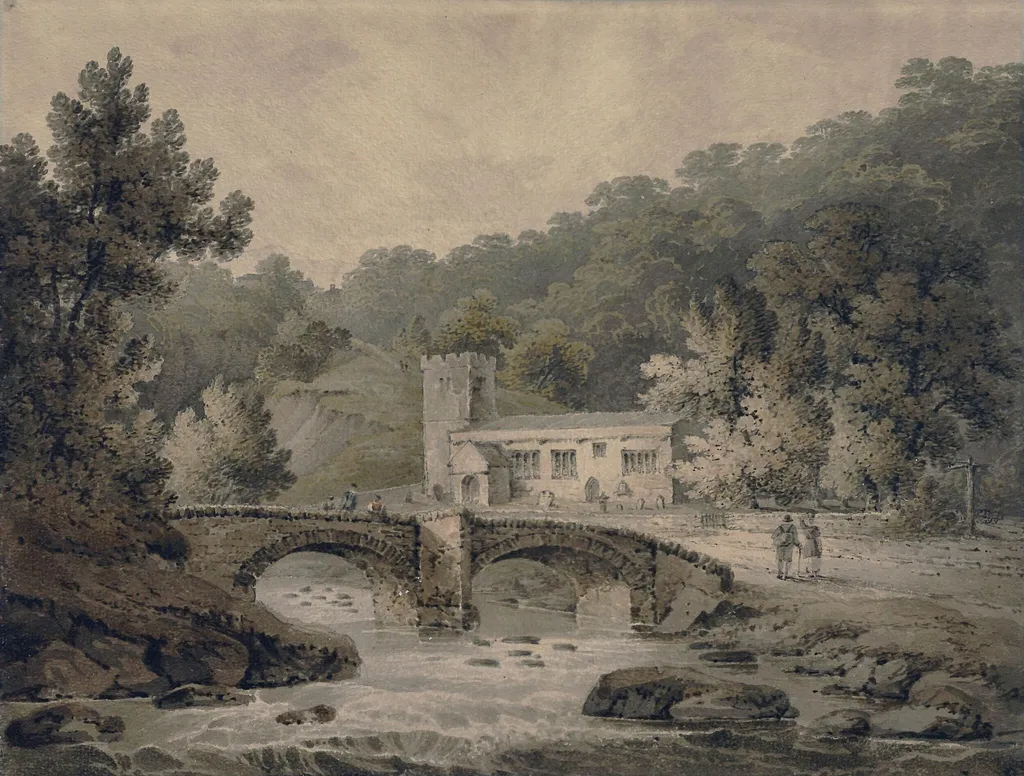
Church and bridge at Hubberholme, Yorkshire is a watercolor work on paper by the British Romanticist artist James Bourne. It dates from 1800 and is held in the collection of the Victoria and Albert Museum.
About this work
Overview
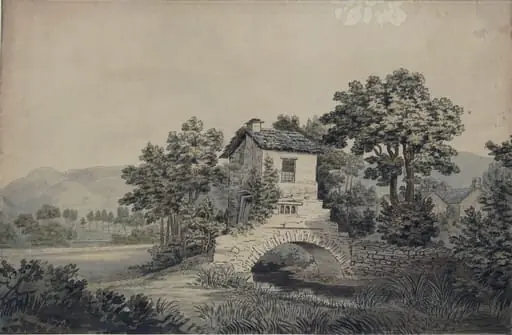
The composition centers on a modest stone church with a slender tower and a narrow bridge arching over a gentle stream.
James Bourne created this watercolour in 1800, capturing a rural scene in Hubberholme, Yorkshire. The composition centers on a modest stone church with a slender tower and a narrow bridge arching over a gentle stream. Soft, diluted pigments convey the quiet atmosphere of a still day, with no dramatic elements to disrupt the calm. The work reflects a tradition of topographical watercolour painting popular in early 19th-century Britain.
Subject & Meaning
The painting presents a humble ecclesiastical structure and a functional bridge as integral parts of the landscape, not as monuments. Their quiet presence suggests a community shaped by routine and place. The few walking figures are incidental, emphasizing the harmony between human structures and the surrounding hills and trees. The scene conveys no narrative, only the enduring rhythm of rural life.
Technique & Style
Bourne employed transparent watercolour washes to suggest subtle shifts in light and atmosphere. Delicate layering creates depth without hard outlines, allowing the paper’s white to suggest highlights. The muted palette—soft greens, greys, and earth tones—enhances the sense of stillness. Brushwork is restrained, prioritizing tonal harmony over detail, characteristic of amateur and topographical artists of the period.
History & Provenance
The work dates from the early 1800s, a time when watercolour was gaining recognition as a medium for recording the British landscape. While Bourne was not a widely known artist, his work aligns with regional practices of documenting local scenery. The painting’s survival suggests it was kept within private collections, possibly by local patrons or relatives, before entering institutional care.
Context
In early 19th-century England, watercolour was increasingly used by amateur artists and surveyors to record topography. Hubberholme, a small village in the Yorkshire Dales, represented the kind of unspoiled countryside valued by contemporaries seeking authenticity. Bourne’s painting fits within a broader trend of documenting rural architecture and natural settings, often for personal or local historical interest.
Legacy
Though not widely exhibited or reproduced, the painting contributes to the archive of regional British watercolours from the period. It offers insight into how ordinary landscapes were perceived and recorded before industrialization transformed the countryside. Its preservation in museum collections ensures its role as a quiet witness to a vanishing rural aesthetic.
Own this work as a print
Artist & collection

Artist
James Elliot Bourne is an English singer-songwriter and musician. He is known as the co-founder of pop-punk bands Busted and Son of Dork, and he also created his own electronic project under the alias Future Boy. From…

![Landscape View [?in North Wales], by John Glover](https://artifactworldgallery.com/img/john-glover--landscape-view-in-north-wales--a6780e3d0b73ec67-w320.webp)