Artwork
Blind Men from the Quinze Vingts, Walking
Blind Men from the Quinze Vingts, Walking is a print by the Romanticist artist Jean Henri Marlet. It dates from 1824 and is held in the collection of the Cleveland Museum of Art.
About this work
Overview
Known primarily for historical subjects, Marlet turned to lithography during its early adoption in France, using the medium to explore scenes of ordinary life.
Jean Henri Marlet, a French artist trained at the Académie de Dijon and later in Jean-Baptiste Regnault’s studio, produced this lithograph around 1824. Known primarily for historical subjects, Marlet turned to lithography during its early adoption in France, using the medium to explore scenes of ordinary life. This print captures a group of blind men from the Quinze-Vingts hospital, reflecting a shift toward social observation in his work during the Bourbon Restoration.
Subject & Meaning
The print portrays a line of blind men, each carrying a cane, moving deliberately along a city street. Their downward gazes and uniform attire suggest institutional care and shared vulnerability. The Quinze-Vingts, a medieval hospital for the blind in Paris, was a known institution, and Marlet’s depiction avoids sentimentality, instead presenting the men with quiet dignity. The scene underscores themes of resilience and communal routine amid societal marginalization.
Technique & Style
Marlet employed lithography to achieve tonal contrasts and textured surfaces, using chiaroscuro to model the figures against a dark, indistinct background. The men’s clothing is rendered in lighter, graded tones, enhancing their three-dimensionality. Bold, deliberate lines convey movement and rhythm in their procession, while the blurred surroundings focus attention on the group’s unified motion. The medium’s capacity for subtle gradation allowed Marlet to merge documentary precision with expressive weight.
History & Provenance
Created during the Bourbon Restoration, the print emerged in a cultural climate that favored national identity and moral narratives. Though Marlet was known for grand historical paintings, this work reflects a growing interest in social realism. The print was likely circulated as a standalone image or in a series, though its early ownership remains undocumented. It entered the Cleveland Museum of Art’s collection as part of a broader acquisition of 19th-century French graphic works.
Context
In early 19th-century France, institutions like the Quinze-Vingts represented state-supported care for the disabled, often depicted in art as symbols of civic duty. Marlet’s choice to portray these men outside the institution, in public space, aligns with Romantic-era interest in human dignity amid hardship. While contemporaries like Géricault focused on dramatic suffering, Marlet’s approach is restrained, emphasizing quiet endurance over spectacle.
Legacy
Marlet’s lithograph stands as an early example of French printmaking engaging with social subjects beyond myth or history. Though not widely exhibited in his lifetime, the work contributes to a broader shift in visual culture toward documenting marginalized lives. It influenced later artists exploring urban realism and the human condition through print, helping to expand lithography’s role beyond commercial illustration.
Artist & collection

Artist
Jean-Henri Marlet, aka Jean Henry Marlet (18 November 1771 – 1847), was a French painter and engraver.

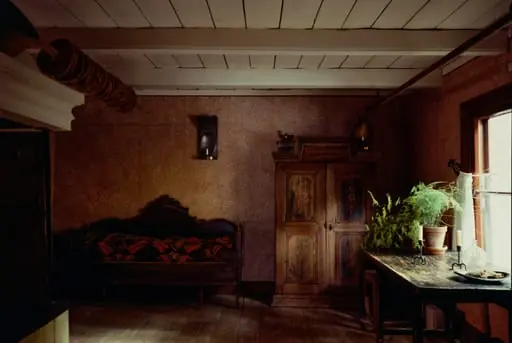 Ruiskumestarin talon keittiö kuvattuna eteisen ovelta.
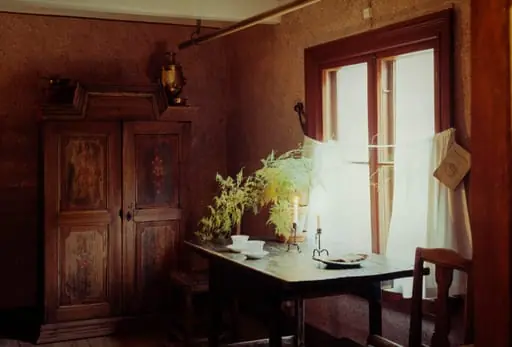 Ruiskumestarin talon keittiö.
 Άτιτλο
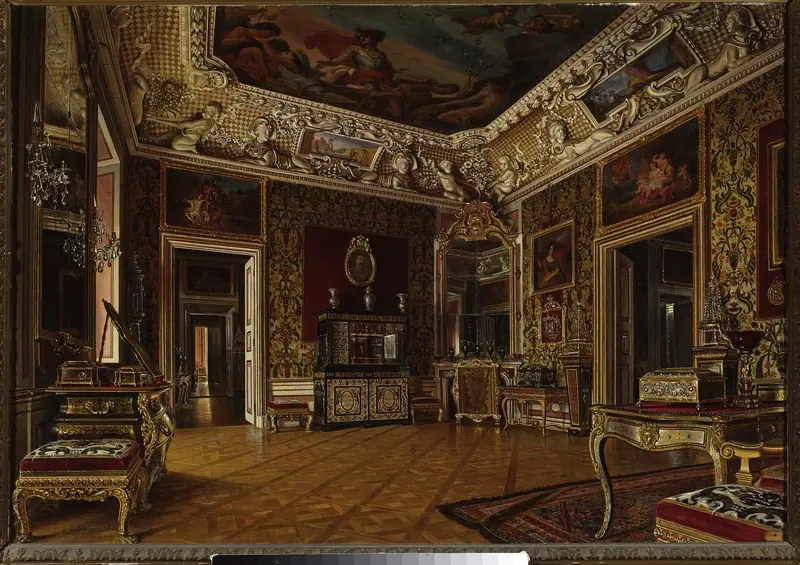 Interior of the royal bedroom at the Wilanów Palace
 A House seen through Trees
 Cana roșie
 A View of a Room of Greek, Roman and Etruscan Antiquities (Salle no. 9) in the Louvre
 Untitled
 Interior
 Things Old and New
 Crizanteme
 Sălcii la Bucium