Artwork
Untitled
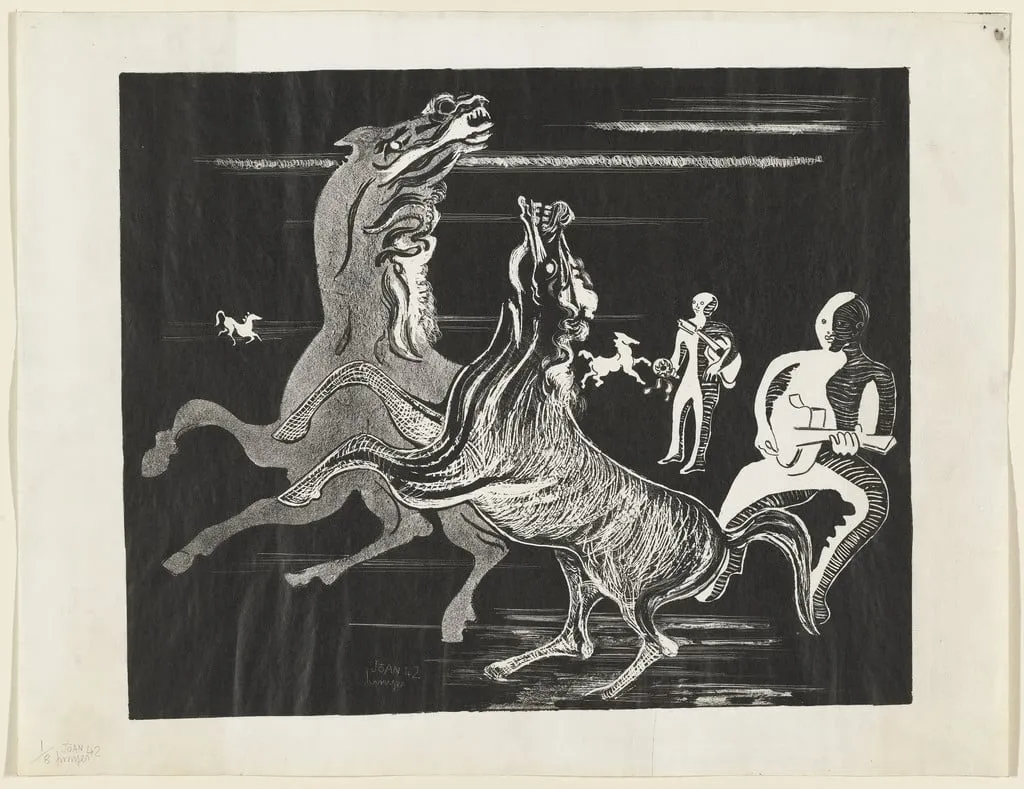
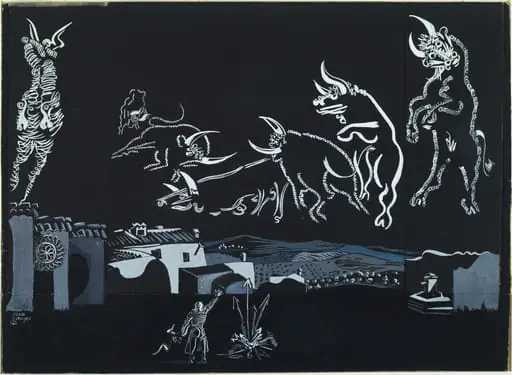
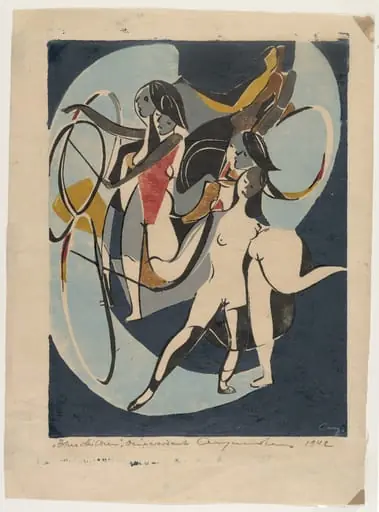
Untitled is an ink print by Joan Junyer. It dates from 1942 and is held in the collection of the Museum of Modern Art. Created in 1942, this lithograph by Joan Miró—often misattributed as Junyer—is part of The Museum of Modern Art’s collection.
About this work
Overview
The composition avoids naturalistic detail, instead favoring symbolic, almost surreal elements arranged in a crowded, energetic field.
Created in 1942, this lithograph by Joan Miró—often misattributed as Junyer—is part of The Museum of Modern Art’s collection. It is a black-and-white print characterized by dynamic, angular forms and a sense of unrestrained movement. The composition avoids naturalistic detail, instead favoring symbolic, almost surreal elements arranged in a crowded, energetic field. The medium allows for crisp contrasts, enhancing the print’s graphic intensity.
Subject & Meaning
The image presents a fantastical hybrid: a horse with a dragon’s head rearing violently, paired with another bucking equine. Two small human figures, one holding a stick and the other passive, appear dwarfed by the beasts. A floating cat and a seated figure at the edge introduce enigmatic, dreamlike interruptions. These elements suggest a psychological or mythic narrative, possibly reflecting inner turmoil or subconscious imagery, common in Miró’s work during this period.
Technique & Style
Executed in lithography, the work exploits the medium’s capacity for fine, sharp lines and tonal contrast. The artist used high-contrast black and white to carve forms against a dark ground, giving the figures an incised, sculptural quality. Jagged contours and swirling lines animate the horses’ manes and the floating cat, creating a sense of tension and motion. The style aligns with Surrealist tendencies, prioritizing instinct over realism.
History & Provenance
Produced in 1942 during Miró’s time in exile in France and later Spain, the print emerged from a period of intense political and personal upheaval. It entered The Museum of Modern Art’s collection in the mid-20th century, likely through the museum’s early focus on European avant-garde prints. Its preservation reflects institutional interest in Surrealist graphic work from the war years.
Context
This print belongs to a broader body of work Miró produced during the early 1940s, when he increasingly turned to symbolic forms and biomorphic abstraction amid the disruptions of World War II. His prints from this era often merge personal mythology with political unease, using reduced palettes and distorted figures to evoke emotional states. Lithography offered him a direct, accessible means to explore these ideas outside painting.
Legacy
The work contributes to the recognition of printmaking as a vital medium for Surrealist expression, not merely a reproductive technique. Miró’s use of lithography to convey psychological depth influenced later generations of artists exploring the intersection of dream imagery and graphic form. Its presence in MoMA’s collection underscores its role in documenting mid-century experimental print practices.
Artist & collection