Artwork
Behind-Glass Painting with Calligraphed Saying: The Blood of Jesus Christ the Son of God Purifies us from all Sin
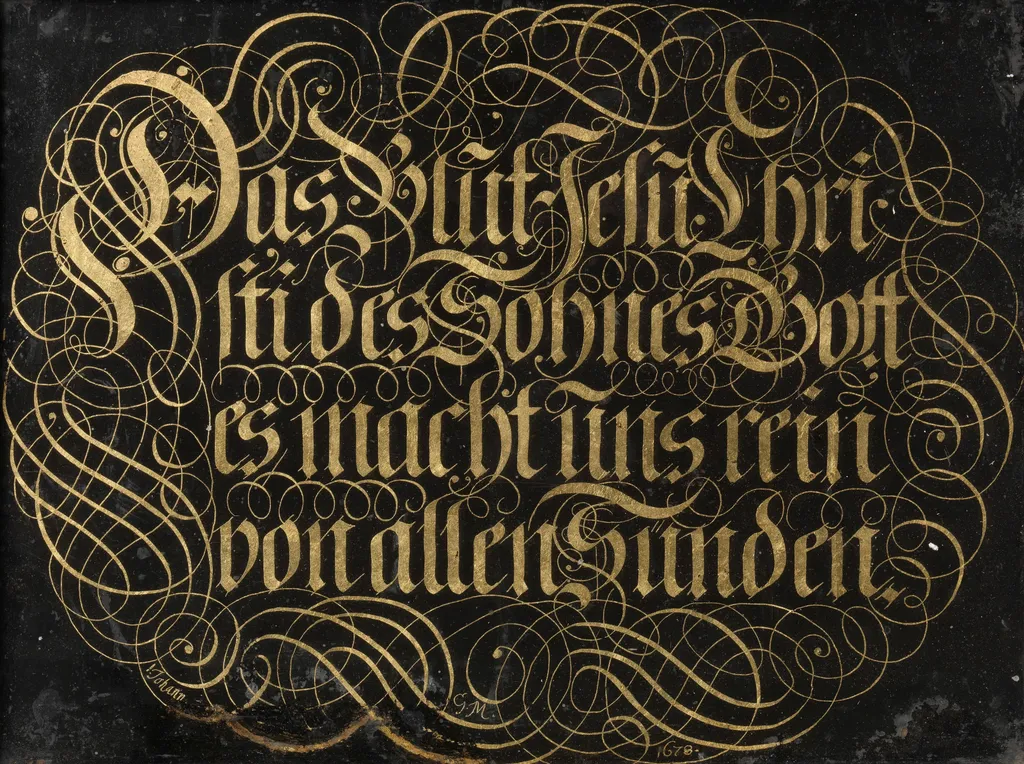
Behind-Glass Painting with Calligraphed Saying: The Blood of Jesus Christ the Son of God Purifies us from all Sin is an unspecified painting by Johann G. M. It dates from 1690 and is held in the collection of the Rijksmuseum. This work is a religious devotional object created in 1690 using vitreous enamel on glass.
About this work
Overview
This work is a religious devotional object created in 1690 using vitreous enamel on glass. It features no figurative imagery, instead presenting a single German inscription in elaborate calligraphy. The text, illuminated against a dark ground, relies on luminous metallic pigments to convey spiritual weight. The medium’s durability and sheen suggest an intention of permanence and reverence.
Subject & Meaning
The absence of imagery directs focus entirely to the word, aligning with Reformation ideals that prioritized scripture over iconography.
The inscription, translated as 'The Blood of Jesus Christ the Son of God Purifies us from all Sin,' reflects Lutheran theological emphasis on redemption through Christ’s sacrifice. The absence of imagery directs focus entirely to the word, aligning with Reformation ideals that prioritized scripture over iconography. The ornate script elevates the text to an object of contemplation, not merely a message.
Technique & Style
Executed in vitreous enamel, the letters are painted onto glass and fired to fuse the pigment permanently. The calligraphy is dense and fluid, with looping, interwoven forms that fill the surface without repetition. Gold and metallic tones catch light, creating a luminous effect against the black background. The technique merges craft with devotional intent, emphasizing material permanence as a metaphor for divine truth.
History & Provenance
The work was produced in the late 17th century, likely in a German-speaking region with strong Lutheran traditions. It entered the Rijksmuseum’s collection in the 19th century, where it remains as part of its holdings of devotional objects. The artist, Johann G. M., is otherwise undocumented, suggesting the piece may have been made by a skilled artisan rather than a named master.
Context
In post-Reformation Germany, devotional objects often replaced traditional religious imagery with textual meditations. This piece reflects a broader trend of using calligraphy as sacred art, particularly in domestic or private worship settings. The use of glass and enamel, while uncommon, aligns with regional practices in decorative religious objects that valued durability and luminosity.
Legacy
As a rare example of enamel calligraphy on glass from this period, it stands as a testament to the intersection of craftsmanship and theology in early modern Protestant devotion. Its preservation in a major museum underscores its significance as a material expression of faith, offering insight into how spiritual concepts were rendered tangible through non-figurative means.
Artist & collection
Artist
German enamel painter of the late 1600s, working in vitreous enamel on metal—think of tiny, durable paintings made to last.

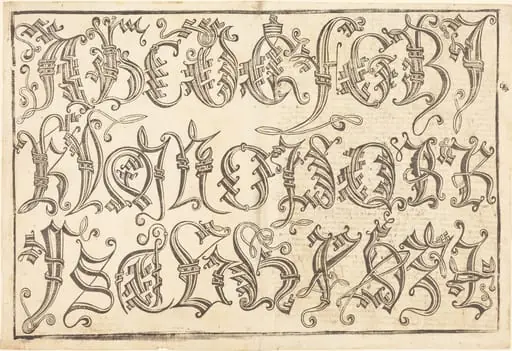 Ornamental Alphabet
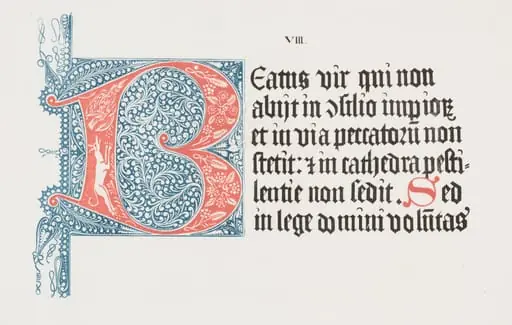 Art of the Lithograph: Psalter- Initial B, Plate VIII
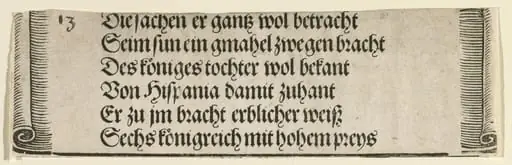 Printed text for "The Betrothal of Philip the Fair with Joan of Castile"
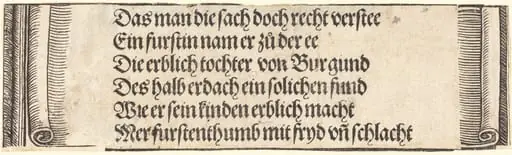 Printed text for "The Betrothal of Maximilian with Mary of Burgundy"
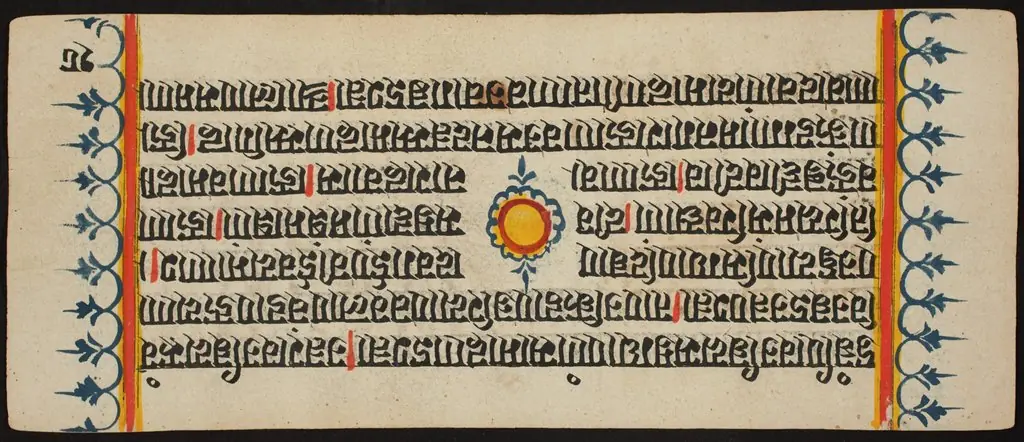 Kalpa Sutra
 Ornament
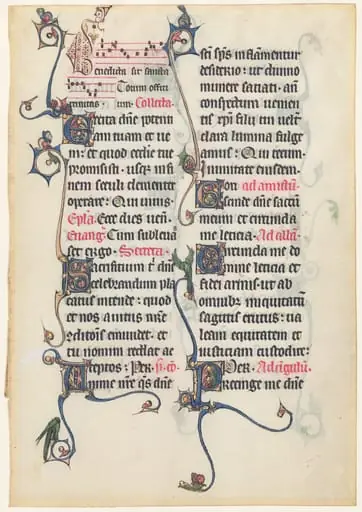 Manuscript Leaf from the Beauvais Missal
 Kalpa Sutra
 Σχέδιο εξωφύλλου για το βιβλιαράκι του V. Khlebnikov "Doski Sudby", που εκδόθηκε μετά το θάνατο του.
 Kalpa Sutra
 Ornament
 Kalpa Sutra