Artwork
Untitled
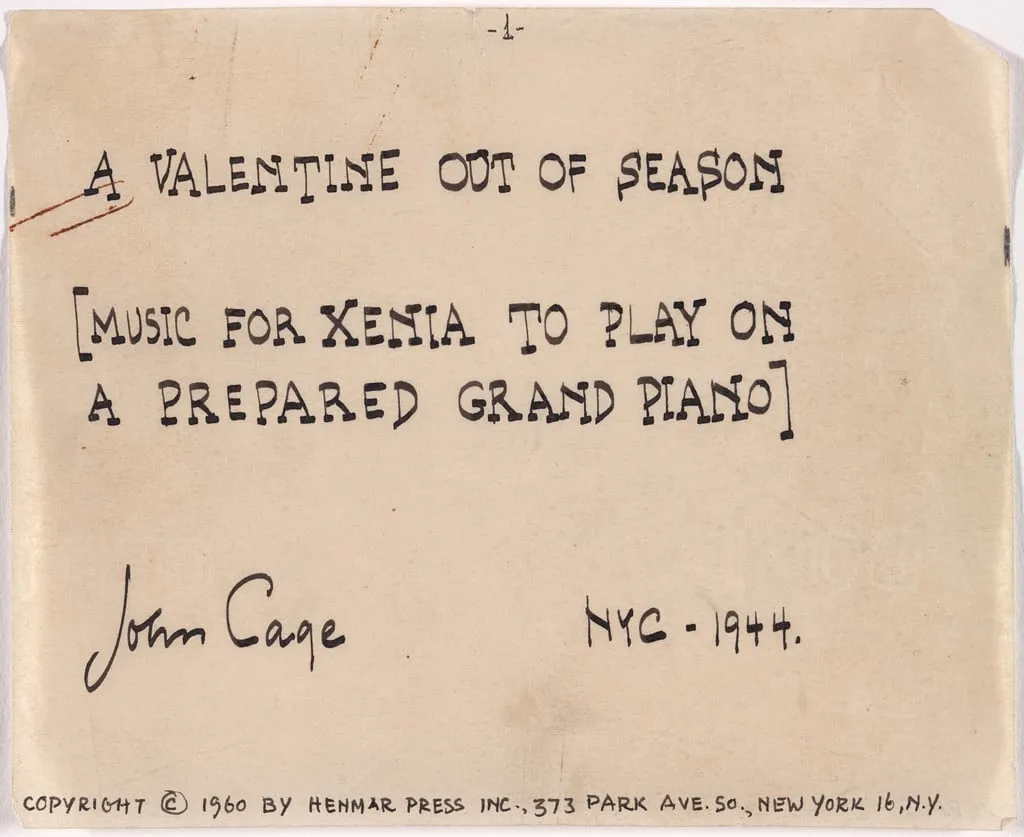
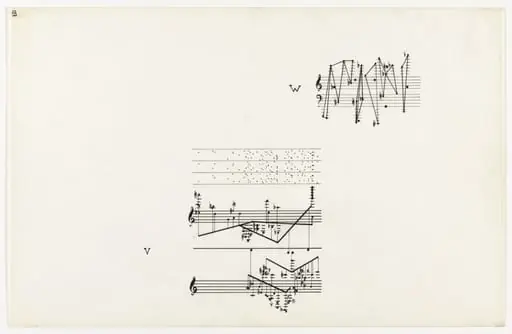
Untitled is a graphite drawing by John Cage. It dates from 1952 and is held in the collection of the Museum of Modern Art.
About this work
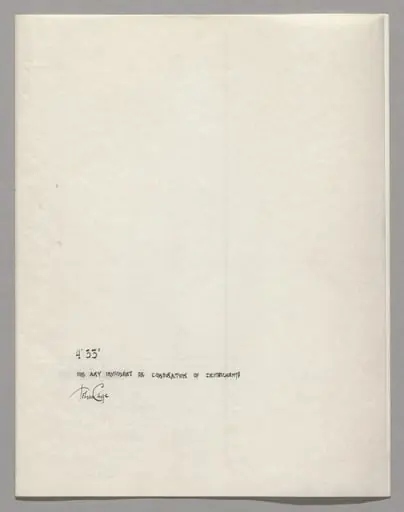
The words say *"A Valentine Out of Season"* at the top, followed by smaller text: *"Music for Xenia to play on a prepared grand piano.
This is a handwritten sheet of paper with black ink. The words say *"A Valentine Out of Season"* at the top, followed by smaller text: *"Music for Xenia to play on a prepared grand piano."* At the bottom, the name *"John Cage"* is signed, along with *"NYC - 1944."* The paper looks old and slightly torn, with a copyright note from 1960.
The phrase *"prepared piano"* hints at Cage’s unusual way of altering pianos to create new sounds. This wasn’t just sheet music—it was an instruction for how to play it differently.
Want to hear what a prepared piano sounds like? Look up John Cage.
Overview
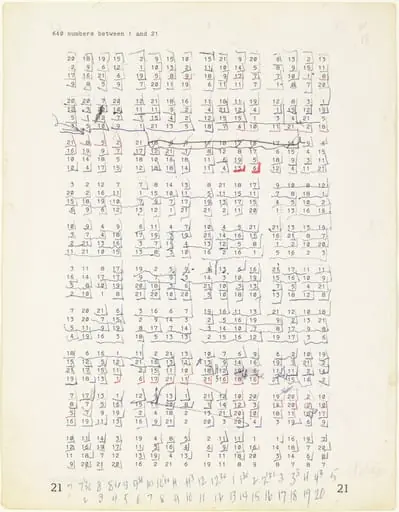
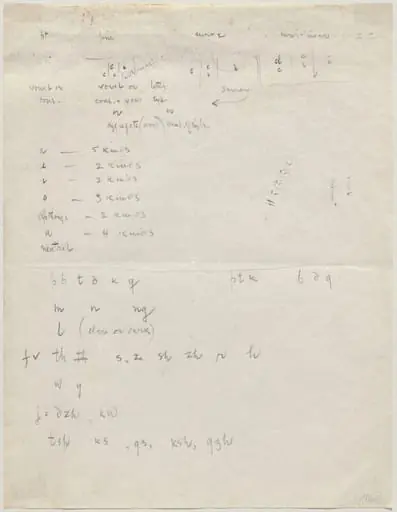
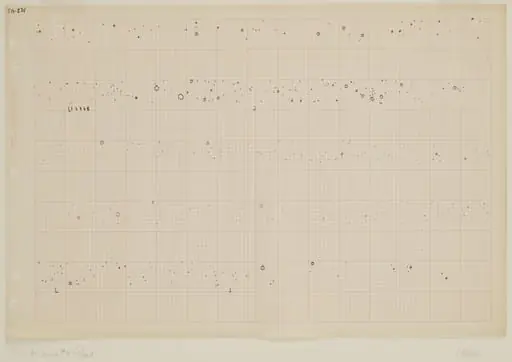
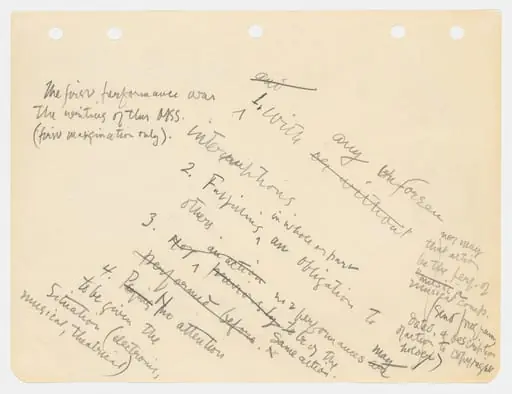
Untitled, a drawing assembled from nine sheets of paper bound with tape, combines ink, colored pencil and collage elements. Executed in 1952, the work resides in the collection of the Museum of Modern Art. Its surface bears handwritten instructions and a dated signature, linking the piece to the composer’s experimental practice.
Subject & Meaning
The central text reads “A Valentine Out of Season” and directs “Music for Xenia to play on a prepared grand piano.” The phrasing suggests a personal dedication while simultaneously framing the sheet as a performance cue, blurring the line between visual object and musical score.
Technique & Style
Cage’s use of multiple media—ink drawing, colored pencil shading, and the physical joining of paper sheets—creates a layered, tactile surface. The inclusion of tape as a binding element underscores the work’s assemblage quality, while the handwritten script emphasizes its status as a functional document rather than a conventional illustration.
History & Provenance
Although the drawing bears the composer’s signature and the notation “NYC – 1944,” it was completed in 1952. A copyright notice from 1960 appears on the lower edge. The piece entered MoMA’s holdings as part of the museum’s effort to document mid‑century avant‑garde practices.
Context
The reference to a “prepared piano” reflects Cage’s pioneering experiments with altering piano timbre by inserting objects between strings. This drawing functions as a score for such an altered instrument, situating the work within the composer’s broader investigations into chance operations and the expansion of musical parameters during the early 1950s.
Artist & collection

Artist
John Milton Cage Jr. was an American composer, artist, and music theorist. A pioneer of indeterminacy in music, electroacoustic music, and non-standard use of musical instruments, Cage was one of the leading figures of…