Artwork
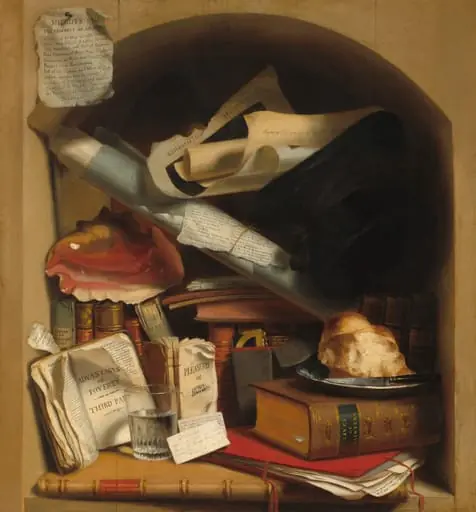
The Poor Man's Store
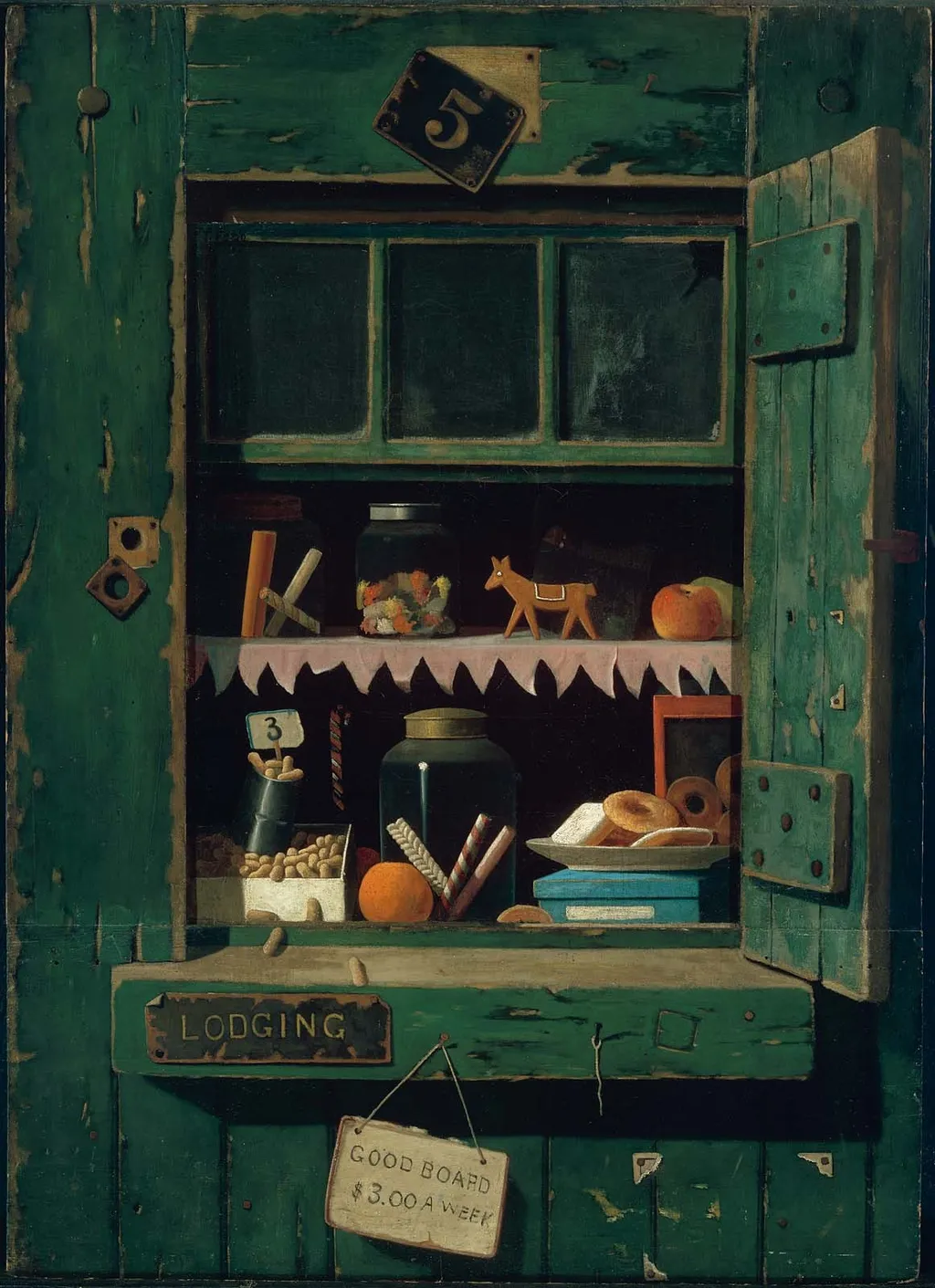
The Poor Man's Store is an unspecified painting by the American Impressionist artist John F. Peto. It dates from 1893 and is held in the collection of the Museum of Fine Arts Boston. John F.
About this work
Overview
John F. Peto’s 1893 canvas, *The Poor Man’s Store*, presents a compact, interior view of a modest shop front. The composition centers on a weathered green door with a small window, behind which shelves hold a jar, a wooden toy horse, apples, bread and nuts. A sign beneath the window advertises lodging and a weekly board rate, anchoring the scene in everyday commerce.
Subject & Meaning
The work captures a slice of late‑19th‑century American life, emphasizing the humble provisions offered to travelers and locals alike. By foregrounding ordinary items—fruit, confections, and a simple sign—Peto underscores the dignity of ordinary labor and the quiet economy of a small storefront.
Technique & Style
Peto employs trompe‑l’œil precision, rendering each object with a surface realism that invites the eye to question its two‑dimensionality. Stark chiaroscuro heightens the contrast between illuminated shelves and the shadowed doorway, while the peeled paint on the door is depicted with meticulous texture, reinforcing the illusion of depth.
History & Provenance
Created during the height of American Impressionism, the painting reflects Peto’s engagement with the movement’s interest in light and everyday subjects. It remained in private collections for much of the 20th century before entering a public museum’s holdings in the early 2000s, where it has been displayed as an exemplar of American trompe‑l’œil.
Context
At the time of its execution, small retail spaces served as social hubs in many towns, and Peto’s focus on such a venue aligns with contemporary artistic trends that valued genre scenes over grand historical narratives. The inclusion of a lodging advertisement hints at the multifunctional nature of rural storefronts.
Legacy
*The Poor Man’s Store* continues to be cited in studies of American realism for its deft combination of illusionistic technique and social observation. The painting’s precise detail and use of light influence later realist painters who explore the visual tension between surface and perception.
Artist & collection

Artist
John Frederick Peto (May 21, 1854 – November 23, 1907) was an American trompe-l'œil ("fool the eye") painter who was long forgotten until his paintings were rediscovered along with those of fellow trompe-l'œil artist William Harnett.