Artwork
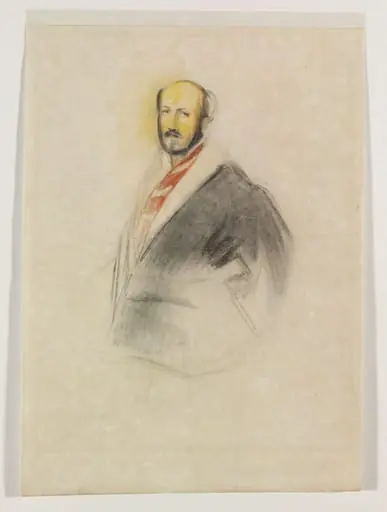
Study for Mehmet Ali Pasha
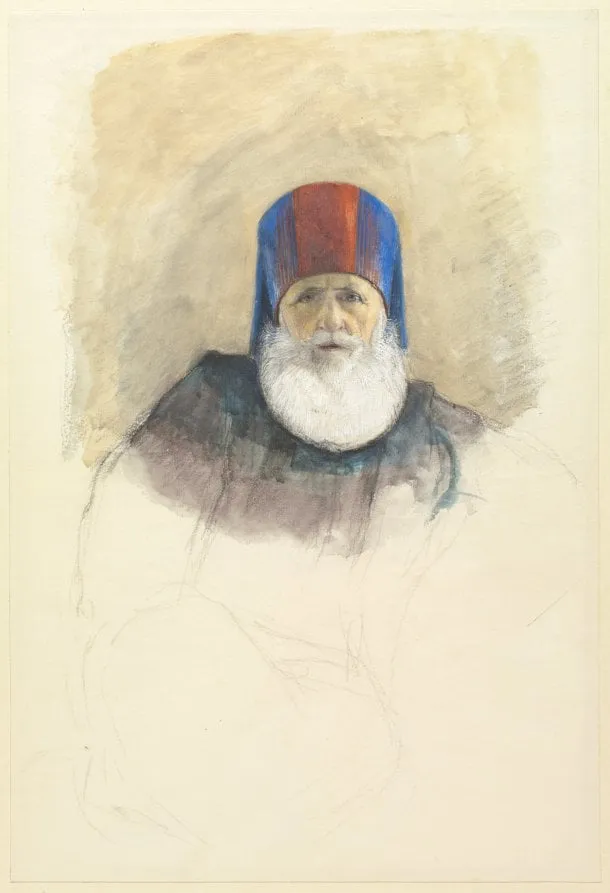
Study for Mehmet Ali Pasha is a drawing by the Romanticist artist John Frederick Lewis. It dates from 1844 and is held in the collection of the Cleveland Museum of Art. This pencil drawing served as a preparatory study for a larger watercolor portrait of Mehmet Ali Pasha, the Ottoman viceroy of Egypt.
About this work
Overview
This pencil drawing served as a preparatory study for a larger watercolor portrait of Mehmet Ali Pasha, the Ottoman viceroy of Egypt. Created by John Frederick Lewis during his decade-long residence in Cairo, it captures a moment of quiet authority. The work reflects Lewis’s commitment to direct observation, executed with swift, assured strokes that prioritize form and texture over finish.
Subject & Meaning
Mehmet Ali Pasha, a pivotal figure in Egypt’s modernization, is depicted seated on a low divan, one hand resting on a ceremonial sword.
Mehmet Ali Pasha, a pivotal figure in Egypt’s modernization, is depicted seated on a low divan, one hand resting on a ceremonial sword. His red turban and richly embroidered coat signal status, while the dim interior and ornate tiles suggest a private, domestic space. Lewis avoids grandeur, instead presenting the ruler as a composed individual within his everyday environment, grounding his power in personal presence rather than spectacle.
Technique & Style
Lewis employed loose, confident pencil lines to suggest the weight and fall of fabric, emphasizing texture over precise detail. The drawing’s economy of mark-making reveals his skill in capturing form quickly, a practice honed through years of sketching in Cairo’s homes. Subtle shading and soft transitions between light and shadow anticipate the atmospheric effects he later refined in his finished watercolors.
History & Provenance
Created during Lewis’s ten-year stay in Cairo (1837–1851), this study was part of a broader project to document Egyptian life with fidelity. After returning to England in 1851, he exhibited over 600 watercolors based on these sketches. The final watercolor derived from this study is held at the Victoria and Albert Museum, while the drawing remains a testament to his process of working directly from life.
Context
In the mid-19th century, European interest in the Middle East grew, but few artists lived as long as Lewis did among their subjects. His immersion in Cairo allowed him to portray local figures with nuance, avoiding exoticized stereotypes. This study exemplifies a shift toward ethnographic accuracy in Orientalist art, rooted in sustained engagement rather than fleeting observation.
Legacy
Lewis’s approach influenced later artists seeking authenticity in depictions of non-European cultures. His use of soft-edged transitions and attention to material detail anticipated techniques associated with sfumato, though applied in a distinctly 19th-century context. Though often categorized as Orientalist, his work endures for its quiet realism and respect for the dignity of his subjects.
Artist & collection
Artist
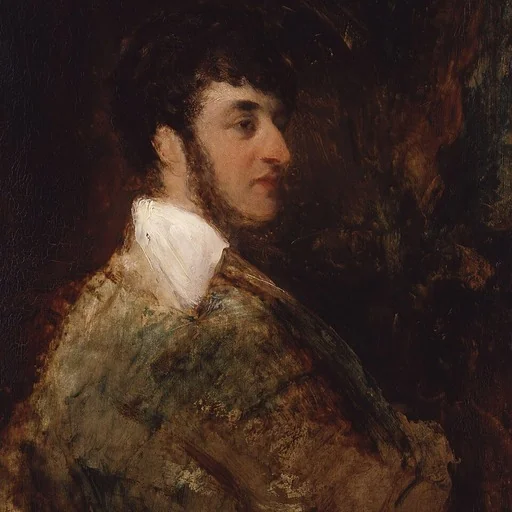
John Frederick Lewis (1804–1876) was an English Orientalist painter. He specialized in Oriental and Mediterranean scenes in detailed watercolour or oils, very often repeating the same composition in a version in each…

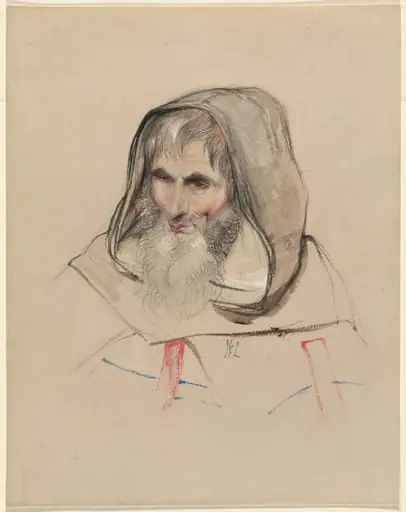 Head of a Spanish Monk
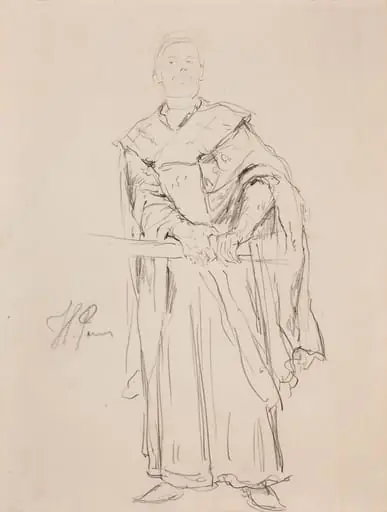 Luonnos maalaukseen Pyhä Nikolaus Lyykian Myrasta
 Rabindranath Tagore
 Alphonse Legros
 Head of a fisherman
 Study for the Magician in "Conte de Fée" (Story of a Fairy)
 Προσωπογραφία του Γεωργίου Ιακώβου Καλαϊσάκη
 Prince Rupert receiving the Charter of the Hudson Bay Company from Charles II
 Polish Jew. Israel Abramovich
 History: Study for the Old Man
 Professor Justus Brinckmann
 Philip of Burgundy