Artwork
Wild Turkey Cock, Hen and Young
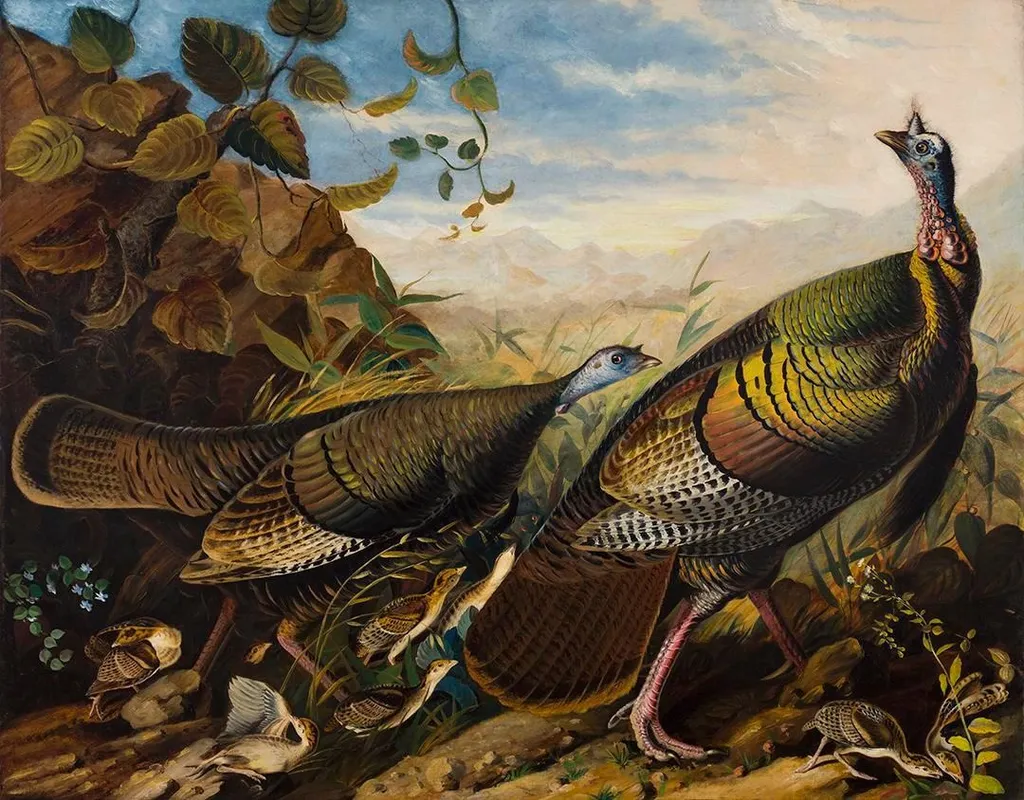
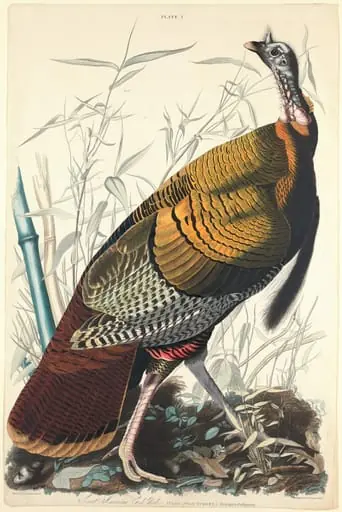
Wild Turkey Cock, Hen and Young is an unspecified painting by the American Folk Art artist John James Audubon. It dates from 1826 and is held in the collection of the Crystal Bridges Museum of American Art.
About this work
Overview
Painted in 1826, this work is one of many studies John James Audubon produced in preparation for his monumental publication, *The Birds of America*.
Painted in 1826, this work is one of many studies John James Audubon produced in preparation for his monumental publication, *The Birds of America*. It depicts a family group of wild turkeys in their natural habitat, capturing the birds with scientific precision and a sense of lived observation. Audubon, a French-American naturalist, sought to portray North American avian life with both accuracy and vitality, moving beyond static specimen drawings to show behavior and environment.
Subject & Meaning
The painting presents a male turkey in full plumage, flanked by a more muted hen and her young. The contrast in size and coloration reflects biological roles: the male’s vibrant feathers signal dominance and courtship, while the females’ subdued tones aid in camouflage. The grouping suggests familial structure in the wild, emphasizing natural behavior over idealized composition. The scene carries no allegory; its meaning lies in its faithful representation of avian life in early 19th-century America.
Technique & Style
Audubon rendered the birds using watercolor, pencil, and ink, with fine brushwork capturing the texture of feathers and the sheen of skin. The background, rendered in soft earth tones and muted blues, grounds the subjects without distracting from them. His compositions often placed birds in dynamic, lifelike poses, avoiding the stiff profiles common in earlier natural history illustrations. The landscape elements are suggestive rather than detailed, serving as context rather than focus.
History & Provenance
This painting originated as a preparatory study for *The Birds of America*, created during Audubon’s time in England, where he sought subscribers and engravers for his large-scale publication. It was likely made between 1825 and 1827, during a period of intense production. The work remained in private hands after its completion, eventually entering institutional collections as interest in Audubon’s scientific art grew in the late 19th and 20th centuries.
Context
In the early 1800s, American natural history was still developing as a formal discipline. Audubon’s work stood apart by combining field observation with artistic skill, countering the European tendency to depict animals in isolation or in artificial settings. His focus on native species reflected a growing national interest in documenting the continent’s unique biodiversity, even as habitats were rapidly changing due to westward expansion.
Legacy
Audubon’s turkey studies helped redefine how wildlife was visually recorded, influencing generations of naturalists and illustrators. While later scientific illustration became more standardized, his emphasis on movement, habitat, and behavioral context remained influential. Today, his original watercolors are valued not only for their scientific contribution but also as artifacts of early American environmental consciousness.
Artist & collection
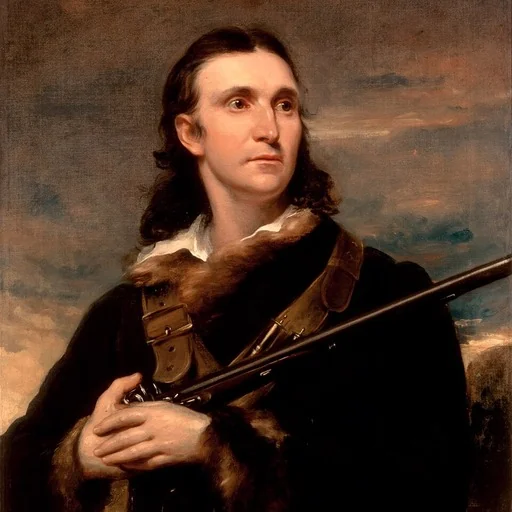
Artist
John James Audubon (born Jean-Jacques Rabin, April 26, 1785 – January 27, 1851) was a French-American artist, entrepreneur, naturalist, explorer, and ornithologist.

Museum
Crystal Bridges Museum of American Art
Continue through works from the same source collection.