Artwork
Hermit Thrush
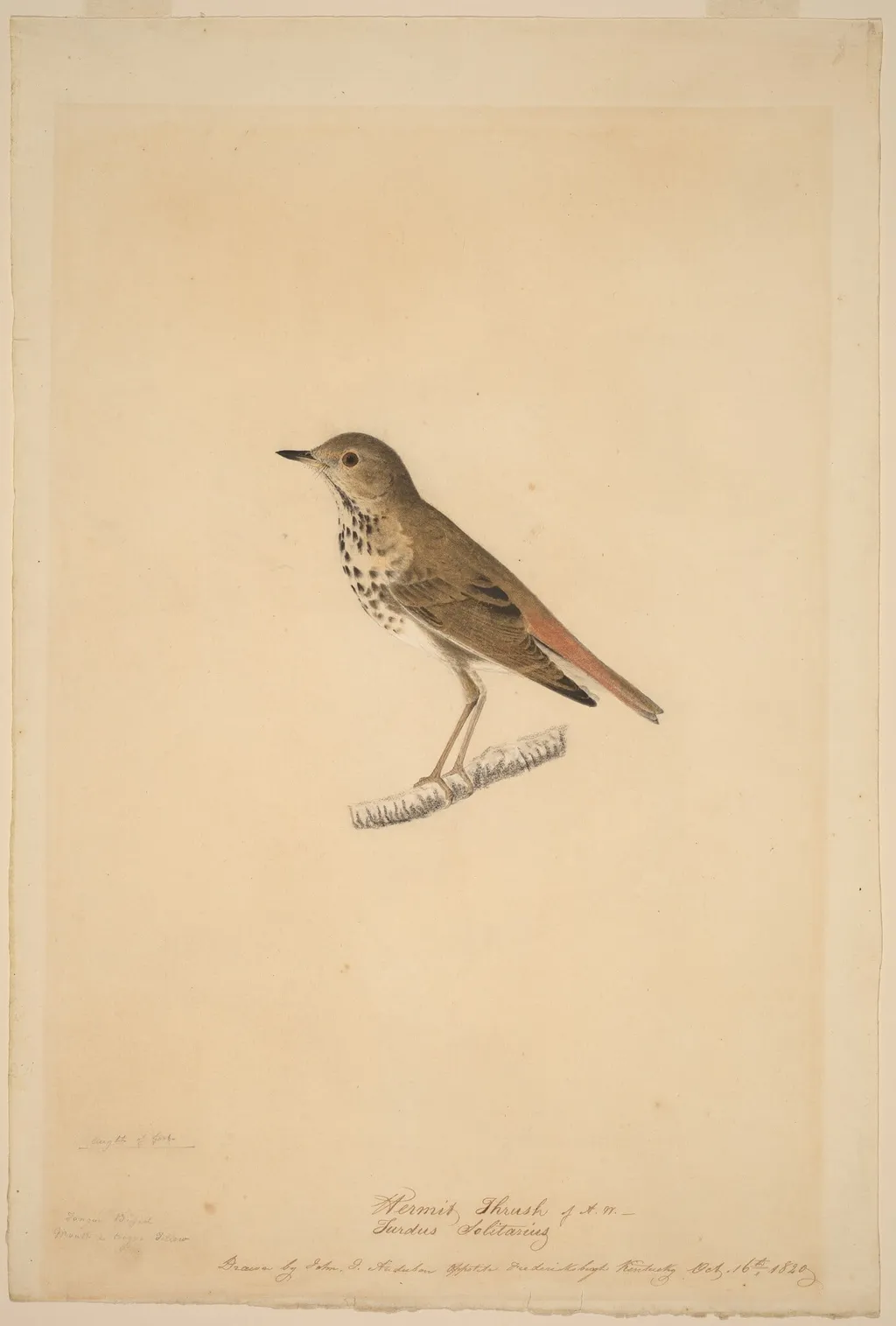
Hermit Thrush is a chalk drawing by the Romanticist artist John James Audubon. It dates from 1820 and is held in the collection of the National Gallery of Art.
About this work
Its chest is pale, almost white, and its tail feathers fan out in soft red-brown.
This bird sits alone on a branch, its brown back speckled with darker spots. Its chest is pale, almost white, and its tail feathers fan out in soft red-brown. The background is plain, letting the bird stand out clearly.
The artist wrote the bird’s name in neat script: *Hermit Thrush*. The date and place—*Kentucky, Oct. 16, 1820*—are tucked in the corner like a quiet note.
Next, check out watercolor, glazing to see how artists build up light and color.
Overview
Created in 1820, this drawing by John James Audubon captures a Hermit Thrush using black chalk, watercolor, and gouache over graphite underpinnings. Executed in Kentucky, the work reflects his method of direct observation in the field. Unlike later engraved plates, this original study prioritizes immediacy and tactile detail, preserving the artist’s hand in every stroke and wash.
Subject & Meaning
The Hermit Thrush is rendered in quiet solitude, perched on a bare branch against an unadorned background. Its speckled brown back and pale, nearly luminous underparts are rendered with precision, emphasizing its natural form rather than symbolic meaning. The inclusion of the date and location suggests a record of presence, aligning the image with Audubon’s broader project of documenting avian life as it existed in its habitat.
Technique & Style
Audubon layered graphite for structure, then applied black chalk for definition and depth, followed by translucent watercolor glazes to build subtle tonal shifts. Gouache added opacity to key areas like the eye and beak, enhancing contrast. The restrained palette and lack of background detail focus attention on the bird’s anatomy, revealing his commitment to anatomical accuracy through layered, deliberate mark-making.
History & Provenance
This drawing predates the publication of *The Birds of America* and likely served as a preparatory study. It was made during Audubon’s travels through the American frontier, where he sketched specimens from life. Its survival as an original sheet offers insight into his working process before engravings transformed the images for mass reproduction.
Context
In the early 19th century, ornithology relied heavily on specimen collection and hand-drawn records. Audubon’s practice of drawing birds in lifelike poses, often from freshly killed specimens, broke from static, museum-style depictions. His field notes and sketches, like this one, helped shift scientific illustration toward dynamic naturalism grounded in direct experience.
Legacy
Though widely known for his engraved volumes, Audubon’s original drawings reveal the intimacy of his observational process. This work exemplifies how scientific documentation and artistic discipline converged in his practice. Today, such studies are valued not only for their biological accuracy but as artifacts of early American natural history and the material culture of field observation.
Artist & collection
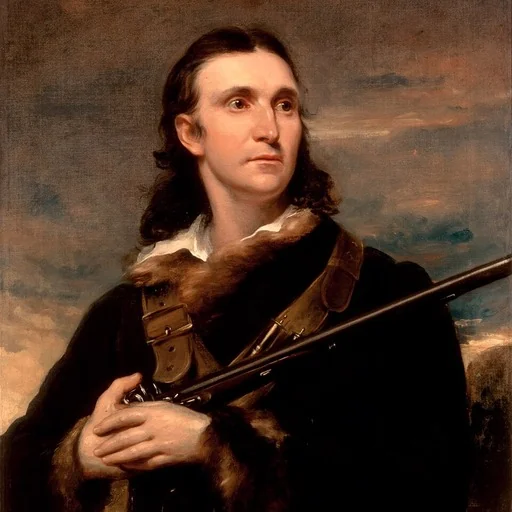
Artist
John James Audubon (born Jean-Jacques Rabin, April 26, 1785 – January 27, 1851) was a French-American artist, entrepreneur, naturalist, explorer, and ornithologist.