Artwork
Stanmer Church, Sussex
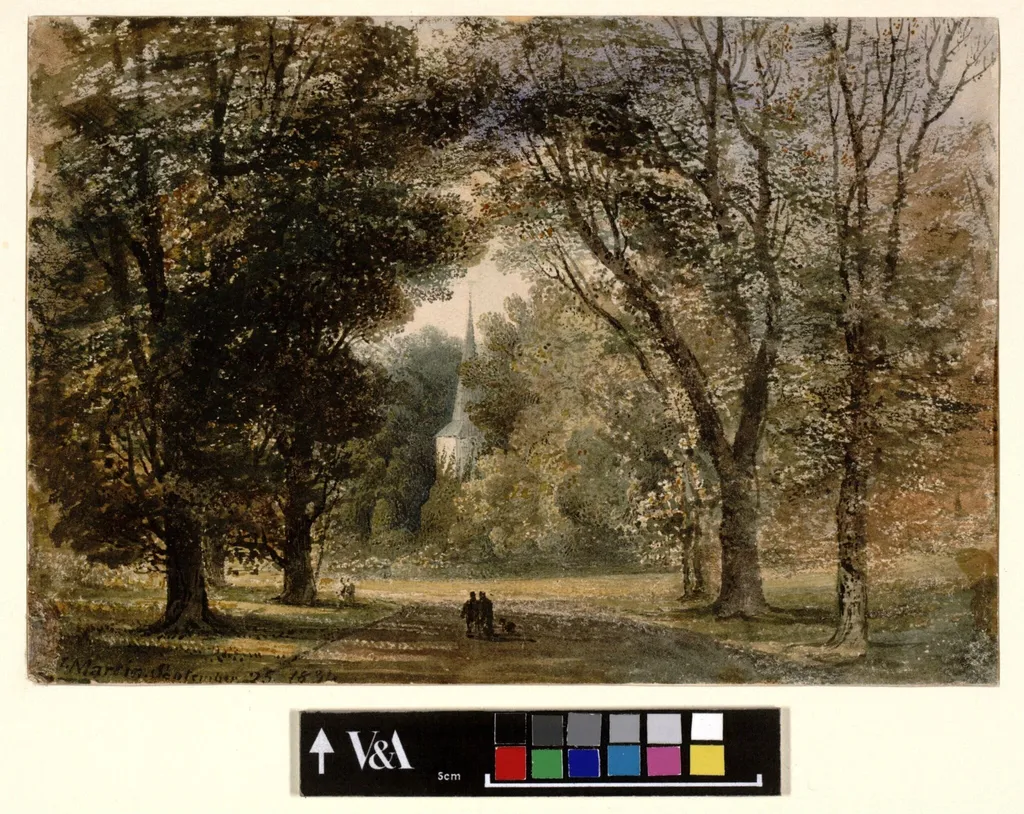
Stanmer Church, Sussex is a watercolor work on paper by the Romanticist artist John Martin. It dates from 17 and is held in the collection of the Victoria and Albert Museum.
About this work
This watercolour shows a church in Stanmer Park, Sussex. It’s painted by John Martin in 1834. Martin often chose dramatic subjects for his landscapes.
The church in the painting is older. It survived until 1838 when the Earl ordered a rebuild. That date matches the painting’s year, so it shows the original building.
Look up the Victoria and Albert Museum.
Overview
John Martin created this watercolour in 1834, depicting a church located in Stanmer Park, Sussex. The work captures the structure before its demolition in 1838, when the 3rd Earl of Chichester commissioned a replacement in the Early English style. Martin’s precise date on the piece confirms it records the earlier building, offering a visual record of a structure soon to vanish.
Subject & Meaning
The painting presents a modest parish church surrounded by rural landscape, devoid of overt drama or grandeur—unusual for Martin, who typically favored apocalyptic or monumental scenes. Its quiet composition suggests a documentary intent, preserving the appearance of a local place of worship before its transformation. The absence of figures or narrative emphasizes the building’s quiet endurance.
Technique & Style
Executed in watercolour, the work displays Martin’s controlled brushwork and attention to architectural detail. Soft washes define the church’s stone surfaces and surrounding foliage, while precise lines outline the tower and windows. The muted palette and restrained composition reflect a shift from his more theatrical landscapes, favoring topographical accuracy over emotional intensity.
History & Provenance
It entered the Victoria and Albert Museum’s collection, where it remains as a historical document of architectural change in early Victorian England.
The church depicted was demolished in 1838 to make way for a new structure commissioned by Henry Thomas Pelham, the 3rd Earl of Chichester. Martin’s painting, dated 25 September 1834, is among the few surviving visual records of the original building. It entered the Victoria and Albert Museum’s collection, where it remains as a historical document of architectural change in early Victorian England.
Context
In the 1830s, many rural churches across England were rebuilt or renovated under the influence of the Gothic Revival. The Earl’s decision to replace Stanmer’s medieval-style church with an Early English design reflected broader ecclesiastical trends. Martin’s watercolour captures the moment just before this transition, preserving a vernacular form that was rapidly becoming obsolete.
Legacy
Though not among Martin’s most famous works, this watercolour holds value as a precise record of a lost building. It provides insight into the architectural landscape of Sussex before large-scale Victorian renovations. Its survival in a major public collection ensures its continued use as a reference for local history and architectural study.
Artist & collection

Artist
John Martin (19 July 1789 – 17 February 1854) was an English Romanticist painter, engraver, and illustrator.







 Windsor Castle from the Great Park, near the End of the Long Walk
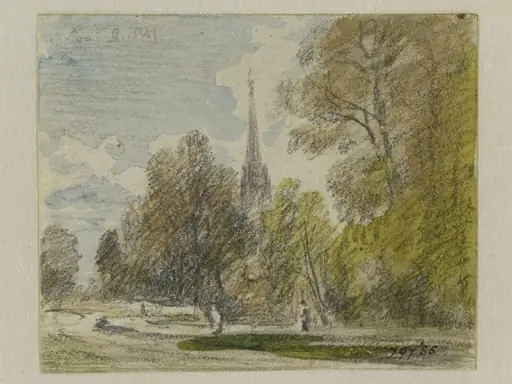 Salisbury Cathedral with trees
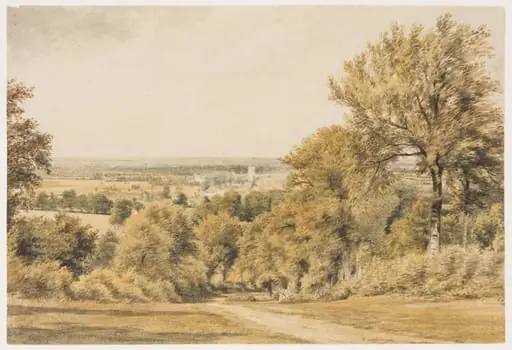 Edgware
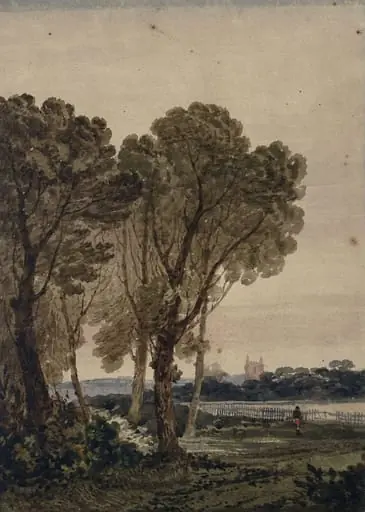 Landscape with church
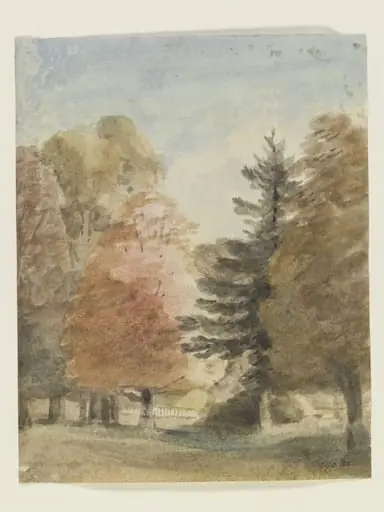 Study of trees in a park, perhaps Helmingham Park
 Forest landscape, sketch
 Woodland scene
 A Road in Wales
 Easton Park
 Landskab ved Fredensborg
 Pleasant Valley, New Jersey
 Long Melford Green on a Frosty Morning, Suffolk