Artwork
Budding Sycamore
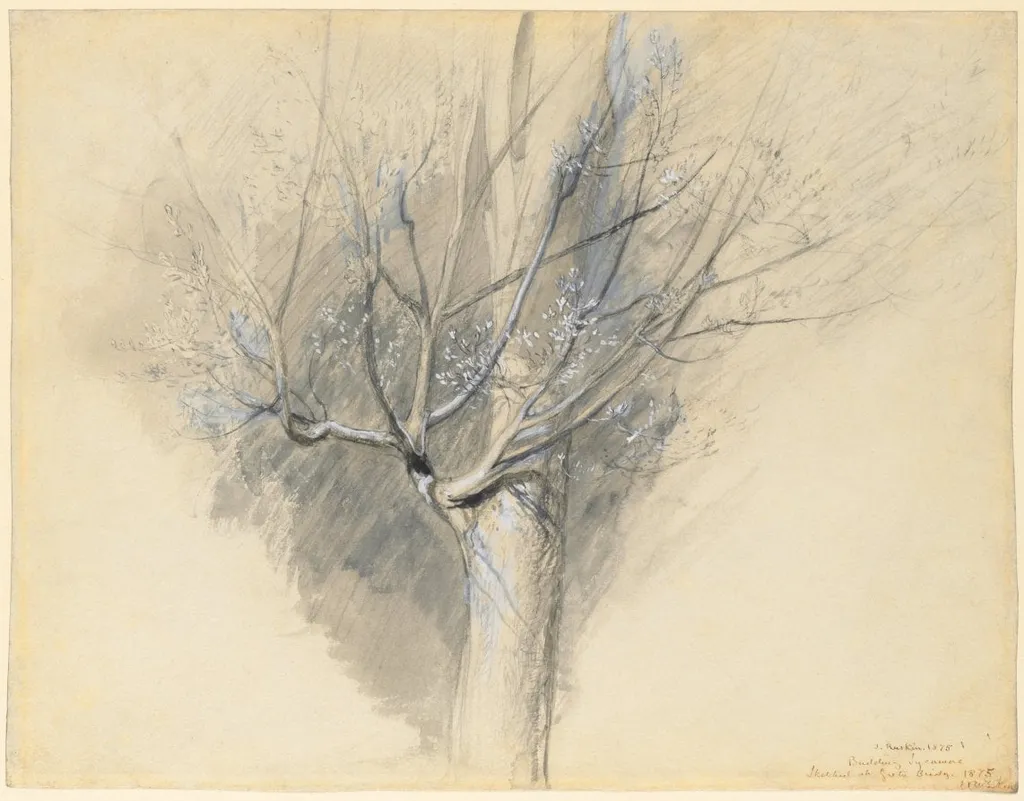
Budding Sycamore is a drawing by the Impressionist artist John Ruskin. It dates from 1876 and is held in the collection of the Cleveland Museum of Art.
About this work
You see a single sycamore branch in early spring, leaves just unfurling in soft green.
Ruskin drew this to teach others how to look. He believed nature’s smallest details held the biggest truths. The edges blur on purpose—he wanted the focus on the leaf, not the frame.
To see more of his careful studies, look up John Ruskin (British, 1819–1900).
Overview
John Ruskin, a leading 19th-century British critic, approached drawing not as mere illustration but as a disciplined act of perception.
John Ruskin, a leading 19th-century British critic, approached drawing not as mere illustration but as a disciplined act of perception. His sketches, including this sycamore study, emerged from a lifelong habit of close observation. He treated every leaf and twig as a subject worthy of rigorous attention, believing that careful rendering could reveal deeper truths about nature’s structure and vitality.
Subject & Meaning
The drawing captures a single sycamore branch in early spring, its young leaves just beginning to unfurl in pale green. Ruskin focused on this modest fragment not for its beauty alone, but as a vessel for understanding natural processes. He saw such details as keys to larger truths—each vein and curve a reflection of universal order, accessible only through patient, unmediated looking.
Technique & Style
Ruskin employed fine, precise lines to define the leaf’s form, while allowing the background to dissolve into soft, indeterminate tones. The edges of the composition are intentionally left unresolved, directing attention inward toward the subject’s texture and growth. This method avoided decorative finish in favor of observational honesty, prioritizing the experience of seeing over polished presentation.
History & Provenance
This drawing is one of many made during Ruskin’s extensive travels and field studies, primarily between the 1830s and 1850s. Created as part of his pedagogical practice, it was likely used to demonstrate his methods to students and followers. Many such studies were later compiled into his instructional writings, forming the basis of his broader philosophy of art and nature.
Context
In an era increasingly shaped by industrialization and photographic reproduction, Ruskin insisted on the irreplaceable value of hand-drawn observation. His work stood in contrast to mechanical reproduction, emphasizing the moral and intellectual discipline required to truly see. For him, drawing was not an artistic luxury but a form of ethical engagement with the natural world.
Legacy
Ruskin’s detailed botanical studies influenced generations of artists and educators who sought to reconnect art with direct experience. Though his critical writings overshadowed his drawings in public memory, his approach to observation—focusing on the small, the transient, the unembellished—remains a touchstone for those who value slow, attentive looking as a form of knowledge.
Artist & collection

Artist
John Ruskin was an English polymath – a writer, lecturer, art historian, art critic, draughtsman and philanthropist of the Victorian era.

![Grove of Trees [verso], by Friedrich Salathé](https://artifactworldgallery.com/img/friedrich-salathe--grove-of-trees-verso--4013b539bd981a94-w320.webp)