Artwork
Wood Interior
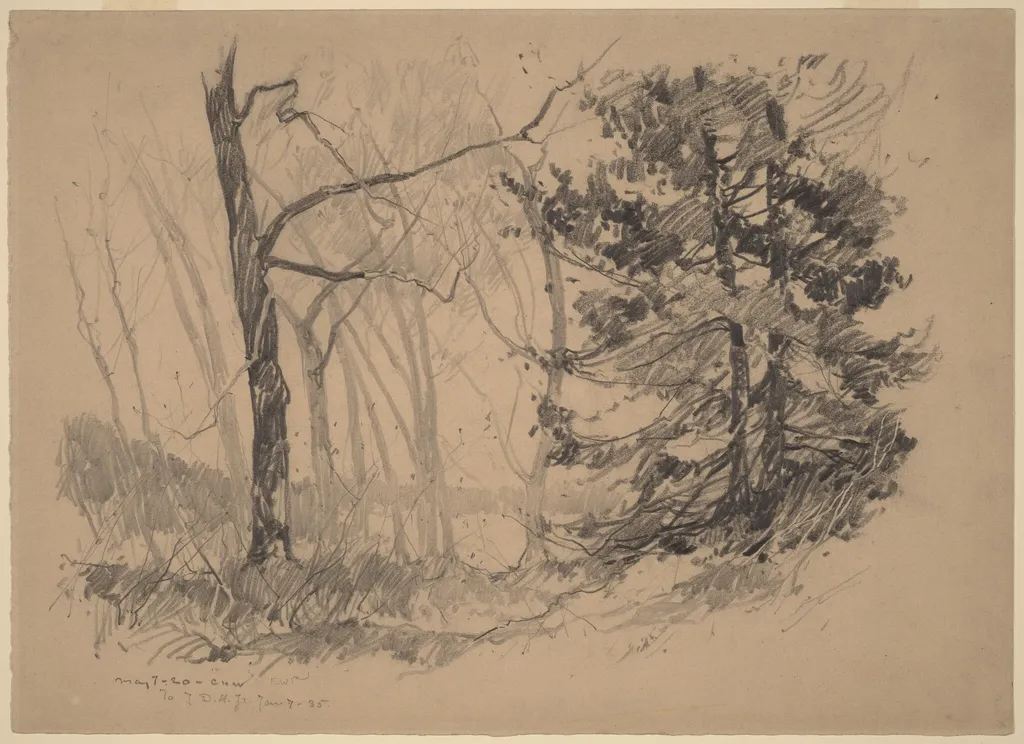
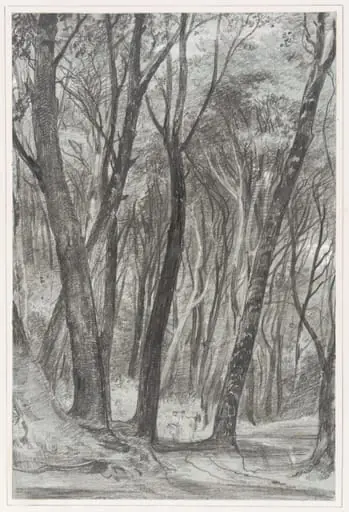
Wood Interior is a graphite drawing by Charles H. Woodbury. It dates from 1920 and is held in the collection of the National Gallery of Art. Charles H.
About this work
The artist dated it 1920 in the corner, but the style feels loose and fast.
This sketch shows a tangle of bare trees and brush in a forest. The lines are rough and uneven, like quick pencil strokes. Shadows and light mix in a soft way, making some spots darker than others.
The artist dated it 1920 in the corner, but the style feels loose and fast. It’s all drawn in graphite, with no color.
Want to see more work like this? Check out Woodbury, Charles H. for similar sketches.
Overview
Charles H. Woodbury created this graphite drawing in 1920, capturing the interior of a wooded area with minimal detail and rapid, unrefined strokes. The work is uncolored and entirely executed in pencil, emphasizing texture and movement over precision. Its informal quality suggests it was made outdoors, likely as a direct response to the scene before him, rather than a polished studio piece.
Subject & Meaning
The drawing depicts a dense thicket of bare trees and underbrush, rendered without clear focal points or narrative cues. The tangled forms suggest the quiet, unstructured growth of a forest in winter or early spring. There is no human presence or symbolic element—only the raw, unmediated observation of natural growth, conveying a sense of solitude and organic disorder.
Technique & Style
Woodbury used graphite to build tone through layered, uneven lines that vary in pressure and direction. Shadows emerge not from shading but from dense clusters of strokes, while lighter areas are left sparse or blank. The sketch’s energy comes from its immediacy—lines are hesitant, overlapping, and sometimes abandoned, reflecting a spontaneous, on-site process rather than deliberate composition.
History & Provenance
Dated by the artist in 1920, the drawing remains unsigned and undated in any formal record beyond the inscription on the sheet. Its survival suggests it was kept among personal studies rather than intended for public display. No documented exhibition or ownership history is known prior to its current location, indicating it was likely retained by the artist or his immediate circle.
Context
In the early 20th century, many American artists turned to direct observation of nature as a counter to academic traditions. Woodbury, known for his coastal sketches, applied this same approach to inland woodlands. This drawing aligns with a broader trend among illustrators and educators who valued the expressive potential of quick, unvarnished pencil work over finished compositions.
Legacy
Though not widely exhibited, this drawing exemplifies Woodbury’s commitment to capturing transient natural forms through direct observation. Its informal character influenced later generations of art students who studied under him, reinforcing the value of sketching as a tool for perception rather than presentation. It remains a quiet testament to his pedagogical and artistic priorities.
Own this work as a print
Artist & collection


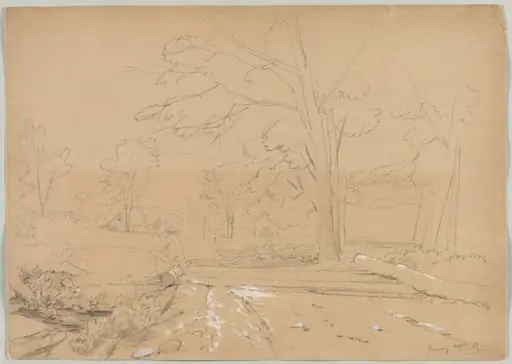 Landscape with Man Fishing, Conway, New Hampshire
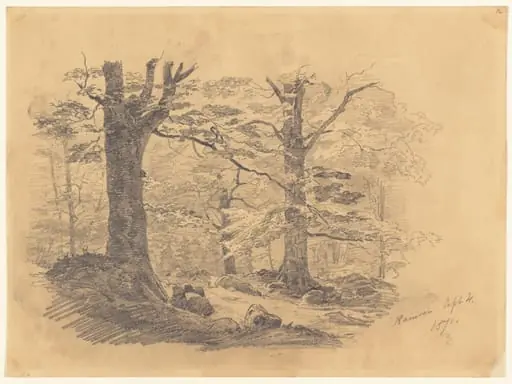 Forest, Ramsau, Germany
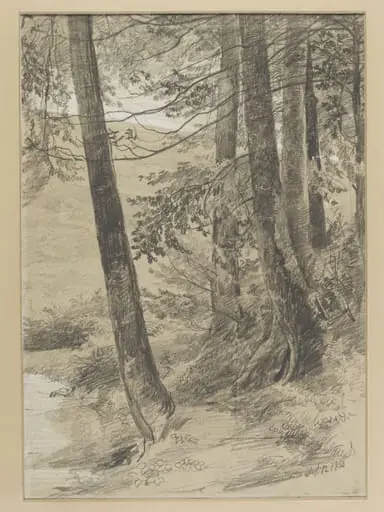 Study of tree stems at King George's Hill, Abinger
 Munich Factory
 Edge of a Wood
 A Great Beech Tree at the Edge of a Wood
 Small Lake (Le petit lac)
 Trees in a Field
 Simsbury, Connecticut
 Wooded Landscape
 The Edge of a Wood at Nohant
 Study of trees, Wotton Woods, Abinger