Artwork
Liber Studiorum: Windmill and Lock
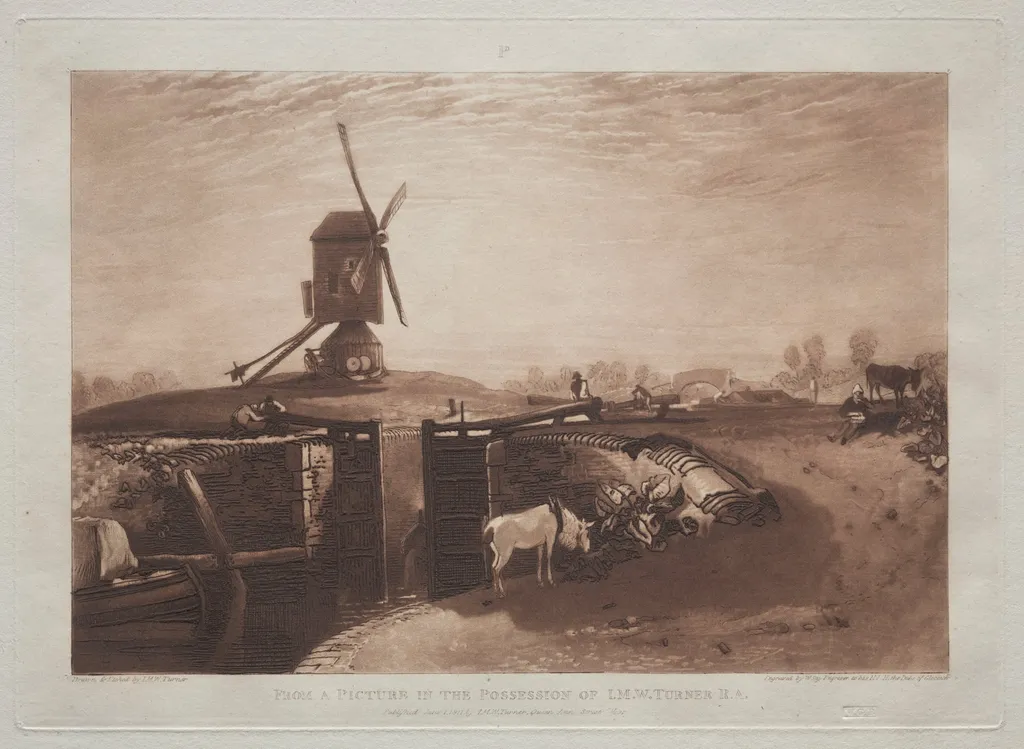
Liber Studiorum: Windmill and Lock is a print by Joseph Mallord William Turner. It dates from 1823 and is held in the collection of the Cleveland Museum of Art.
About this work
Overview
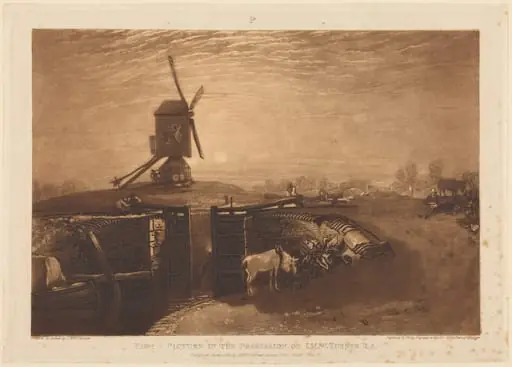
Created around 1823, *Liber Studiorum: Windmill and Lock* is one of seventy prints in Joseph Mallord William Turner’s ambitious series designed to classify landscape art into six thematic categories. Executed in mezzotint and etching, this work exemplifies Turner’s shift toward expressive, atmospheric composition over topographical precision, reflecting his broader exploration of nature’s emotional resonance.
Subject & Meaning
The scene depicts a windmill standing prominently beside a canal lock, a pairing that suggests human intervention within the natural landscape.
The scene depicts a windmill standing prominently beside a canal lock, a pairing that suggests human intervention within the natural landscape. The windmill, central and illuminated, symbolizes industry and endurance, while the lock, partially obscured in shadow, implies quiet utility. Together, they evoke a harmonious yet unromanticized rural economy, grounded in function rather than idealized beauty.
Technique & Style
Turner employed chiaroscuro to model form and direct attention, using deep shadows to anchor the lock and surrounding terrain while leaving the windmill’s sails and upper structure bathed in graded light. The print’s tonal range, achieved through meticulous mezzotint work, conveys atmospheric depth without relying on line or detail, anticipating later explorations of light as an independent subject.
History & Provenance
The *Liber Studiorum* series was conceived by Turner as a scholarly project to elevate printmaking to the status of fine art. He produced these plates himself, often reworking them over years. *Windmill and Lock* was published in 1823 as part of the second group of prints, and early impressions were distributed to patrons and artists, influencing contemporaries and later generations of printmakers.
Context
In the early 1820s, Turner was moving away from traditional topographical landscape toward more subjective interpretations of nature. The *Liber Studiorum* series responded to academic hierarchies that privileged history painting, asserting that landscape could convey moral and poetic ideas. This print reflects his engagement with Enlightenment thought and the industrial transformation of the British countryside.
Legacy
Though not widely recognized in his lifetime as revolutionary, Turner’s *Liber Studiorum* laid groundwork for later movements by prioritizing mood over detail and light over form. The series influenced 19th-century European printmakers and, indirectly, Impressionist and modernist artists who sought to capture transient effects rather than fixed scenes.
Artist & collection
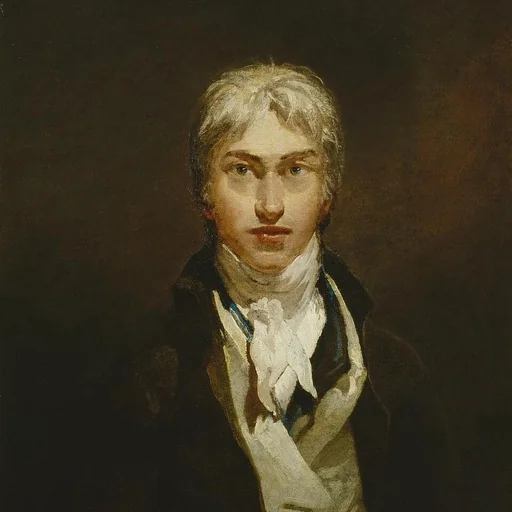
Artist
Joseph Mallord William Turner was born in 1775 at Maiden Lane, Covent Garden, where his father kept a barber and wig-making shop.