Artwork
España y Filipinas
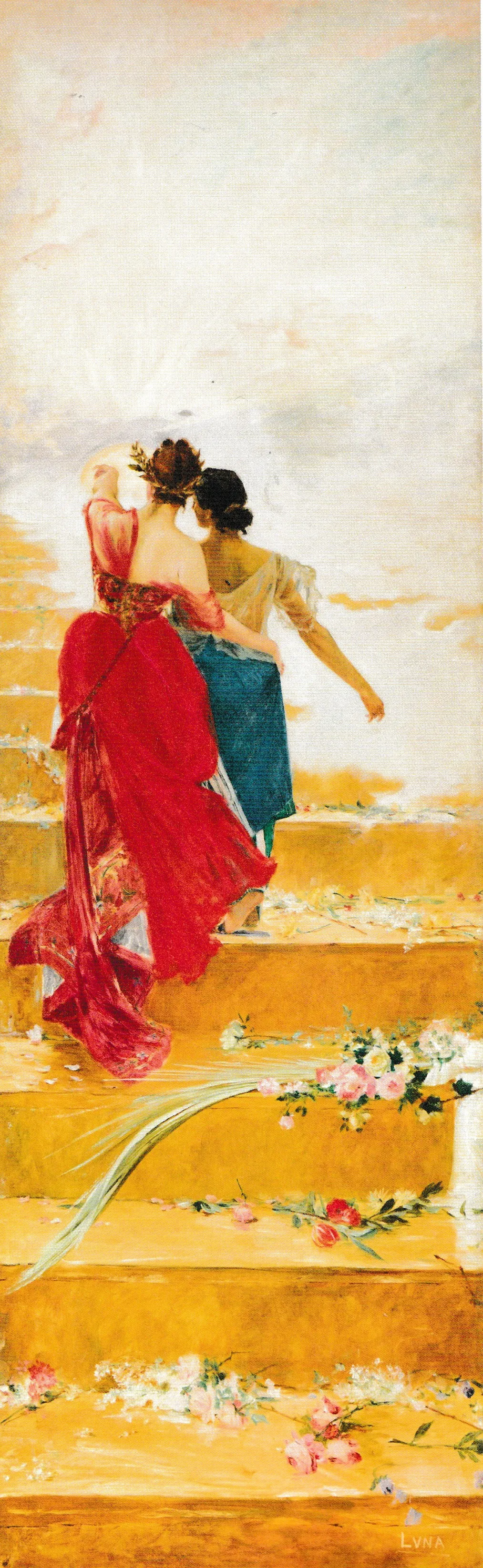
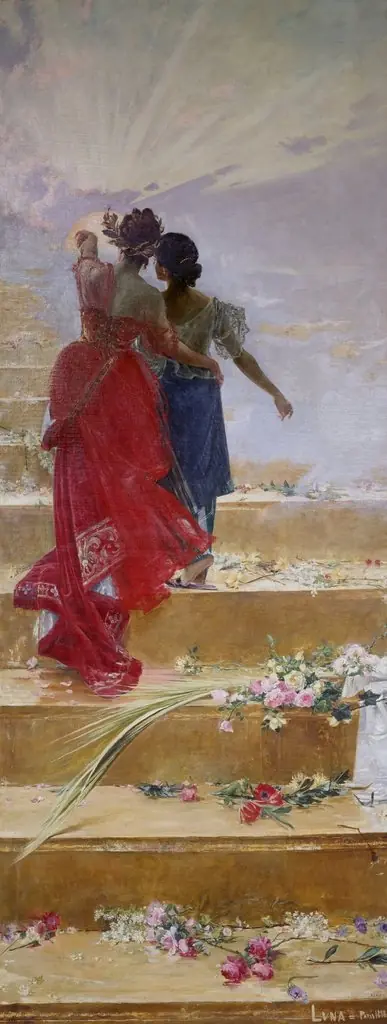
España y Filipinas is an oil painting by the Post-Impressionist artist Juan Luna. It dates from 1894 and is held in the collection of the Lopez Museum.
About this work
Overview
The composition places the women on a sun‑lit terrace, their backs turned toward the viewer as they walk together.
Juan Luna’s España y Filipinas is an oil on canvas work that presents an allegorical scene of two female figures. The composition places the women on a sun‑lit terrace, their backs turned toward the viewer as they walk together. One figure is dressed in a vivid red gown with a patterned shawl, while the other wears a modest beige attire. The setting includes a low wall adorned with pink and white blossoms and pale, cloud‑dotted sky.
Subject & Meaning
The painting personifies Spain and the Philippines as women, suggesting a relationship of guidance or partnership. The brighter, more elaborate costume of the red‑clad figure has traditionally been interpreted as representing Spain, while the simpler attire of the companion symbolizes the Philippines. The shared movement along the terrace conveys a narrative of mutual journey or destiny.
Technique & Style
Luna employs a smooth, academic brushwork characteristic of 19th‑century European painting, rendering the figures with careful modeling and subtle chiaroscuro. The bright palette—particularly the saturated red and warm yellows of the steps—contrasts with the softer pastel sky, creating a balanced visual harmony. The decorative floral motif on the wall adds a decorative, almost ornamental quality to the scene.
History & Provenance
Created by the Filipino painter and revolutionary Juan Luna during the late 1800s, the work reflects his engagement with both European artistic training and nationalist sentiment. It has been catalogued under alternative titles such as España llevando a la gloria a Filipinas and España Guiando a Filipinas, reflecting its allegorical intent. The painting remains part of collections that document Luna’s contribution to Philippine art history.
Context
Luna produced the piece while navigating the cultural tensions of Spanish colonial rule over the Philippines. The allegorical format allowed him to comment on the political relationship without overtly confronting colonial authority, a strategy common among Ilustrado artists who blended European techniques with local themes.
Legacy
España y Filipinas is frequently cited as a lasting example of Luna’s ability to merge academic style with Filipino subject matter. The work continues to be referenced in discussions of colonial-era visual culture and serves as a visual record of the complex ties between Spain and the Philippines during the period.
Artist & collection
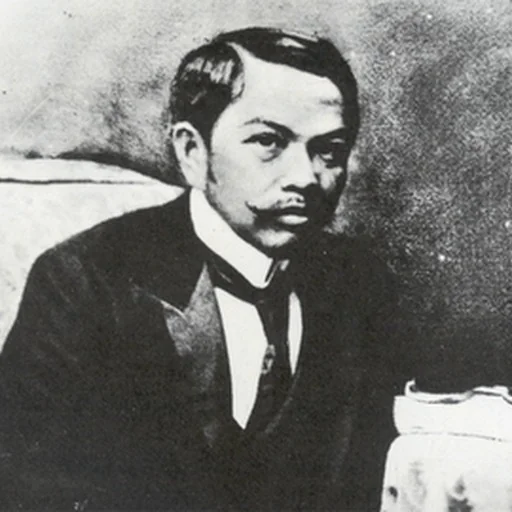
Artist
Juan Luna de San Pedro y Novicio (Spanish: , Tagalog: ; October 25, 1857 – December 7, 1899) was a Filipino painter, sculptor and a political activist of the Philippine Revolution during the late 19th century.