Artwork
葛飾北斎画 桔梗に蜻蛉|Dragonfly and Bellflower
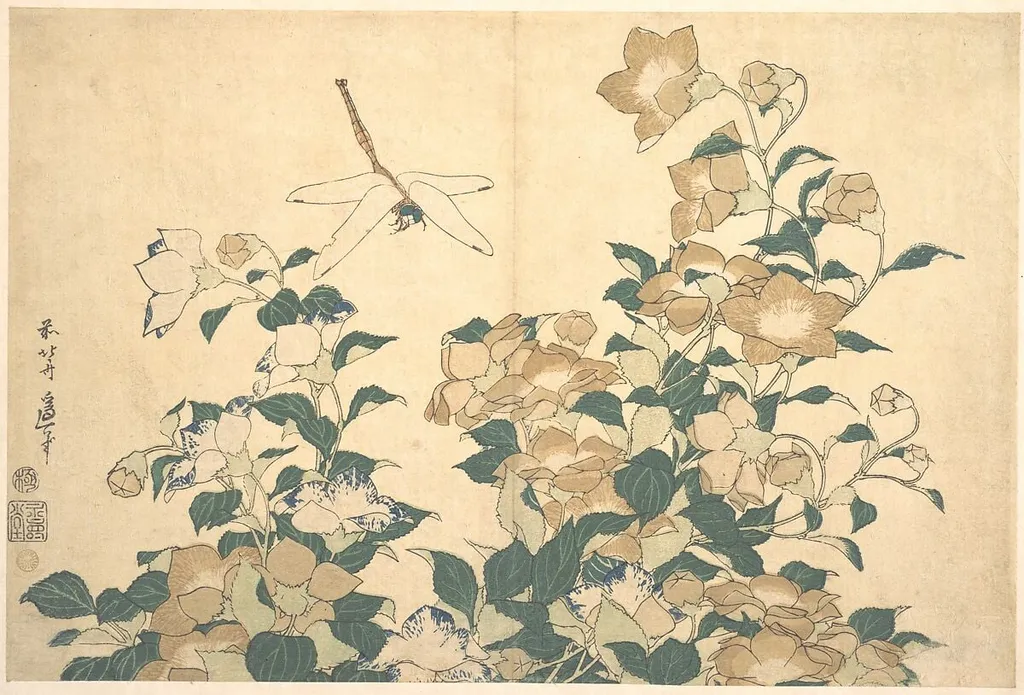
葛飾北斎画 桔梗に蜻蛉|Dragonfly and Bellflower is an ink print by the Japonisme artist Katsushika Hokusai. It dates from 1824 and is held in the collection of the Metropolitan Museum of Art.
About this work
Overview
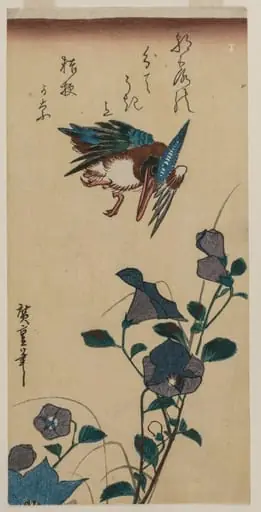
Created around 1824, this surimono woodblock print by Katsushika Hokusai depicts a dragonfly hovering above two clusters of bellflowers. Executed in ink and color on paper, the composition is held in the collection of The Metropolitan Museum of Art. The image balances a delicate botanical study with the fleeting presence of an insect, characteristic of Hokusai’s interest in natural subjects.
Subject & Meaning
The central motif features a dragonfly in mid‑flight, its slender body and outstretched wings rendered with fine detail. Below, two bellflower heads display rounded petals in muted brown‑green tones, set against dark, gently undulating leaves. The juxtaposition of the insect’s motion against the static flowers evokes a momentary encounter in nature, highlighting transience and observation.
Technique & Style
Precise line work defines the dragonfly’s anatomy, while the bold outlines of the blossoms create a clear spatial hierarchy within the limited format.
Hokusai employs the surimono technique, a privately commissioned woodblock print noted for its refined execution. The palette is restrained, relying on a limited range of pigments that emphasize contrast between the dark foliage and the lighter flower petals. Precise line work defines the dragonfly’s anatomy, while the bold outlines of the blossoms create a clear spatial hierarchy within the limited format.
History & Provenance
The print was produced during Hokusai’s prolific Edo period career, a time when surimono were often created for poetry societies and special occasions. It entered the collection of The Metropolitan Museum of Art through acquisition in the early twentieth century, where it remains catalogued as an example of Hokusai’s lesser‑known botanical and insect studies.
Context
In the early nineteenth century, Japanese artists frequently explored natural motifs in response to both domestic aesthetic traditions and the growing popularity of ukiyo‑e prints. Hokusai’s work reflects this trend, integrating scientific observation with artistic stylization. The dragonfly and bellflower motif also appears in contemporary poetry and seasonal symbolism, linking the image to broader cultural associations of summer and fleeting beauty.
Artist & collection

Artist
Katsushika Hokusai spent his life in Edo, now Tokyo, where he drew and carved prints for a living.