Artwork
Danish Farm with Manor House
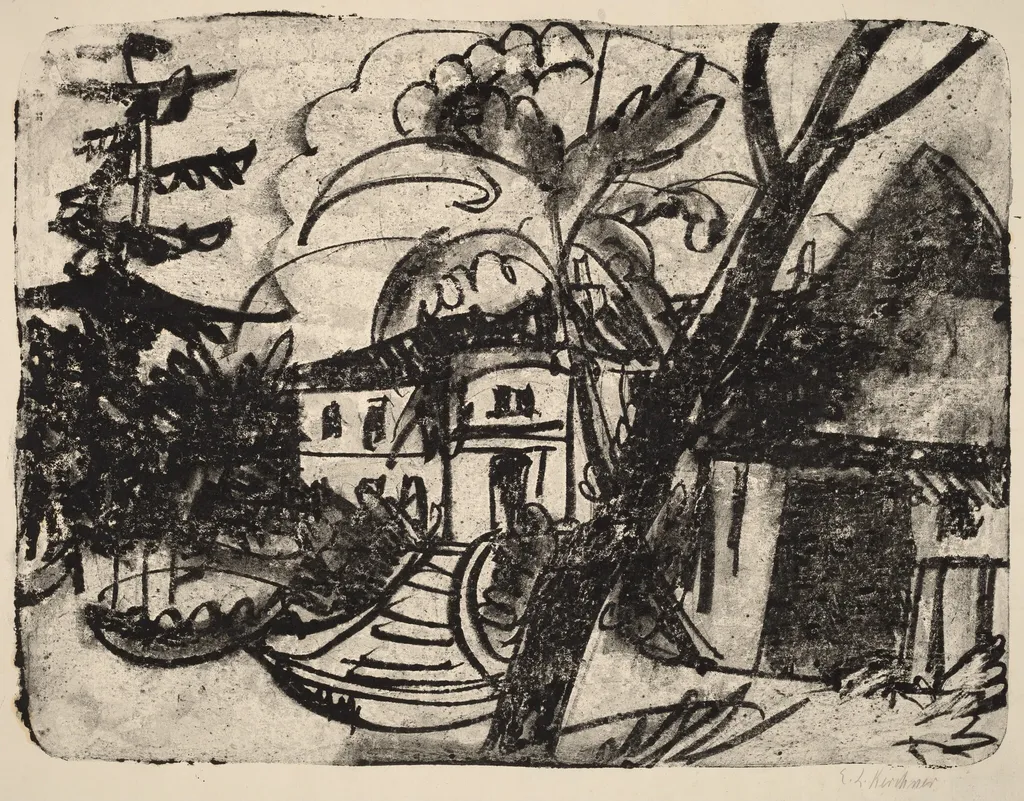
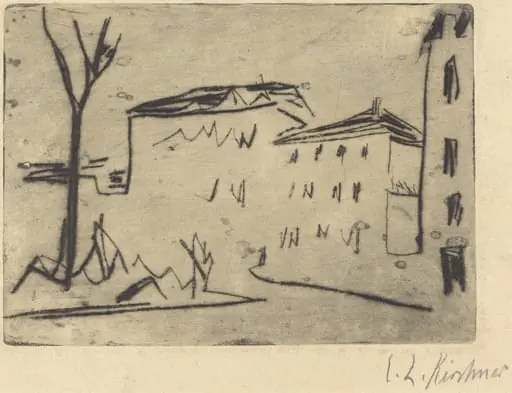
Danish Farm with Manor House is an ink print by Ernst Ludwig Kirchner. It dates from 1912 and is held in the collection of the National Gallery of Art.
About this work
Overview
Its stark monochrome palette and energetic lines reflect Kirchner’s interest in simplifying form to convey psychological presence.
Ernst Ludwig Kirchner produced this black lithograph in 1912 during his time in Germany, before the upheavals of World War I. As a co-founder of Die Brücke, he was deeply invested in printmaking as a medium for direct, emotional expression. The work captures a rural Danish farmstead with minimal detail, emphasizing structure and atmosphere over realism. Its stark monochrome palette and energetic lines reflect Kirchner’s interest in simplifying form to convey psychological presence.
Subject & Meaning
The composition centers on a manor house surrounded by sparse vegetation, set against an open, almost barren landscape. The building, rendered with angular outlines, appears isolated and enduring, while the sprawling foreground tree dominates the lower half, its limbs reaching outward like gestures of tension or protection. The absence of human figures and the muted environment suggest a quiet, introspective mood—perhaps reflecting Kirchner’s own sense of displacement or contemplation of rural life amid modernizing Europe.
Technique & Style
Executed in black lithography, the image relies on bold, uneven lines and textured washes to define form. Kirchner’s hand is evident in the deliberate roughness—lines are jagged, contours uneven, and spatial depth suggested through overlapping shapes rather than perspective. The lack of tonal gradation heightens the graphic intensity, aligning with Die Brücke’s rejection of academic naturalism in favor of expressive immediacy. The print’s raw quality mirrors the urgency of its execution.
History & Provenance
Created in 1912, the lithograph emerged from Kirchner’s active period in Dresden and later Moritzburg, where he and Die Brücke members frequently explored rural surroundings for subject matter. Though the title references Denmark, the scene likely stems from German countryside visits. The work entered circulation through Kirchner’s print publications and later collections, preserving its place in early 20th-century German printmaking archives without notable gaps in documented ownership.
Context
In the years before World War I, Kirchner and his peers sought to break from traditional representation, drawing inspiration from folk art, non-Western sculpture, and the emotional power of spontaneous mark-making. This lithograph aligns with broader Expressionist aims: distilling nature into essential forms to evoke inner states. The rural setting, common in Die Brücke’s output, served as both refuge and metaphor—a space removed from urban alienation yet charged with existential stillness.
Legacy
Kirchner’s lithographs, including this one, helped redefine printmaking as a vehicle for modernist expression rather than mere reproduction. The work’s emphasis on line, emotional tone, and structural simplification influenced later generations of artists exploring abstraction and psychological landscape. Though less celebrated than his paintings, this print remains a key example of how print media became integral to Expressionism’s visual language.
Artist & collection
Artist
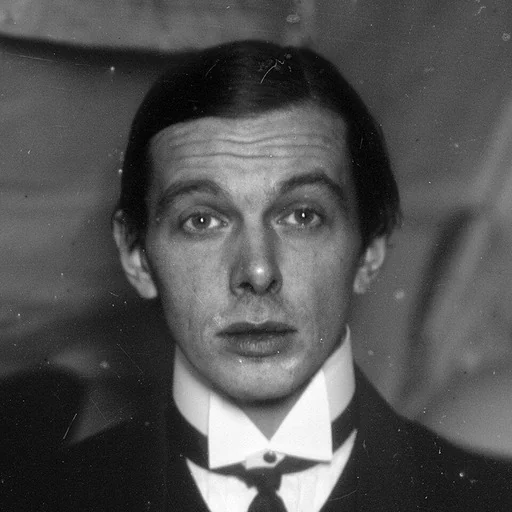
Ernst Ludwig Kirchner (6 May 1880 – 15 June 1938) was a German expressionist painter and printmaker.

![Dance Hall Bellevue [obverse], by Ernst Ludwig Kirchner](https://artifactworldgallery.com/img/ernst-ludwig-kirchner--dance-hall-bellevue-obverse--d1e14aac4297c69e-w320.webp)
![Nude Figure [reverse], by Ernst Ludwig Kirchner](https://artifactworldgallery.com/img/ernst-ludwig-kirchner--nude-figure-reverse--4b135f0364753e98-w320.webp)
![Two Nudes [obverse], by Ernst Ludwig Kirchner](https://artifactworldgallery.com/img/ernst-ludwig-kirchner--two-nudes-obverse--eb3914183f0bc96d-w320.webp)
![Dancing Couple in the Snow [reverse], by Ernst Ludwig Kirchner](https://artifactworldgallery.com/img/ernst-ludwig-kirchner--dancing-couple-in-the-snow-reverse--87ca007d7c05b553-w320.webp)