Artwork
Girl, with Another Rubbing Her Belly
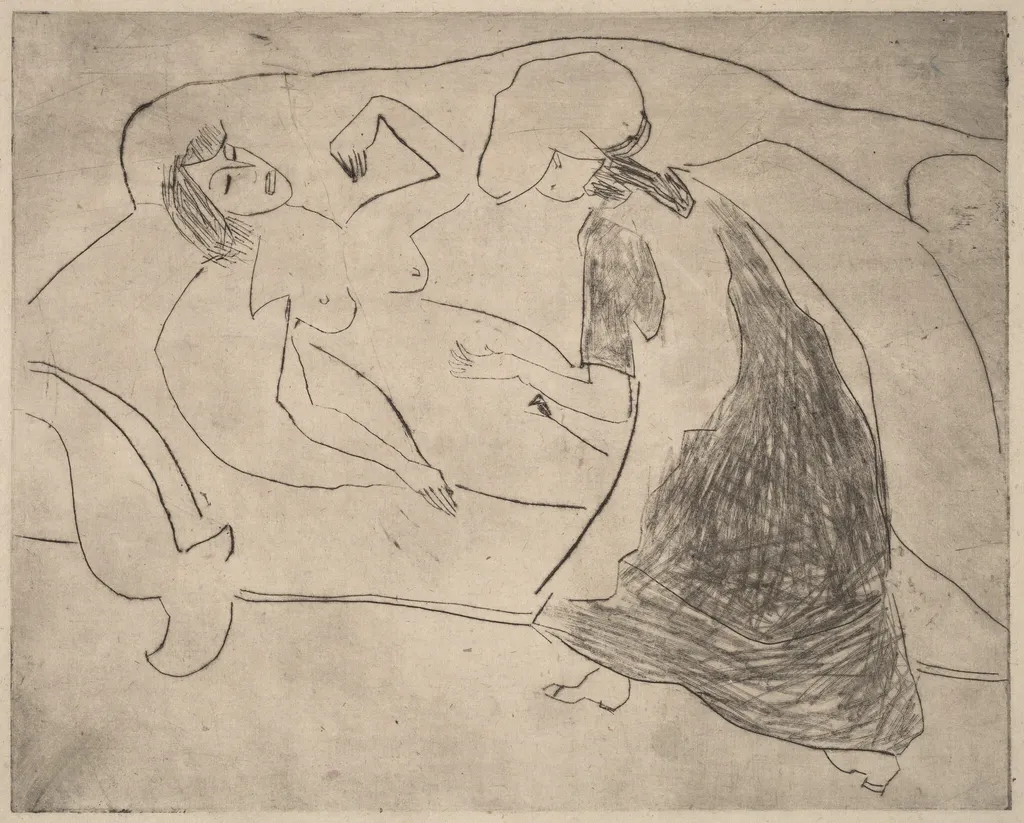
Girl, with Another Rubbing Her Belly is an ink print by Ernst Ludwig Kirchner. It dates from 1910 and is held in the collection of the National Gallery of Art.
About this work
Overview
The work is a small-scale, intimate study executed by scratching directly into a metal plate, producing lines that retain the immediacy of sketching.
Ernst Ludwig Kirchner created this drypoint print in 1910, during his active years with the German Expressionist group Die Brücke. The work is a small-scale, intimate study executed by scratching directly into a metal plate, producing lines that retain the immediacy of sketching. Unlike polished engravings, its raw texture reflects the group’s preference for emotional authenticity over technical refinement.
Subject & Meaning
Two women are depicted in a private, unidealized moment: one reclines while another gently touches her abdomen. The interaction suggests intimacy or care, but without narrative clarity. Kirchner avoids psychological exposition, instead focusing on physical presence and bodily proximity. The lack of facial detail and contextual setting shifts emphasis to gesture and form, aligning with Expressionism’s interest in inner states over external realism.
Technique & Style
Drypoint allowed Kirchner to create dense, uneven lines by incising the plate with a sharp tool, capturing the spontaneity of a drawn sketch. The reclining figure’s contours are smoother, contrasting with the agitated, wavy strokes defining the standing woman’s dress. The surface retains the grain of the plate, and the image appears deliberately unfinished—emphasizing process over completion, a hallmark of Die Brücke’s aesthetic.
History & Provenance
Created in 1910, this print emerged from Kirchner’s Berlin studio, where he and Die Brücke members experimented with printmaking as a vehicle for personal expression. It was likely produced in a small edition, common for artist-led print workshops of the time. While its early ownership is undocumented, it entered institutional collections in the mid-20th century as Expressionism gained scholarly recognition.
Context
In 1910, Kirchner was deepening his exploration of the human figure amid urban life and intimate relationships. Die Brücke artists rejected academic conventions, favoring raw lines and emotional intensity. This print reflects their engagement with non-Western art and modern life’s fragmented rhythms, positioning the body not as idealized form but as a site of lived experience and unmediated presence.
Legacy
Kirchner’s drypoints, including this work, helped redefine printmaking as a medium for expressive immediacy rather than reproduction. Though lesser known than his paintings, these intimate studies influenced later generations of artists who valued process and emotional honesty over polish. The piece remains a quiet example of how Expressionism transformed everyday gestures into visual language.
Artist & collection
Artist
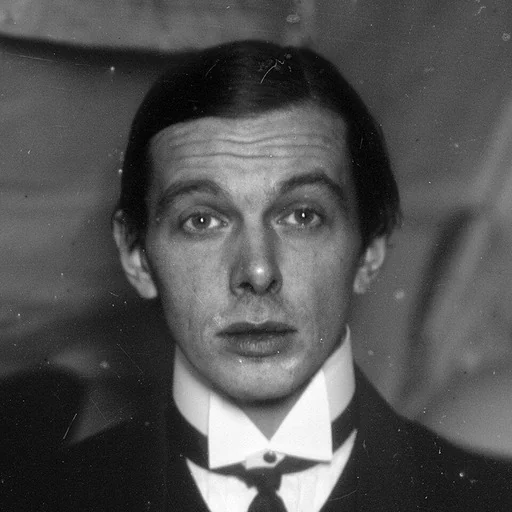
Ernst Ludwig Kirchner (6 May 1880 – 15 June 1938) was a German expressionist painter and printmaker.

![Dance Hall Bellevue [obverse], by Ernst Ludwig Kirchner](https://artifactworldgallery.com/img/ernst-ludwig-kirchner--dance-hall-bellevue-obverse--d1e14aac4297c69e-w320.webp)
![Nude Figure [reverse], by Ernst Ludwig Kirchner](https://artifactworldgallery.com/img/ernst-ludwig-kirchner--nude-figure-reverse--4b135f0364753e98-w320.webp)
![Two Nudes [obverse], by Ernst Ludwig Kirchner](https://artifactworldgallery.com/img/ernst-ludwig-kirchner--two-nudes-obverse--eb3914183f0bc96d-w320.webp)
![Dancing Couple in the Snow [reverse], by Ernst Ludwig Kirchner](https://artifactworldgallery.com/img/ernst-ludwig-kirchner--dancing-couple-in-the-snow-reverse--87ca007d7c05b553-w320.webp)
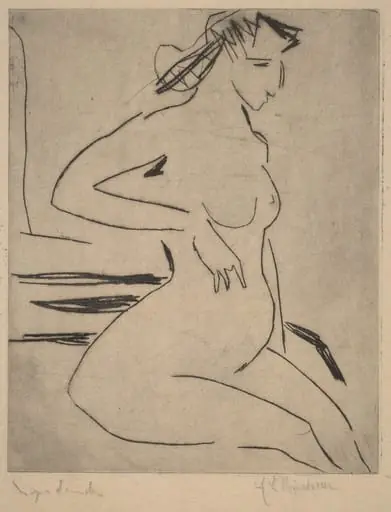 Female Nude Seated
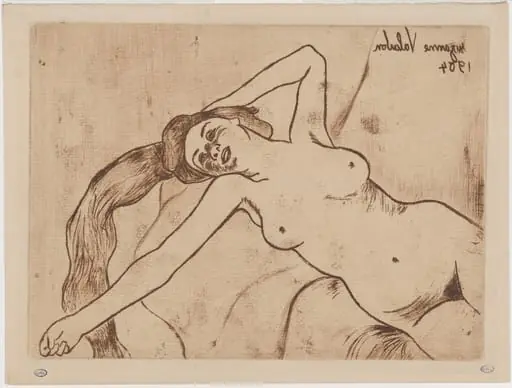 Kitty
Kitty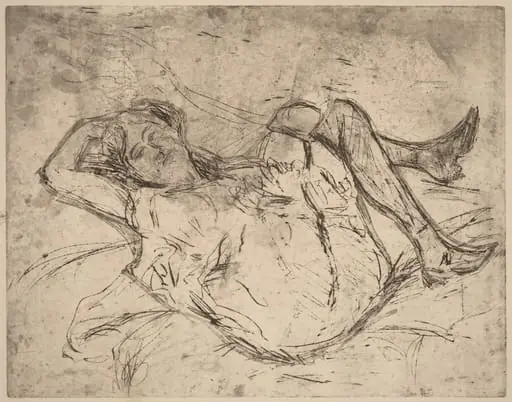 Dreaming Girl
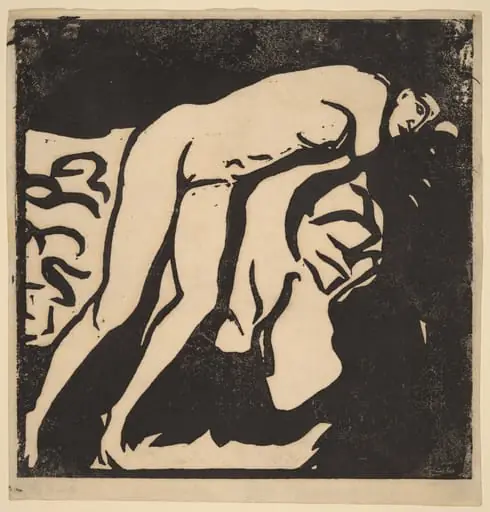 Nude Girl
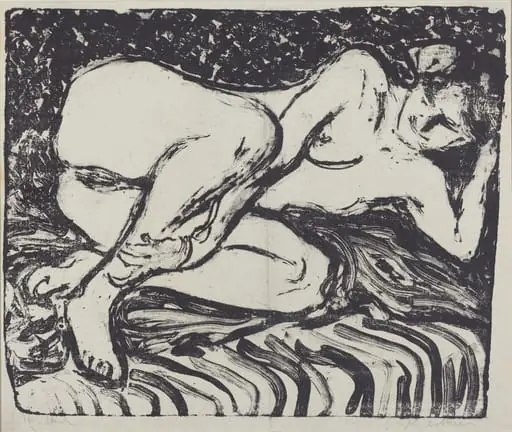 Reclining Nude
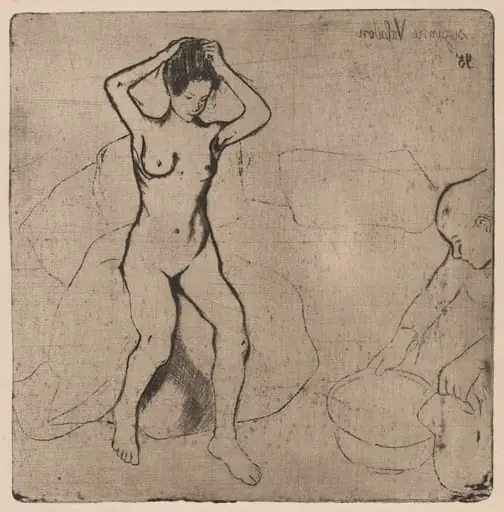 Catherine prépare le tub et Louise nue se coiffe (Catherine Prepares the Bath and Louise, Nude, Fixes her Hair)
 The Dead Man (Der tote Mann)
 Femme nue passant sa chemise (Nude Woman Taking Off Her Chemise)
 Untitled
 Female Nude Reclining (Femme nue couchee)
 Femme nue, assise sur son lit, de face (Nude Woman, Seated on Her Bed, Front View)
 Smiling Woman Reclining on a Sofa (Femme souriant etendue sur un canape)