Artwork
Nude Girl at her Toilette
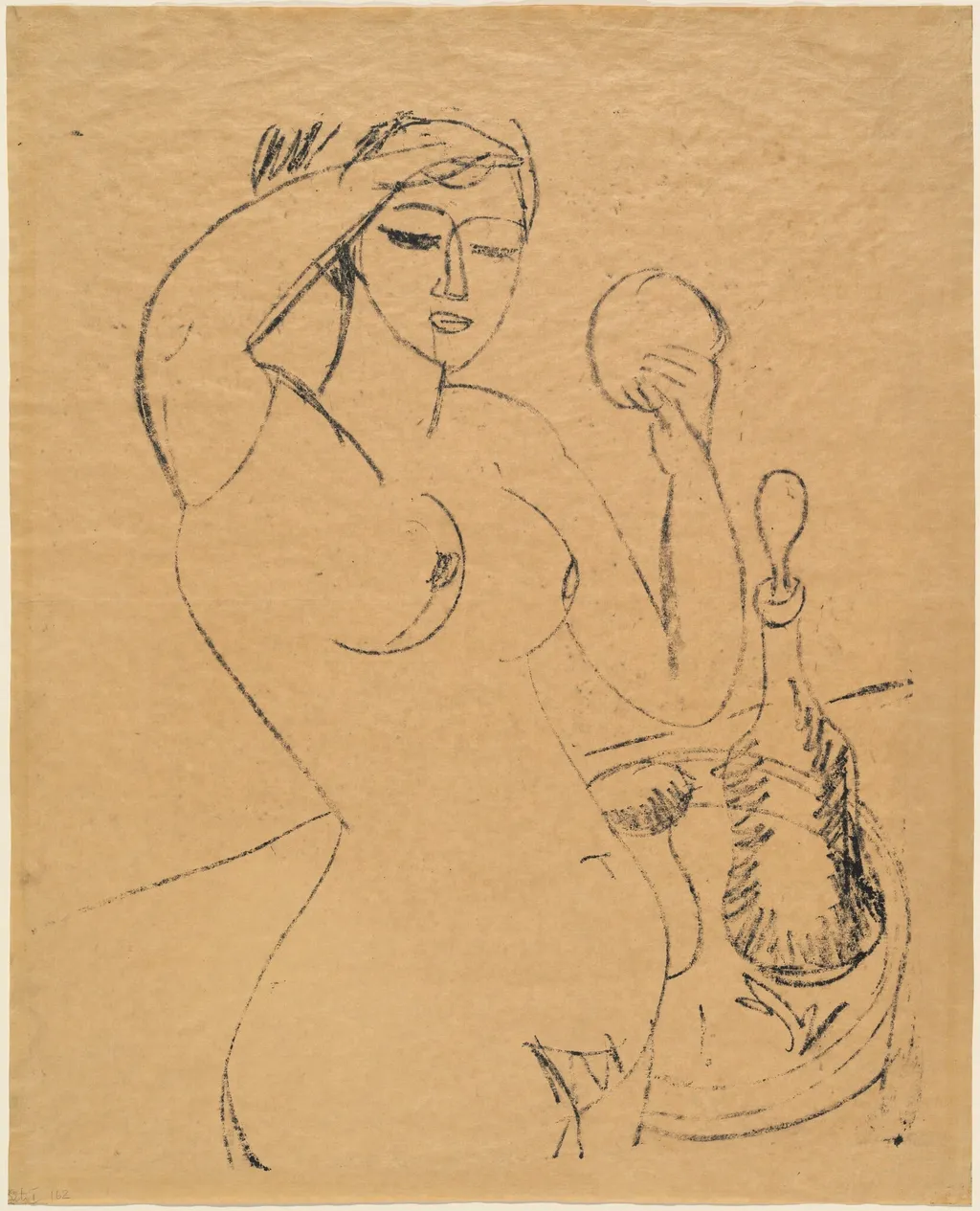
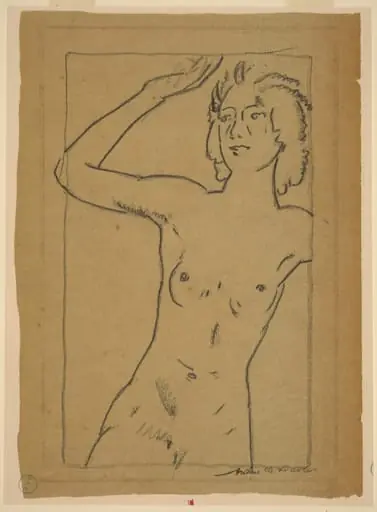
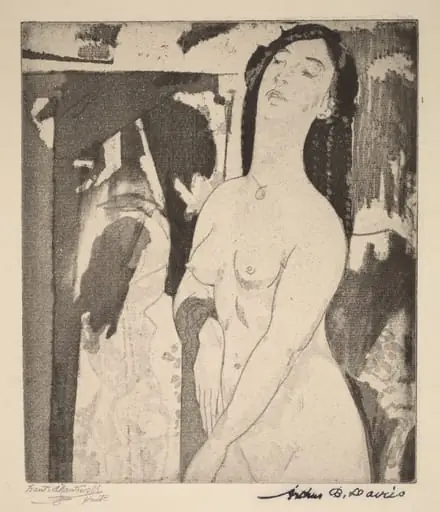
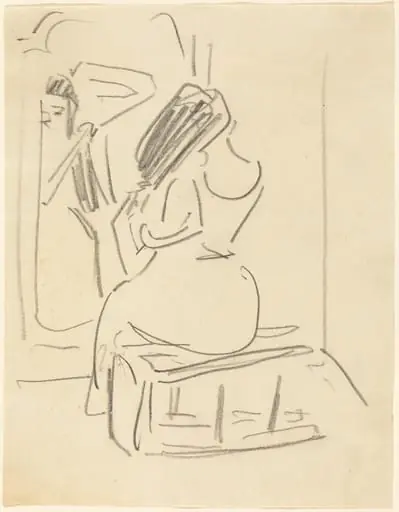
Nude Girl at her Toilette is an ink print by Ernst Ludwig Kirchner. It dates from 1912 and is held in the collection of the National Gallery of Art.
About this work
Overview
Its rough, spontaneous lines reflect the Expressionist interest in emotional truth over polished technique.
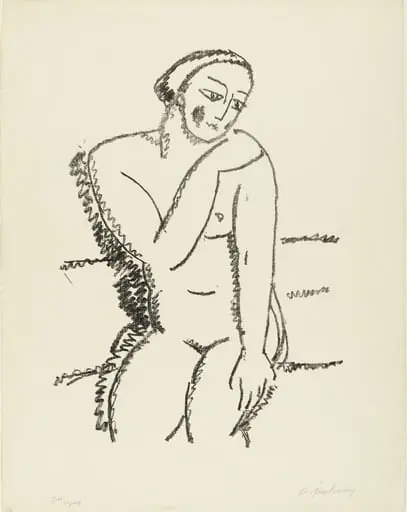
Created in 1912, *Nude Girl at her Toilette* is a lithograph by Ernst Ludwig Kirchner on beige wove paper. As a member of Die Brücke, Kirchner used printmaking to explore personal and psychological themes. The work captures a private moment with minimal detail, emphasizing gesture over realism. Its rough, spontaneous lines reflect the Expressionist interest in emotional truth over polished technique.
Subject & Meaning
The image portrays a woman alone in a domestic space, engaged in the quiet act of adjusting a small mirror. Her posture is relaxed, unidealized, and unguarded, suggesting intimacy rather than spectacle. Kirchner avoids classical nudity, instead presenting the figure as a real, contemporary woman. The scene conveys solitude and self-awareness, aligning with Die Brücke’s focus on authentic human experience.
Technique & Style
Kirchner employed lithography to achieve a direct, sketch-like quality. The lines are urgent and uneven, with smudged ink enhancing the sense of immediacy. The beige paper remains largely untouched, allowing the figure to emerge through sparse, gestural marks. Details are omitted—facial features, textures, and background are suggested rather than rendered—emphasizing form and movement over finish.
History & Provenance
The print was made during Kirchner’s most productive period in Dresden, before his relocation to Davos. Like many of his works, it was later targeted by the Nazi regime as 'degenerate art.' Some copies were confiscated, destroyed, or sold abroad. Surviving impressions are now held in public collections, preserving a record of his early modernist experimentation.
Context
In early 20th-century Germany, artists sought to break from academic traditions. Die Brücke members, including Kirchner, turned to raw, unrefined imagery to express inner states. This print reflects their fascination with everyday life, psychological depth, and the body as a site of authentic emotion—distinct from the idealized nudes of earlier art.
Legacy
Kirchner’s approach to the nude in this work influenced later generations of printmakers who valued emotional honesty over technical refinement. The lithograph stands as an example of how modern artists redefined the human figure through immediacy and simplicity. Its preservation counters the cultural erasure attempted by the Nazi regime, affirming its place in modern print history.
Own this work as a print
Artist & collection
Artist
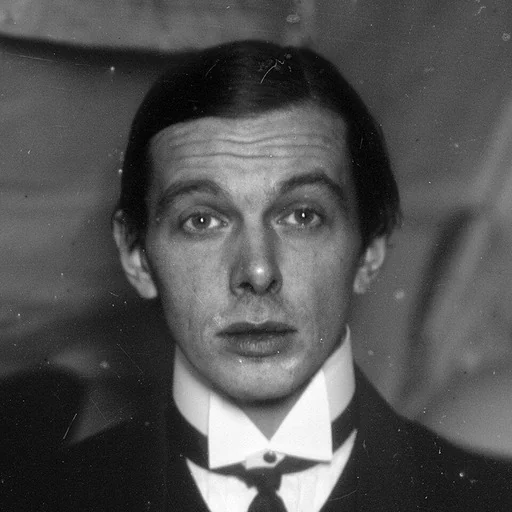
Ernst Ludwig Kirchner (6 May 1880 – 15 June 1938) was a German expressionist painter and printmaker.

![Dance Hall Bellevue [obverse], by Ernst Ludwig Kirchner](https://artifactworldgallery.com/img/ernst-ludwig-kirchner--dance-hall-bellevue-obverse--d1e14aac4297c69e-w320.webp)
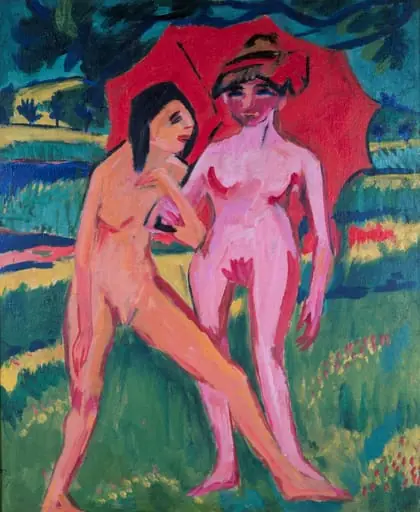
![Nude Figure [reverse], by Ernst Ludwig Kirchner](https://artifactworldgallery.com/img/ernst-ludwig-kirchner--nude-figure-reverse--4b135f0364753e98-w320.webp)
![Two Nudes [obverse], by Ernst Ludwig Kirchner](https://artifactworldgallery.com/img/ernst-ludwig-kirchner--two-nudes-obverse--eb3914183f0bc96d-w320.webp)
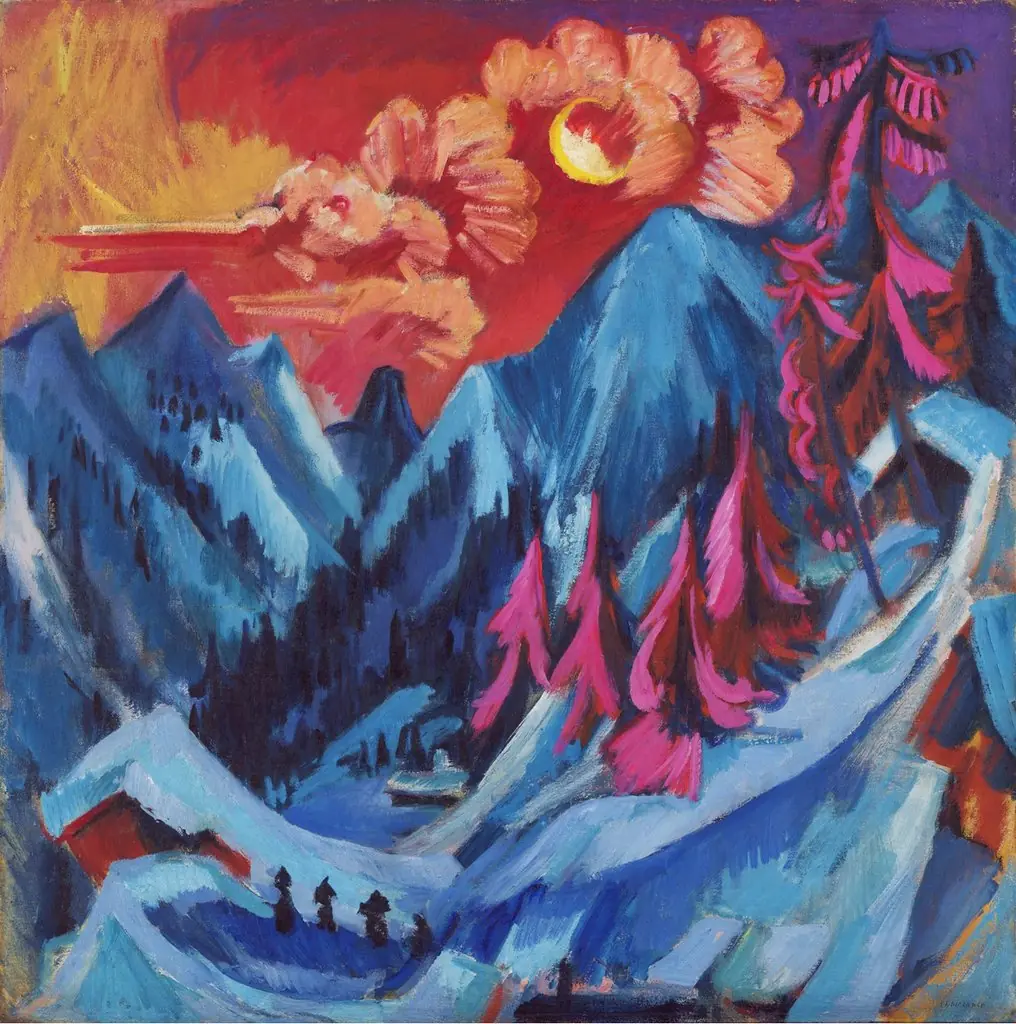
![Dancing Couple in the Snow [reverse], by Ernst Ludwig Kirchner](https://artifactworldgallery.com/img/ernst-ludwig-kirchner--dancing-couple-in-the-snow-reverse--87ca007d7c05b553-w320.webp)