Artwork
Propaganda Stand (Workers of the World Unite)
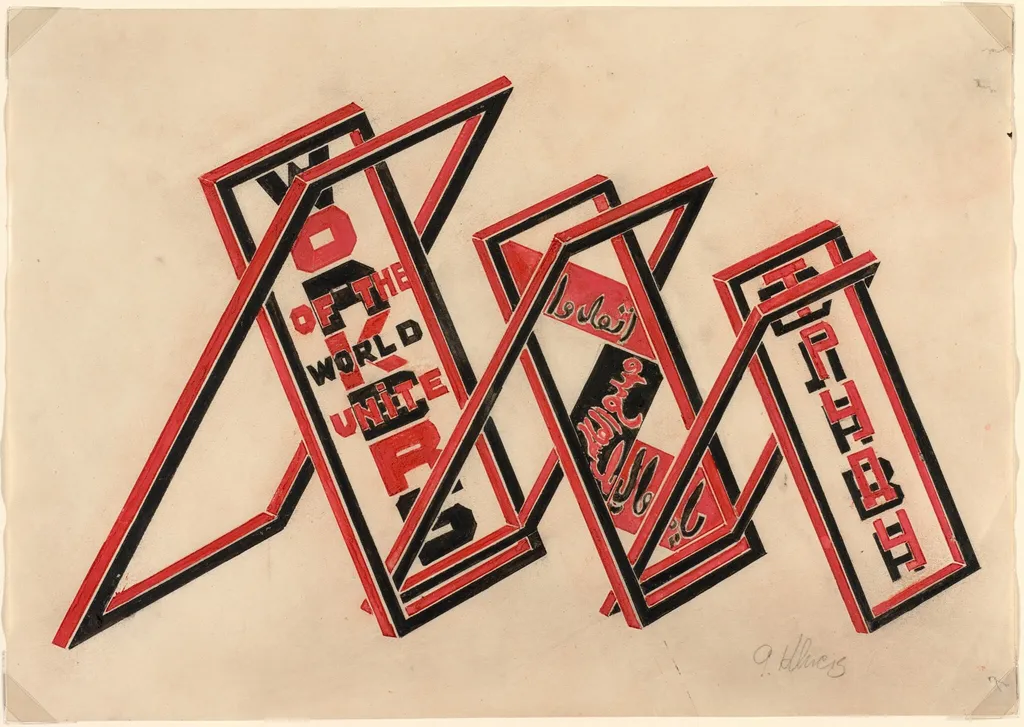
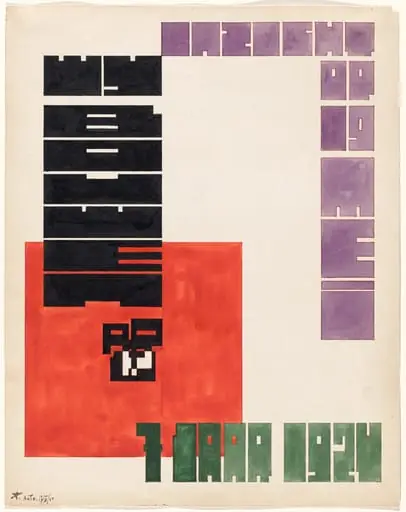
Propaganda Stand (Workers of the World Unite) is a gouache drawing by Gustav Klutsis. It dates from 1922 and is held in the collection of the National Gallery of Art.
About this work
Overview
Created in 1922, *Propaganda Stand (Workers of the World Unite)* is a gouache drawing on paper, executed by Latvian constructivist Gustav Klutsis.
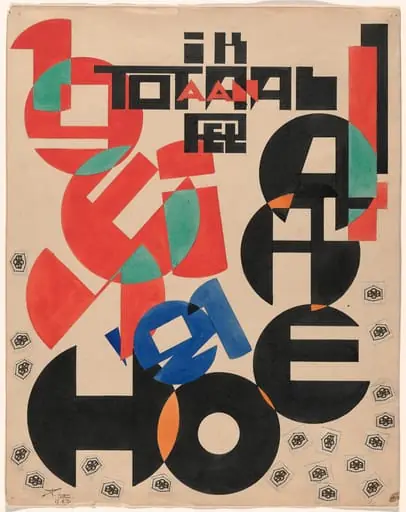
Created in 1922, *Propaganda Stand (Workers of the World Unite)* is a gouache drawing on paper, executed by Latvian constructivist Gustav Klutsis. The composition consists of three sharply angled red panels bearing bold black lettering, set against a light background. The central panel displays the English slogan “Workers of the World Unite,” while the flanking panels contain fragments of text in another language, their edges truncated to emphasize dynamism.
Subject & Meaning
The work functions as a visual rallying cry for international labor solidarity, echoing the communist slogan that underpinned Soviet propaganda. By arranging the slogans on tilted signs, Klutsis suggests movement and urgency, reinforcing the call for collective action among workers across national boundaries.
Technique & Style
Klutsis employed gouache, an opaque water‑based medium, over a graphite underdrawing, allowing vivid reds and stark blacks to dominate the composition. The flat, graphic treatment and the use of bold typographic elements align with Constructivist principles that favored utilitarian design, clear visual communication, and the integration of text and image.
History & Provenance
Klutsis, a prominent figure in the early Soviet avant‑garde, produced the drawing alongside his wife Valentina Kulagina, both known for state‑commissioned propaganda. The piece reflects his experimentation with photomontage and graphic layout, practices he refined while working for Soviet publishing and exhibition bureaus during the 1920s.
Context
The drawing emerges from the Constructivist movement’s emphasis on art as a tool for social engineering. In the post‑revolutionary period, artists were encouraged to create functional visual material that could be reproduced for posters, banners, and exhibition displays, directly serving the ideological goals of the new regime.
Artist & collection
Artist
Gustav Gustavovich Klutsis (Latvian: Gustavs Klucis, Russian: Густав Густавович Клуцис; 4 January 1895 – 26 February 1938) was a pioneering Latvian photographer and major member of the Constructivist avant-garde in the early 20th century.