Artwork
The Council of Salvation
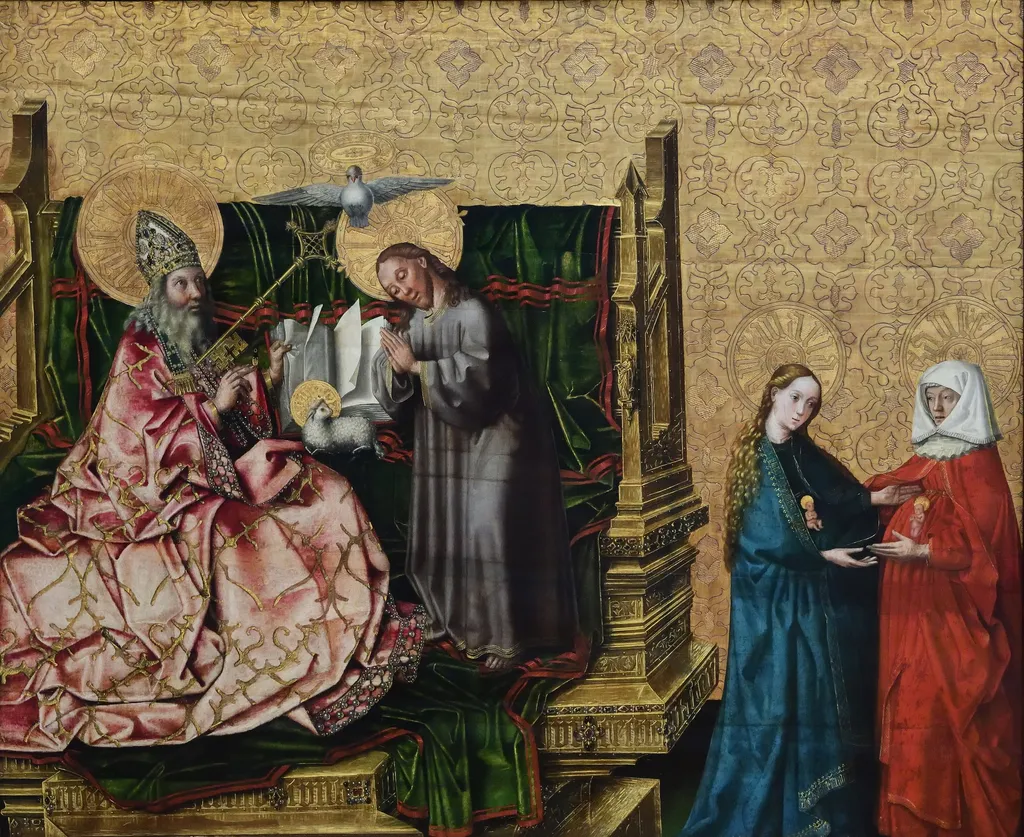
The Council of Salvation is a paint painting by the Northern Renaissance artist Konrad Witz. It dates from 1445 and is held in the collection of the Gemäldegalerie Berlin.
About this work
Overview
Konrad Witz’s panel, dated to 1445, portrays a religious assembly known as the Council of Salvation. Executed in oil on panel, the work resides in Berlin’s Gemäldegalerie. The composition centers on a dignified figure in a red robe and mitre, seated upon a throne draped in green velvet, surrounded by clerics and two women in modest attire.
Subject & Meaning
To his right, a man in a gray habit clasps his hands in prayer, suggesting a moment of deliberation or supplication.
The central figure, likely a bishop or abbot, holds a staff that signifies ecclesiastical authority. To his right, a man in a gray habit clasps his hands in prayer, suggesting a moment of deliberation or supplication. The two women, one clad in blue and the other in red, wear head coverings, indicating modesty and possibly representing patron saints or allegorical virtues within the council’s discourse.
Technique & Style
Witz renders the scene with meticulous attention to texture: the sheen of the velvet drapery, the intricate patterns of the garments, and the gilded wall background are all delineated with fine brushwork. A restrained palette of reds, greens, and muted earth tones creates visual hierarchy, allowing the central throne and its occupant to dominate the viewer’s eye.
History & Provenance
Created in the mid‑15th century, the painting entered the collection of the Gemäldegalerie in Berlin, where it has been on public display since the museum’s establishment. Its provenance prior to acquisition remains undocumented, but the work reflects the devotional commissions typical of Swiss and German ecclesiastical patrons of the period.
Context
The Council of Salvation belongs to a tradition of late medieval religious panels that depict ecclesiastical gatherings. Witz, active in Basel, was known for integrating realistic spatial settings with symbolic content, a practice that anticipates the naturalism of early Renaissance art in the Upper Rhine region.
Own this work as a print
Artist & collection


 L'Annonciation
 Saint Catherine refuses idolatry
 Presentation of Jesus Christ at the Temple
 Anna Selbdritt
 Presentation of Jesus at the Temple
 The Annunciation
 Madonna and Child with Saints in the Enclosed Garden
 Madonna and Child Enthroned with Saints
 Triptych of the Presentation of Jesus in the Temple
 Adoration of the Magi
 Verkündigung an Maria
 Christ's Bath