Artwork
Untitled
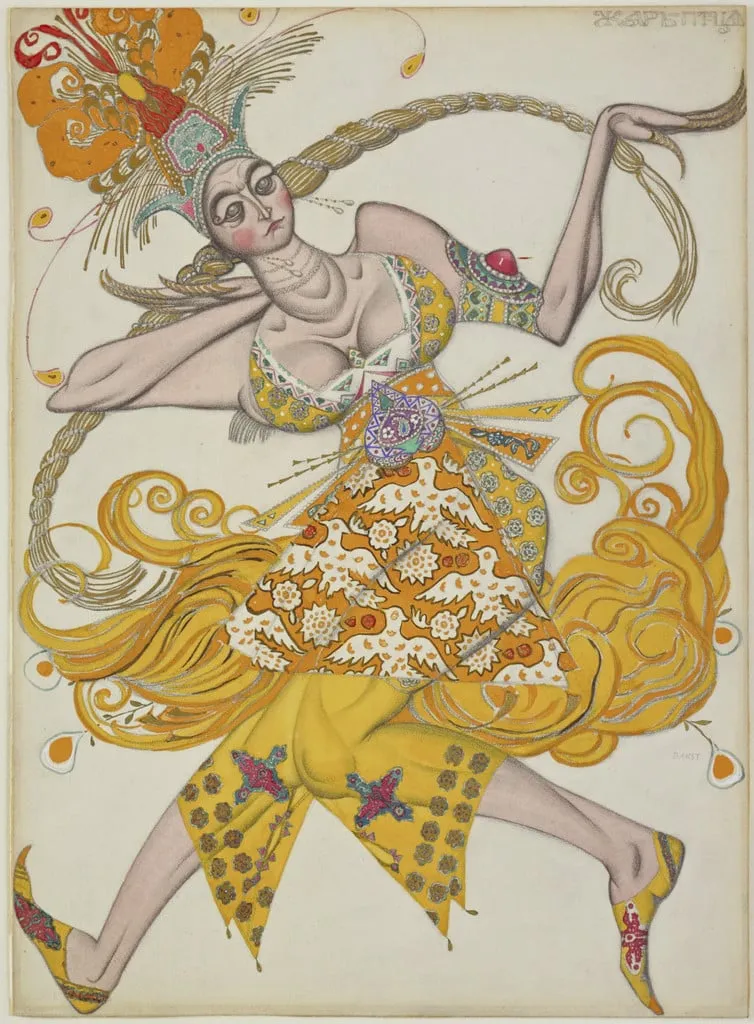
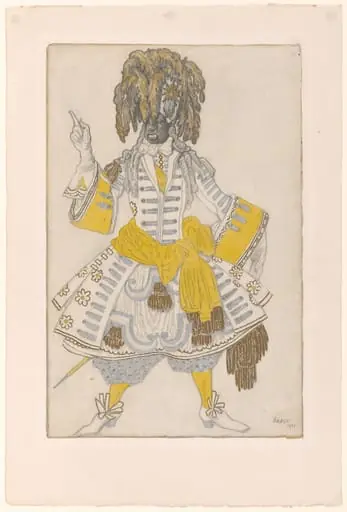
Untitled is a watercolor drawing by Léon Bakst. It dates from 1913 and is held in the collection of the Museum of Modern Art. Created in 1913, this work is a preparatory design for a costume in Igor Stravinsky and Michel Fokine’s ballet *The Firebird*.
About this work
Overview
Executed in gouache, watercolor, metallic paint, and pencil on paper mounted to board, it reflects Léon Bakst’s role as a visual architect of stage spectacle.
Created in 1913, this work is a preparatory design for a costume in Igor Stravinsky and Michel Fokine’s ballet *The Firebird*. Executed in gouache, watercolor, metallic paint, and pencil on paper mounted to board, it reflects Léon Bakst’s role as a visual architect of stage spectacle. The piece functions not as a finished artwork but as a technical blueprint, guiding the execution of costume and movement under theatrical lighting.
Subject & Meaning
The figure depicted is the Firebird, a mythical creature from Slavic folklore, rendered as a towering, flame-like dancer. Its elongated form, clad in swirling red, gold, and black patterns, evokes both divine power and primal energy. The jagged, feather-like contours suggest motion and transformation, aligning the costume’s design with the ballet’s narrative of enchantment, capture, and redemption.
Technique & Style
Bakst employed layered watercolor glazes to achieve luminous depth, overlaying translucent washes to intensify hue without opacity. Metallic paint was strategically applied to catch stage light, enhancing the costume’s ethereal glow. Pencil underdrawing guided the composition, while bold, angular forms reflect the influence of Art Nouveau and Russian folk motifs, fused into a distinctly modern theatrical language.
History & Provenance
This design was produced during Bakst’s tenure with Sergei Diaghilev’s Ballets Russes, a period when he revolutionized stage aesthetics. Created in Paris, it was likely used by costumers to translate his vision into fabric and structure for the 1910 premiere of *The Firebird*. Its survival offers rare insight into the collaborative process behind one of early 20th-century ballet’s most influential productions.
Context
Bakst’s work emerged amid a flourishing exchange between visual art and performance in pre-war Europe. His designs broke from naturalism, embracing symbolic color and stylized form to elevate dance into a total sensory experience. This piece sits at the intersection of Russian iconography, Parisian modernism, and the growing interest in non-Western aesthetics that defined avant-garde theater of the era.
Legacy
Bakst’s costume designs redefined how movement and attire interacted on stage, influencing generations of theater and fashion designers. The integration of metallics and layered pigments became a model for theatrical costuming beyond ballet. This drawing endures as a testament to the precision and imagination required to translate myth into physical performance.
Artist & collection
Artist
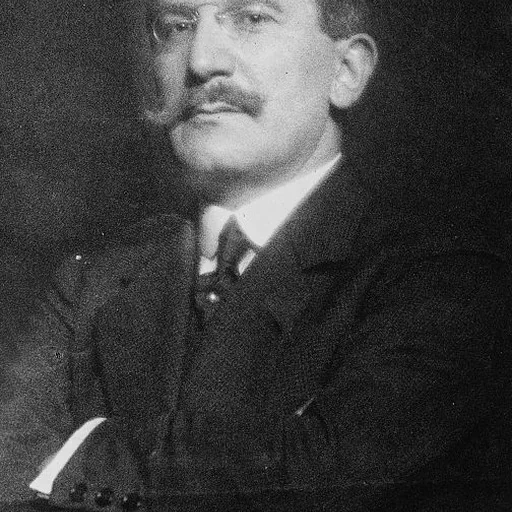
Léon (Lev) Samoylovich Bakst (Russian: Леон (Лев) Самойлович Бакст), born Leyb-Khaim Izrailevich Rosenberg (8 February 1866 – 27 December 1924), was a Russian painter and scene and costume designer of Jewish origin.

![[...]anou d'or, by Madeleine & Madeleine](https://artifactworldgallery.com/img/madeleine-madeleine--anou-d-or--5e4d4a722f363347-w320.webp)