Artwork
Mulet (Mule or Saddled Donkey)
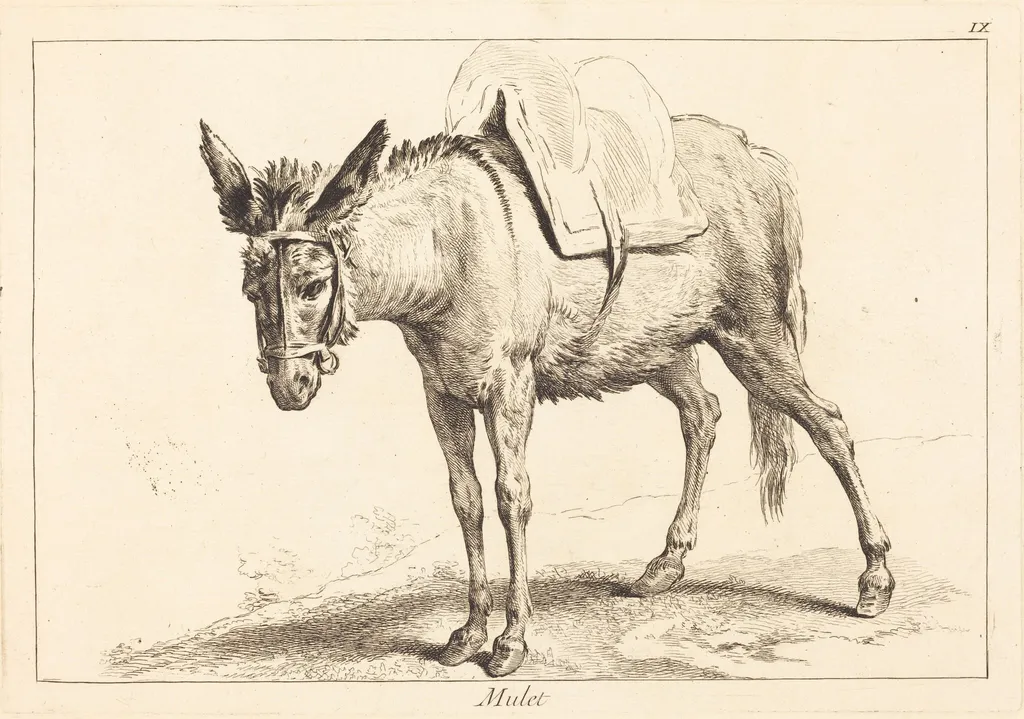
Mulet (Mule or Saddled Donkey) is an ink print by the Baroque artist Jacques-Philippe Le Bas. It dates from 1745 and is held in the collection of the National Gallery of Art.
About this work
Overview
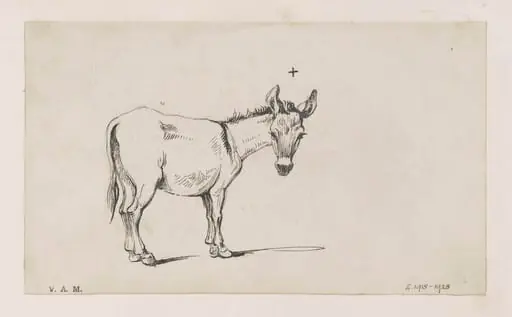
Mulet, created in 1745 by Jacques-Philippe Le Bas, is a print executed in etching and engraving. It presents a single donkey bearing a simple saddle, rendered with precise line work. Unlike many prints of the period that featured mythological or aristocratic subjects, this work centers on a common working animal, reflecting a quiet interest in the mundane.
Subject & Meaning
The donkey, depicted without ornament or narrative context, is presented as a subject worthy of careful observation. Its inclusion suggests an appreciation for the dignity of everyday labor and the quiet presence of working animals in 18th-century French life. The absence of human figures or dramatic setting directs attention to the animal’s form and posture.
Technique & Style
Le Bas employed fine etched lines and controlled engraving to define the donkey’s musculature and the texture of its saddle. The tonal gradations are achieved through cross-hatching and delicate stippling, typical of reproductive printmaking of the era. The composition is restrained, emphasizing clarity and anatomical accuracy over emotional expression.
History & Provenance
The print was produced during Le Bas’s active years as a reproductive engraver in Paris, known for translating paintings into prints for wider circulation.
The print was produced during Le Bas’s active years as a reproductive engraver in Paris, known for translating paintings into prints for wider circulation. While the original source image is unknown, the work likely served as a study or standalone piece within a broader tradition of animal studies in print. Its survival in institutional collections indicates early recognition of its technical merit.
Context
In mid-18th-century France, artistic focus often leaned toward grand historical or religious themes. Le Bas’s choice to depict a humble donkey aligns with a growing interest in naturalism and the observation of ordinary life, a trend that would later influence Realism. This print reflects a quieter, more observational current within print culture of the time.
Legacy
Mulet stands as an example of how skilled engravers elevated everyday subjects through technical precision. Though not widely exhibited today, it contributes to the understanding of how 18th-century artists found artistic value in the unremarkable, laying groundwork for later movements that celebrated the ordinary as worthy of artistic attention.
Artist & collection