Artwork
Ruined Temple on a Hill
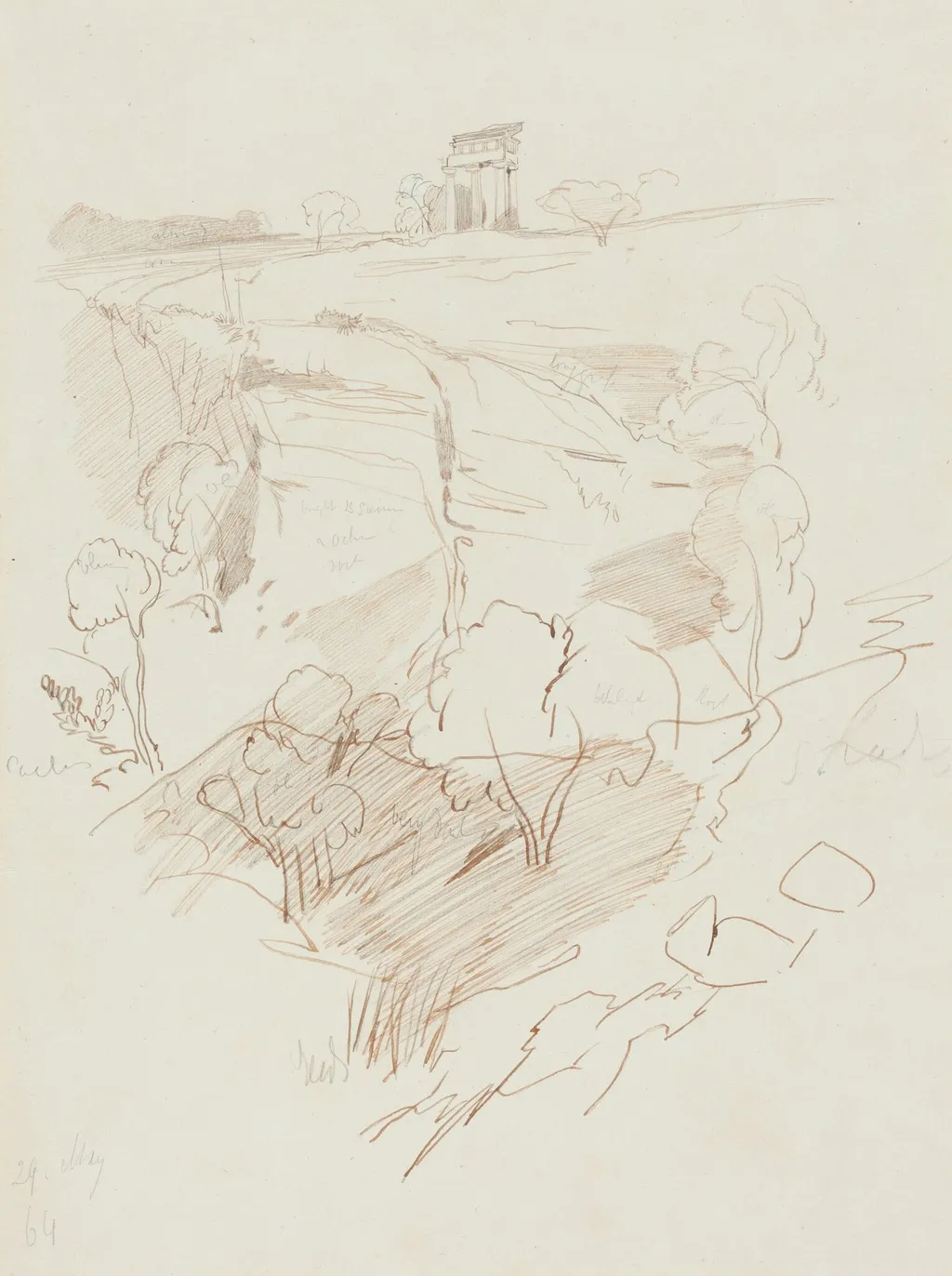
Ruined Temple on a Hill is an ink drawing by the Impressionist artist Edward Lear. It dates from 1864 and is held in the collection of the National Gallery of Art.
About this work
Overview
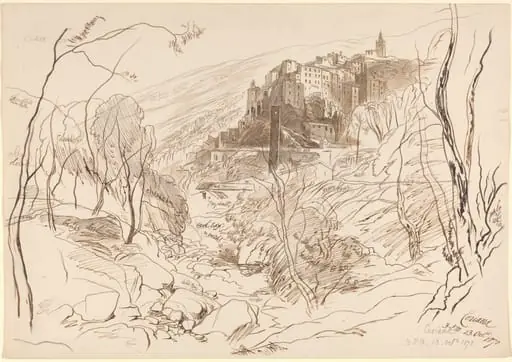
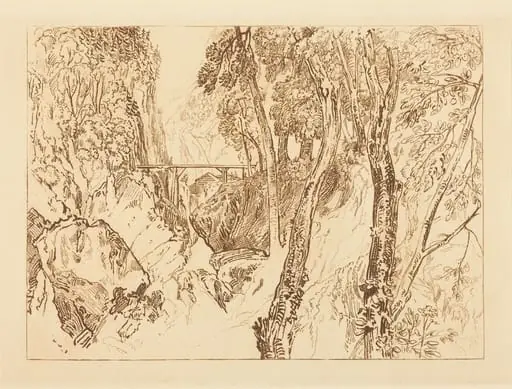
Ruined Temple on a Hill, created by Edward Lear in 1864, is a drawing executed in pen and brown ink over graphite on blue wove paper. It depicts a landscape with a ruined temple situated on a hill, surrounded by foliage, with visible signs of deterioration on the temple's structure.
Subject & Meaning
The subject is a ruined temple on a hill, set amidst trees, bushes, rocks, and plants. The scene blends observational detail with compositional artistry, characteristic of Lear's travel-inspired works, which often documented landscapes with precision and aesthetic balance.
Technique & Style
Lear employed pen, brown ink, and graphite on blue wove paper, achieving depth and texture.
Lear employed pen, brown ink, and graphite on blue wove paper, achieving depth and texture. The use of lines and shading imparts a sense of movement and energy. While the piece reflects Lear's typical draughtsmanship, its attribution to Impressionism and Realism in the source may misrepresent Lear's style, as his work is more closely associated with detailed, realistic illustrations rather than the spontaneous capture of light and color typical of Impressionism.
History & Provenance
Completed in 1864, the drawing is part of Edward Lear's body of work as a traveling draughtsman. It is currently held in the collection of the National Gallery of Art in Washington.
Context
This work fits within Lear's broader practice of documenting travel scenes, combining precise observation with artistic arrangement, though it does not align with the Impressionist movement's key characteristics.
Legacy
As part of Lear's oeuvre, it contributes to his reputation as a meticulous and artistically inclined traveler and illustrator, distinct from the Impressionist and Realist movements.
Artist & collection
Artist
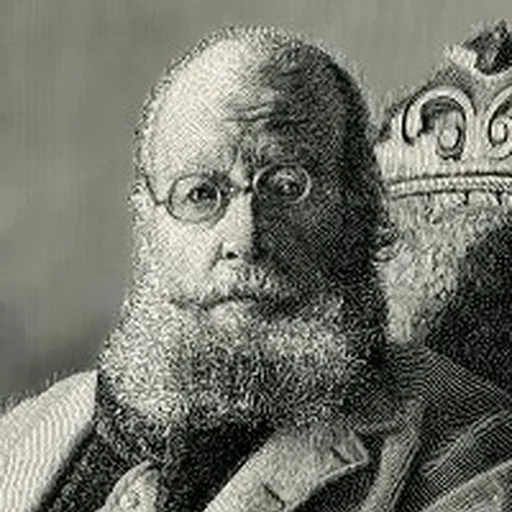
Edward Lear (12 May 1812 – 29 January 1888) was an English artist, illustrator, musician, author and poet, who is known mostly for his literary nonsense in poetry and prose and especially his limericks, a form he popularised but which term…

 An Ancient Wall with a Ruined Gate
 Landscape with Man Fishing, Conway, New Hampshire
 Casa Garden, Macau
 Gate to the Farmhouse, Pont-Aven
 Wooded Landscape
 Landscape with Trees
 Untitled
 A wooded hillside at Underriver, near Sevenoaks, Kent
 View of Marino (recto)
![View through the Trees at Tivoli [recto], by Jasper Francis Cropsey](https://artifactworldgallery.com/img/jasper-francis-cropsey--view-through-the-trees-at-tivoli-recto--982b0e365e4ea403-w320.webp) View through the Trees at Tivoli [recto]
View through the Trees at Tivoli [recto] On the Severn
 Mill near the Grand Chartreuse