Artwork
Wounded French Attacked by a Cosack
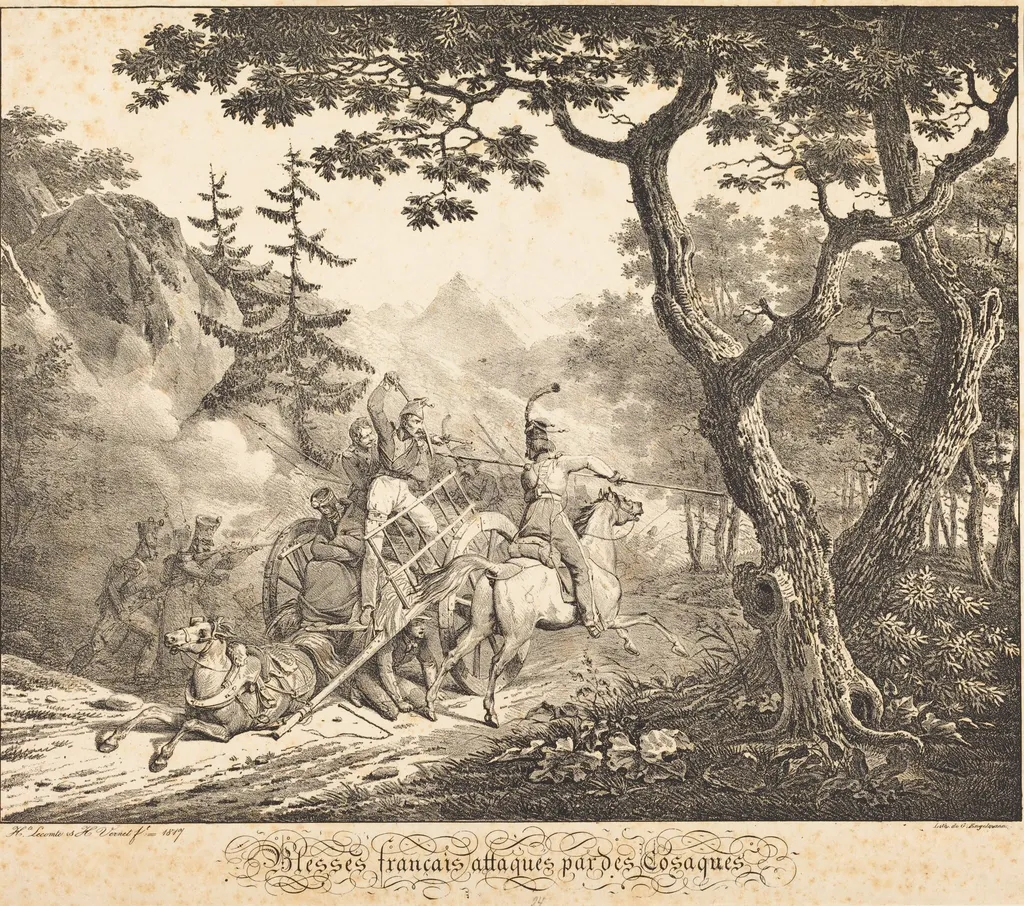
Wounded French Attacked by a Cosack is an ink print by the Romanticist artist Hippolyte Lecomte. It dates from 1817 and is held in the collection of the National Gallery of Art.
About this work
Overview
Though primarily known for monumental historical paintings and theatrical designs, he turned to printmaking to reach broader audiences.
Hippolyte Lecomte produced this lithograph in 1817, capturing a moment of violence during the Napoleonic Wars. Though primarily known for monumental historical paintings and theatrical designs, he turned to printmaking to reach broader audiences. The work belongs to a wave of lithographs emerging in post-Napoleonic France, where the medium’s speed and accessibility made it ideal for disseminating military narratives to the public.
Subject & Meaning
The scene depicts French soldiers overwhelmed by Cossack cavalry in a rugged, forested landscape. Figures are caught mid-action—some wounded, others retreating or firing—conveying sudden chaos rather than organized combat. The title, 'Les francs attaqués par les cosaques,' frames the event as a brutal ambush, reinforcing a national narrative of French vulnerability during the retreat from Russia. The imagery evokes trauma without glorifying victory.
Technique & Style
Lecomte employed lithography to achieve dense, tonal contrasts that heighten the scene’s urgency. Fine lines define the tangled underbrush and uneven terrain, while smudged areas suggest smoke and movement. The composition is crowded and diagonal, guiding the eye through the fray. Unlike painted works, the print’s immediacy stems from its graphic clarity and the medium’s capacity for rapid reproduction, aligning with its documentary intent.
History & Provenance
Created shortly after Napoleon’s defeat, the print emerged during a period of national reflection on military loss. It likely responded to public interest in war stories and the Cossacks’ fearsome reputation during the 1812 Russian campaign. Though no early ownership records are documented, its production coincided with a surge in political prints, suggesting it was circulated widely, possibly as a broadsheet or album plate.
Context
Lithography’s rise in early 19th-century France transformed how war was visualized. Artists like Lecomte, trained in academic traditions, adapted to this new medium to engage with contemporary events. This print reflects a broader trend: historical subjects rendered in accessible formats to shape public memory. The Cossack threat, real and symbolic, became a potent motif in French visual culture after 1815.
Legacy
While not widely exhibited today, the print exemplifies how lithography bridged fine art and popular media in post-revolutionary France. It preserves a visual language of wartime suffering that influenced later war reporting and illustrated journalism. Lecomte’s shift from canvas to print underscores the changing role of the artist in an age of mass communication, where imagery could shape collective memory beyond elite circles.
Artist & collection
Artist
Hippolyte Lecomte (French pronunciation: ; 28 December 1781, Puiseaux – 25 July 1857, Paris) was a French painter best known for large scale historical paintings and ballet designs.

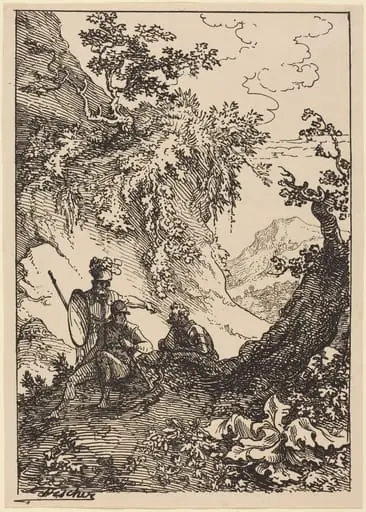 Landscape with Men in Armor, Tree Stump
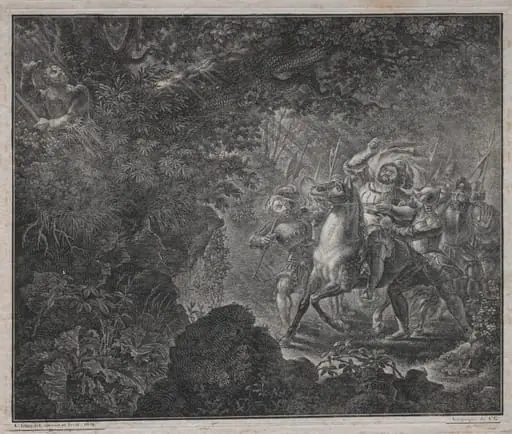 William Tell at Küssnacht
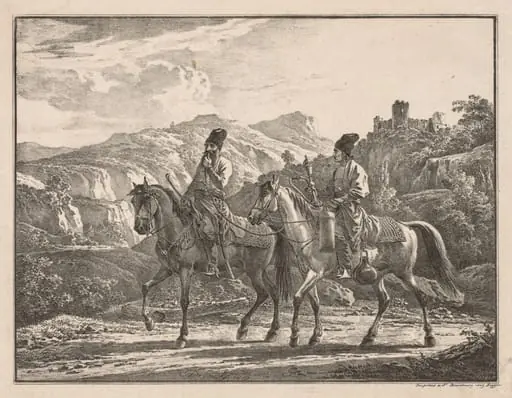 Two Cossacks on Horseback
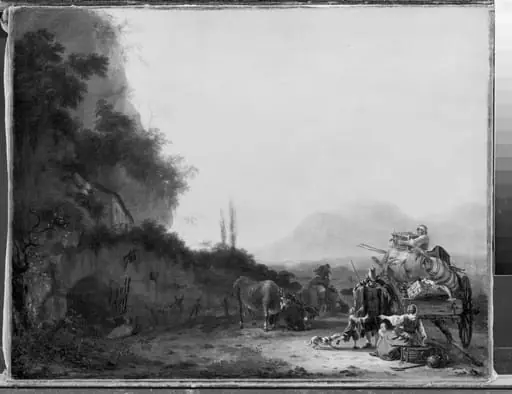 Landscape with a Removal Cart
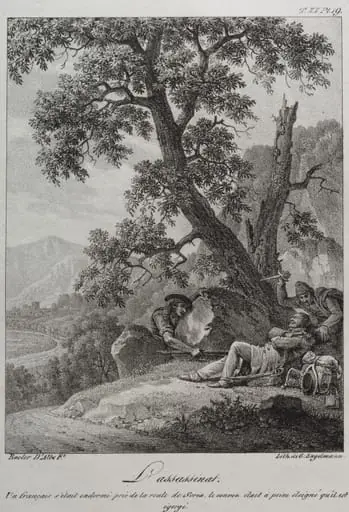 Spanish Campaign: The Assassination
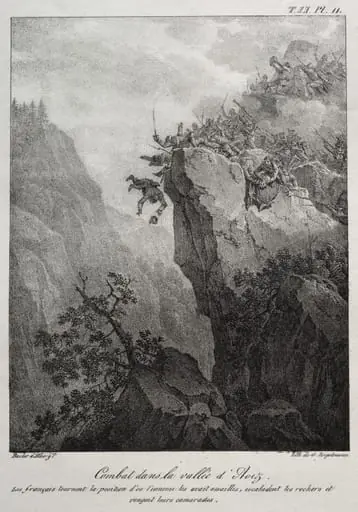 Spanish Campaign: Combat in the Aoiz Valley, Province of Navarre
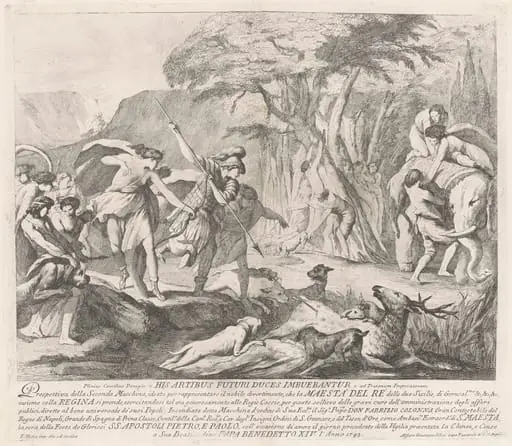 The Seconda Macchina for the Chinea of 1743: The Royal Hunt
 Man and Veiled Woman on Horseback
 Mountainous Landscape
 Cavalry and Hay Wagon
 Discovery of the Criminal Soldiers
 Essais de gravure à l'eau forte par Alexandre Calame, I, pl. 21