Artwork
The Seconda Macchina for the Chinea of 1743: The Royal Hunt
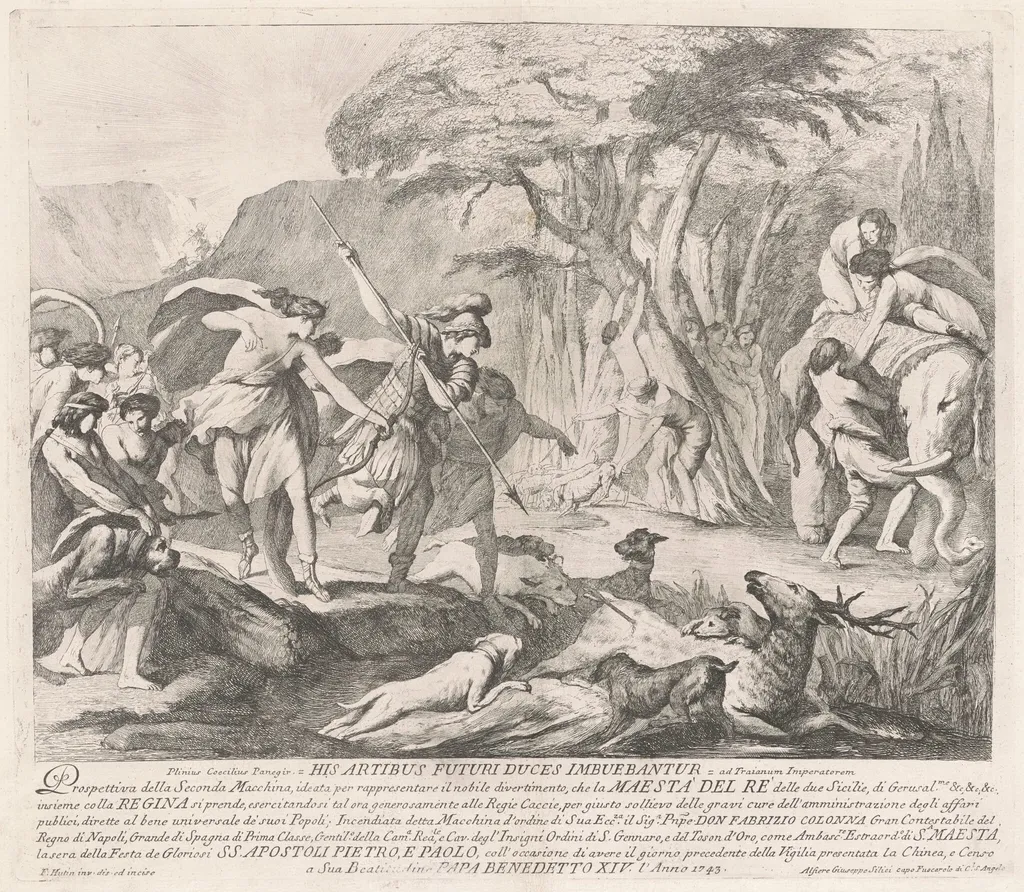
The Seconda Macchina for the Chinea of 1743: The Royal Hunt is an ink print by the Baroque artist François Hutin. It dates from 1743 and is held in the collection of the National Gallery of Art.
About this work
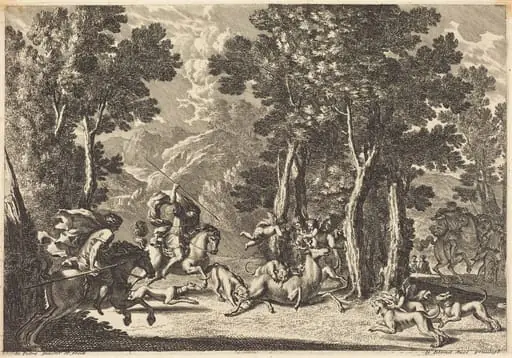
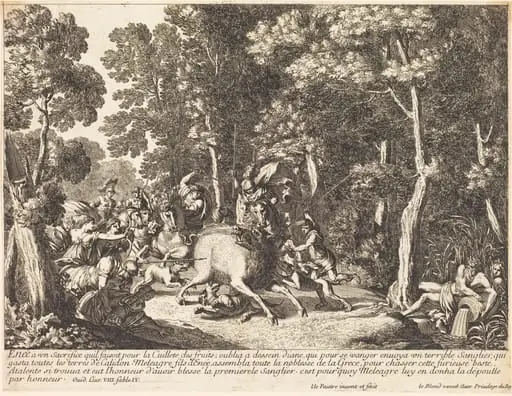
This etching shows a busy royal hunt scene from 1743. Hunters on horseback chase deer through a forest. Noblemen wear wigs and fancy clothes. Dogs scatter near their feet.
The print was made for a festival called the Chinea. It celebrates a treaty between Naples and Rome. The artist used fine lines to show movement and detail.
Look up this technique next time you see etching.
Overview
Created in 1743 by François Hutin, this etching was produced as part of a ceremonial sequence for the Chinea festival in Naples.
Created in 1743 by François Hutin, this etching was produced as part of a ceremonial sequence for the Chinea festival in Naples. It depicts a royal hunt, one of several elaborate prints commissioned to commemorate the annual tribute ceremony between the Kingdom of Naples and the Papal States. The work functions as both documentation and spectacle, capturing a moment of courtly ritual through precise linear detail.
Subject & Meaning
The scene portrays nobility on horseback pursuing deer through a wooded landscape, surrounded by hounds and attendants. The figures, dressed in 18th-century aristocratic attire with powdered wigs, reflect the performative nature of court life. The hunt symbolizes royal authority and control over nature, reinforcing the legitimacy of the Bourbon monarchy in Naples through the ritualized display of power.
Technique & Style
Hutin employed fine, controlled etching lines to render motion and texture, capturing the flurry of horses, dogs, and foliage with rhythmic precision. The composition is dense yet orderly, guiding the eye through the chase without clutter. The tonal range is subtle, relying on line variation rather than shading to suggest depth and volume, characteristic of refined printmaking of the period.
History & Provenance
The print was one of several designed for the Chinea, a tribute procession established in the 15th century and renewed annually by the Neapolitan court. Made for distribution among dignitaries and participants, it served as a commemorative artifact of the event. Its survival in institutional collections today reflects its role as a historical record of Bourbon ceremonial culture.
Context
The Chinea festival originated from a 14th-century agreement in which Naples paid an annual tribute to Rome, symbolizing political submission and later evolving into a grand spectacle. By 1743, the event had become a vehicle for displaying Bourbon wealth and legitimacy. Hutin’s etching was part of a broader visual program that linked royal authority to tradition, pageantry, and the natural world.
Legacy
Though not widely known outside specialized circles, the print remains a valuable artifact of 18th-century Neapolitan court culture. It exemplifies how printmaking was used to disseminate political symbolism through accessible imagery. Its technical precision and ceremonial subject matter continue to inform studies of early modern visual propaganda and aristocratic ritual.
Own this work as a print
Artist & collection