Artwork
Blind Tom poster
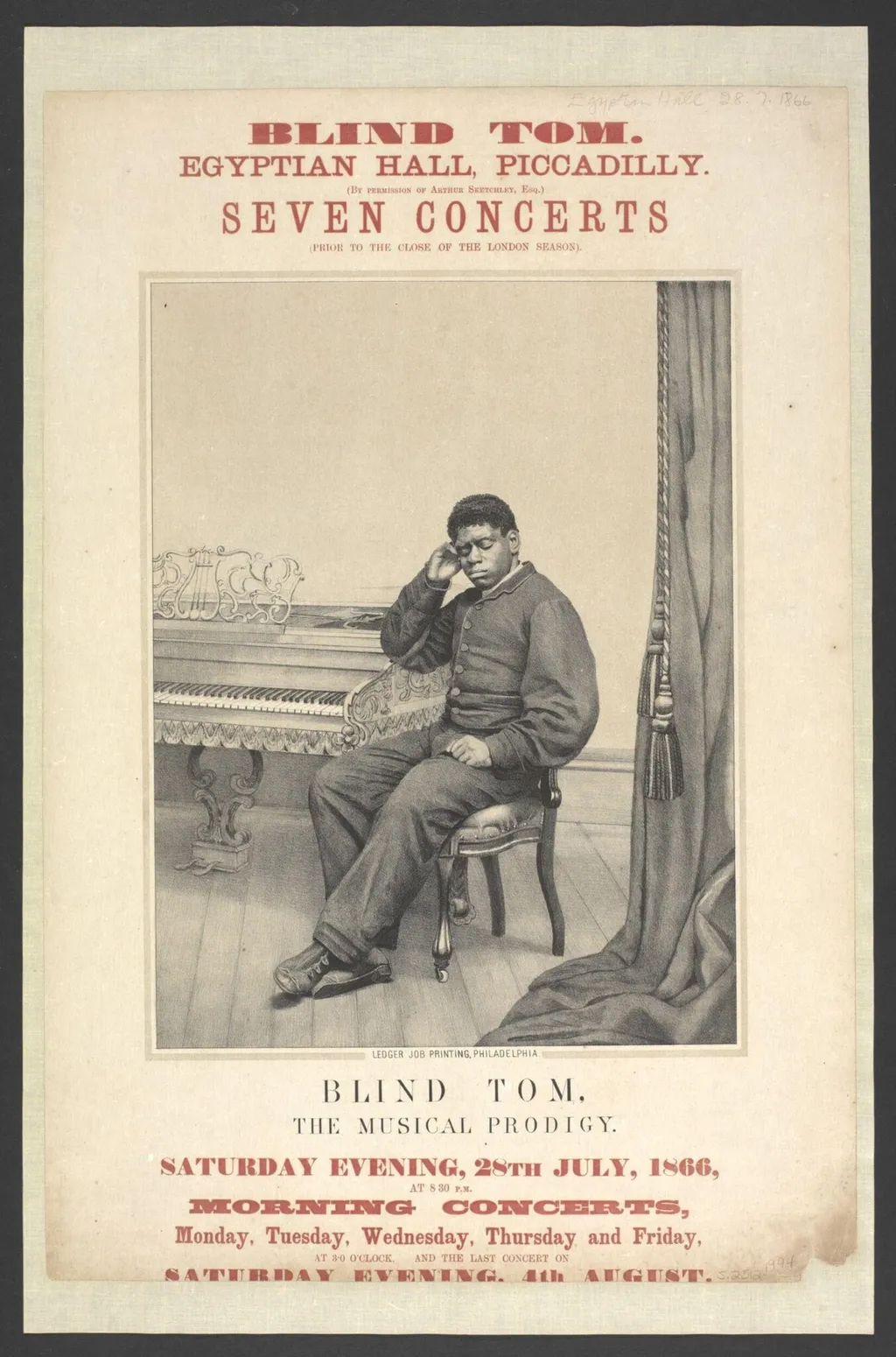
Blind Tom poster is a poster by the Impressionist artist Ledger Job Printing. It dates from 1866 and is held in the collection of the Victoria and Albert Museum. A promotional poster from 1866 advertises a series of concerts by Thomas Wiggins, known as Blind Tom, held at London’s Egyptian Hall.
About this work
Overview
The layout emphasizes the venue, date, and number of performances, reflecting standard 19th-century advertising practices for musical events.
A promotional poster from 1866 advertises a series of concerts by Thomas Wiggins, known as Blind Tom, held at London’s Egyptian Hall. Designed in black and white, it pairs a simple illustration of the performer with bold typographic elements to convey event details. The layout emphasizes the venue, date, and number of performances, reflecting standard 19th-century advertising practices for musical events.
Subject & Meaning
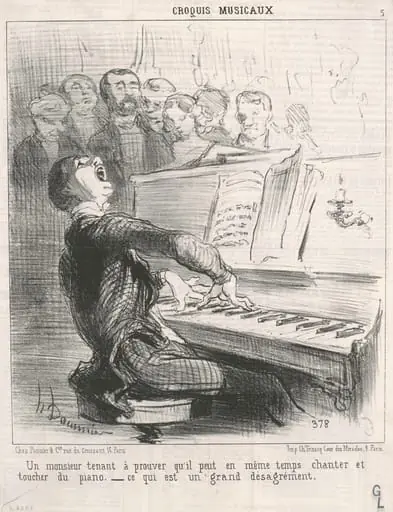
The illustration depicts Tom seated at a piano, one hand raised near his face — a gesture suggesting concentration or introspection. His blind status is visually implied but not overtly dramatized. The image avoids caricature, instead presenting him as a focused musician. The poster’s purpose was to attract audiences to his performances, framing him as a singular talent rather than a curiosity.
Technique & Style
The poster employs a restrained, linear aesthetic with minimal shading. The background includes a window and curtain, adding spatial depth without ornamental excess. The typography is bold and hierarchical, guiding the viewer’s eye from title to date to venue. While the rendering is detailed, it lacks the loose brushwork or color modulation associated with Impressionism; its style aligns more closely with commercial engraving conventions of the era.
History & Provenance
The poster was produced for Tom’s 1866 London tour, part of his international performances following his early fame in the United States. Organized by his manager, it reflects efforts to establish his reputation in Europe. Surviving examples are rare, making this artifact a key document of how Black musicians were marketed during the post-Civil War period.
Context
Blind Tom was one of the first African American musicians to achieve widespread commercial success in the U.S. and abroad. His performances, often billed as extraordinary due to his blindness and alleged savant abilities, occurred amid complex racial dynamics. While audiences were fascinated by his musical feats, the framing of his talent frequently reinforced stereotypes, even as it granted him unusual visibility.
Legacy
This poster endures as a material trace of a performer whose life and artistry were shaped by exploitation and public fascination. It documents the commercial machinery behind 19th-century musical spectacle and offers insight into how disability and race were navigated in entertainment. Today, it serves as a historical artifact for reevaluating the boundaries between admiration and objectification.
Artist & collection
Artist
Ledger Job Printing made bold, colorful posters in the 1860s that advertised performers like the tightrope-walking child prodigy El Niño Eddie and the pianist Blind Tom.