Artwork
Lot intoxicated by his daughters
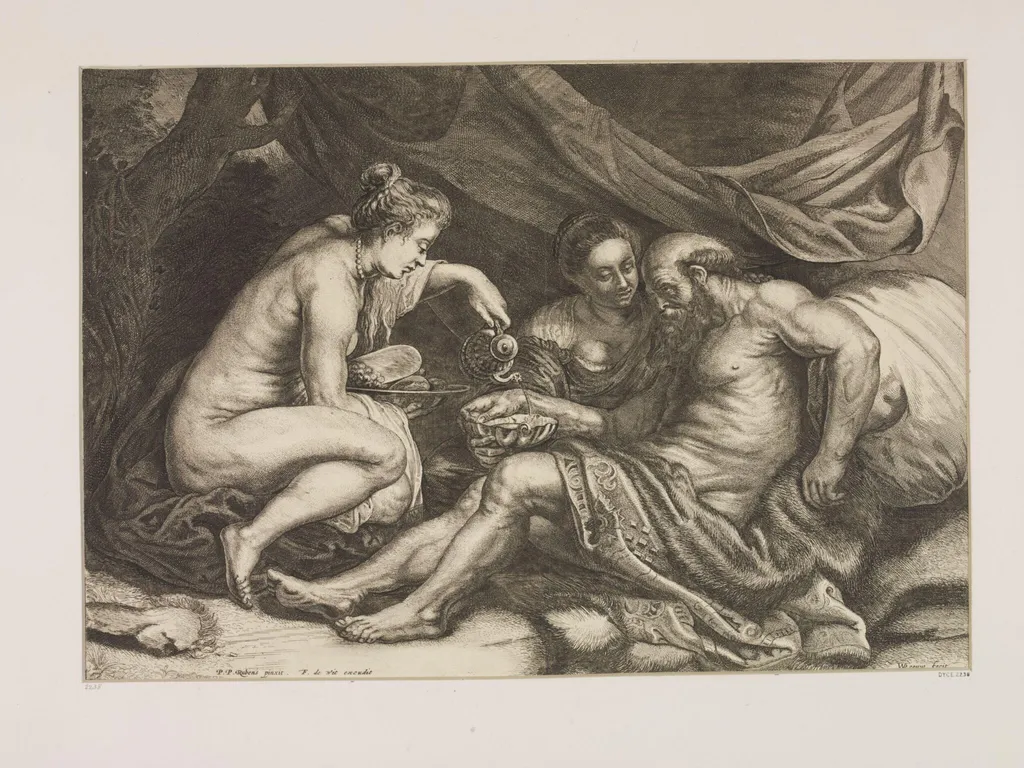
Lot intoxicated by his daughters is a print by Willem van der Leeuw. It dates from 1650 and is held in the collection of the Victoria and Albert Museum.
About this work
Overview
This print on paper, created by Willem van der Leeuw, reproduces a composition originally devised by Peter Paul Rubens. It depicts a scene from the biblical story of Lot and his daughters, rendered without inscribed title or text. The image is executed in a high-contrast style, using tonal shifts to define form and space, with figures emerging from a shadowed, rocky interior.
Subject & Meaning
The scene illustrates the moment after Lot, having fled Sodom, becomes intoxicated by his daughters’ wine in a cave.
The scene illustrates the moment after Lot, having fled Sodom, becomes intoxicated by his daughters’ wine in a cave. The daughters, both nude, plot to conceive children by their father to preserve his lineage. The man’s slumped posture and disheveled appearance suggest intoxication or exhaustion, while the women’s gestures imply calculation and resolve, conveying a narrative of moral ambiguity and survival.
Technique & Style
Van der Leeuw employs chiaroscuro to model the figures with strong light and deep shadow, enhancing their three-dimensionality against the dark cave setting. The textures of fur, skin, and fabric are suggested through varied line and tone rather than detailed rendering. The composition is tightly framed, focusing attention on the psychological tension between the three figures without extraneous detail.
History & Provenance
The print derives from a lost painting by Rubens, likely produced in the early 17th century. Van der Leeuw, active in the Netherlands during the same period, specialized in reproductive engravings of Flemish compositions. This print circulated as part of a broader market for illustrated biblical scenes, though no definitive record of its original ownership or early collection exists.
Context
In early modern Europe, biblical narratives were frequently adapted for visual media to convey moral lessons or human drama. Rubens’s original design reflected Counter-Reformation interests in emotionally charged religious subjects. Van der Leeuw’s print made such imagery accessible beyond elite collections, aligning with the rise of print culture and the dissemination of religious stories through reproductive techniques.
Legacy
Though not widely exhibited today, the print remains a documented example of how Flemish compositions were disseminated across Northern Europe through engraving. It reflects the enduring influence of Rubens’s iconography and the role of printmakers in shaping public visual culture. The work contributes to understanding how biblical themes were interpreted and reproduced in the 17th-century print trade.
Artist & collection