Artwork
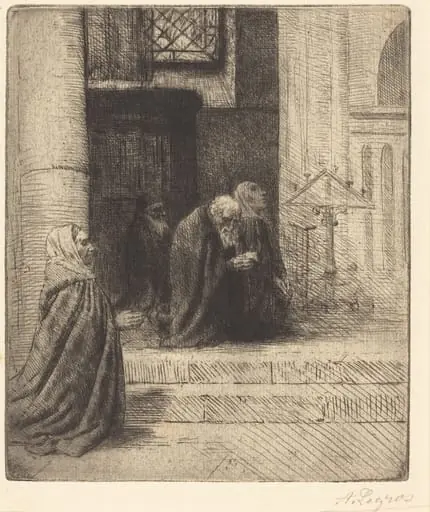
Choir in a Spanish Church (Le choeur d'une eglise espagnole)
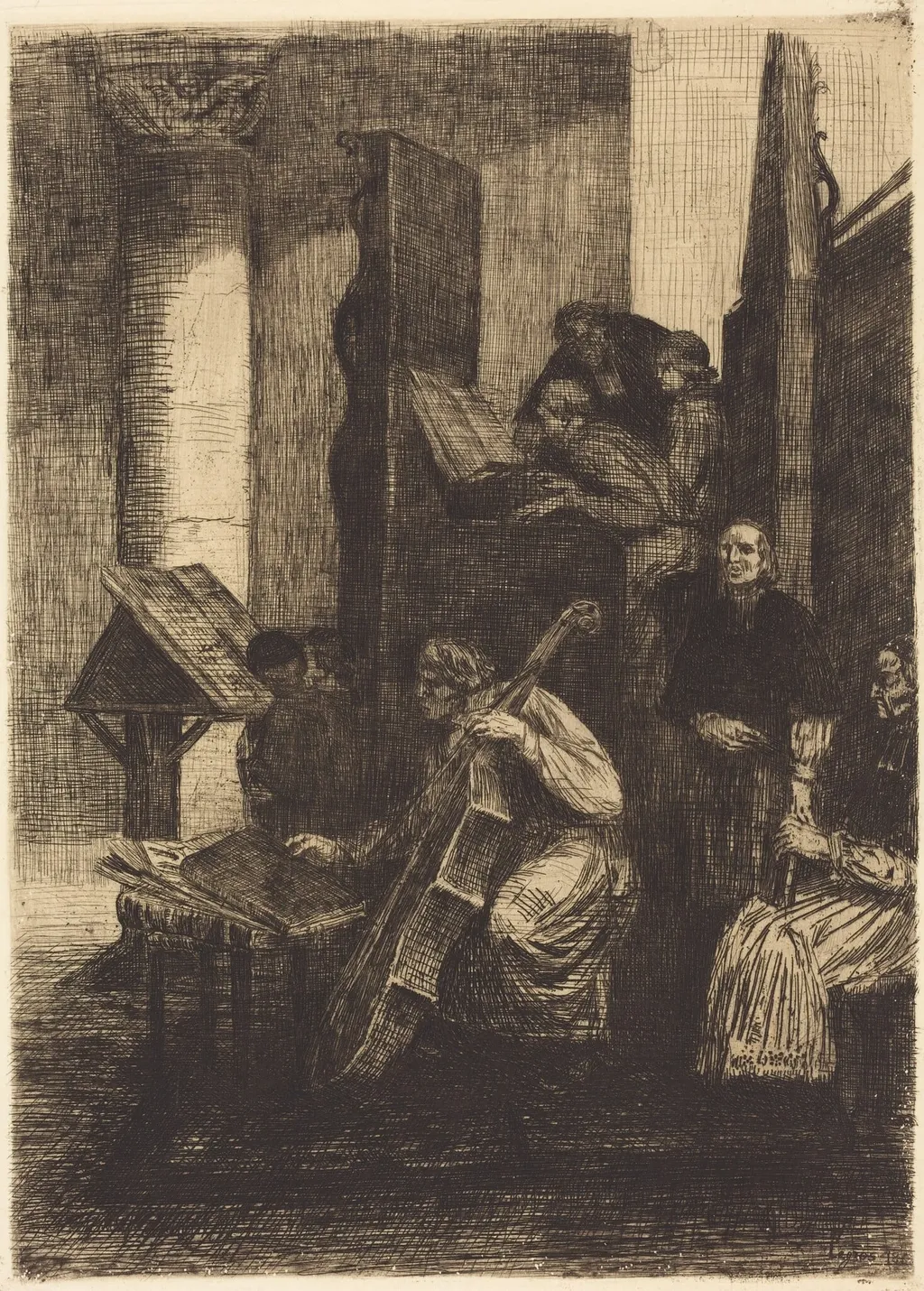
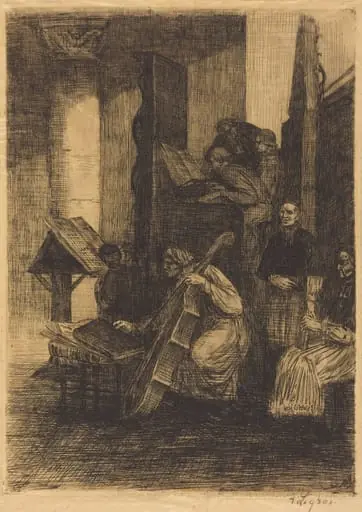
Choir in a Spanish Church (Le choeur d'une eglise espagnole) is an ink print by the Impressionist artist Alphonse Legros. It dates from 1860 and is held in the collection of the National Gallery of Art.
About this work
Next, check out etching to see how artists like Legros carved into metal plates to create these detailed prints.
This etching shows a dimly lit church choir. Four singers sit in robes, holding sheet music. One man plays a cello in the front, while others hum or read notes. The walls are rough stone, and light streams through tall, narrow windows.
The artist used sharp lines to show texture—look at how the fabric folds or the wood grain. This was made in 1860, when artists focused on real-life scenes over idealized ones.
Next, check out etching to see how artists like Legros carved into metal plates to create these detailed prints.
Overview
Created in 1860, *Choir in a Spanish Church* is an etching by Alphonse Legros, a French artist who later became influential in British printmaking. The work captures a quiet moment inside a Spanish church, focusing on the choir members engaged in their ritual. Legros, known for his versatility across media, used etching to explore light, texture, and quiet human presence, aligning with 19th-century shifts toward observational realism.
Subject & Meaning
The scene portrays four singers in ecclesiastical robes, one playing cello, others reading music or murmuring. No grand ceremony is depicted; instead, the focus is on the intimate, repetitive act of communal worship. The stillness and subdued activity suggest reverence through ordinary detail rather than spectacle, reflecting a broader interest in authentic, unembellished religious life.
Technique & Style
Legros employed fine, incised lines to render the rough stone walls, folded fabric, and wooden choir stalls with precision. The etching’s chiaroscuro effect is achieved through controlled ink density, with light filtering through narrow windows to carve form from shadow. The technique emphasizes tactile surfaces—wood grain, woolen robes, and parchment sheets—highlighting the artist’s mastery of etching’s capacity for subtle tonal variation.
History & Provenance
Executed in 1860, the print predates Legros’s move to London in 1863, where he later became a central figure in the revival of etching as a serious artistic medium. Though made in Spain, the work entered British artistic discourse after his relocation. Its production reflects Legros’s early engagement with Northern European print traditions before his institutional influence in England.
Context
In the 1860s, European artists increasingly turned from idealized historical or mythological subjects to scenes of everyday life. Legros’s focus on a modest church interior aligns with this trend, paralleling Realist movements in painting. Etching, once primarily reproductive, was being reimagined as a vehicle for personal expression, and Legros’s work contributed to its renewed credibility among fine artists.
Legacy
Though less widely known than his later British teaching career, this early etching demonstrates Legros’s foundational skill and sensitivity to light and texture. It helped establish his reputation as a printmaker committed to quiet observation, influencing a generation of British artists who embraced etching as a medium for intimate, non-idealized imagery.
Artist & collection

Artist
Alphonse Legros (French pronunciation: ; 8 May 1837 – 8 December 1911) was a French, later British, painter, etcher, sculptor, and medallist.

![Intérieur d'église à Milan [Interior of a Church in Milan], by Mosè Bianchi](https://artifactworldgallery.com/img/mose-bianchi--interieur-d-eglise-a-milan-interior-of-a-church-in-milan--6e5465a8fb58e0ea-w320.webp)